

she was only 4 her
grandfather noticed a
spark. He called her far-
brent, on fire.
And indeed Barbra was
burning with a desire: for
fame. "From the age of 7
she wanted to be in
films," her mother said in
Streisand: A Biography
by Anne Edwards (Little,
Brown and Co.).
As she grew, Barbra
found herself more in love
with films (especially with
her favorite actor, Marlon
Brando) than ever. But it
wasn't until she was in
high school that she dis-
covered her passion for
music.
A top student at Eras-
mus Hall High School,
Barbra took chorus in her
freshman year. It was
then she'first realized that
her singing abilities were
far ahead of other girls
her age. So she decided
to make a record (all you Abba Eban
needed at the time was a
wasn't even 1 before his father
few dollars), on which she sang
died. Alida later became close with
"Zing Went the Strings of My
a family friend, Dr. Isaac Eban, a
Heart" and "You'll Never Know."
native of Belfast, whom she would
She still has the record to this day.
one day wed.
Young Aubrey was a private child
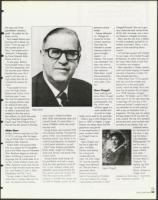
Abba Eban
who enjoyed reading. He loved the
Aubrey Solomon was born on Feb.
game cricket, was conscientious at
2,1915, not long after the begin-
boarding school; and, thanks to his
ning of World War I, to Alida and
maternal grandparents, he received
Abraham Meir Solomon.
a solid Jewish education, as well.
Alida's father had picked Abra-
Each Friday Aubrey's grandfather,
ham as a groom for his daughter,
Eliahu Sacks, taught him Hebrew,
and at first Alida was not interested.
Torah
and Talmud, and Jewish histo-
Then Abraham began to write her
ry and culture.
letters. Exhibiting a command of
Young Aubrey loved being with
language that he would pass on to
his grandfather and took in every-
his son, whose Hebrew name was
thing
the older gentleman could tell
Abba, Solomon wrote such love let-
him. In fact, Aubrey's mother and
ters to Alida that she could not resist
stepfather
were concerned that the
him, says Robert St. John in Eban
boy was ail work and no play. Per-
(Doubleday and Co., Inc.).
haps they found some comfort,
Though raised in South Africa,
however, in the fact that Aubrey told
Alida lived in London after she mar-
his sister he hoped to grow up and
ried. Her second child, Aubrey,
Chagall (Putnam). She ran a gro-
cery where she sold various kinds
of fish; fish, of course, are a recur-
rent theme in Chagall's paintings.
Marc was the only boy, a beauti-
ful child completely spoiled by his
mothers and sisters. Marc, in turn,
grew to love everything about
women.
He had less success with children
his own age, who mocked his gen-
tle features. So rather than play on
the street, Marc liked to look from
his window and imagine.
Marc attended a cheder, played
violin and loved singing; he hoped
one day to become a cantor. He
also enjoyed geometry.
When Marc was 13 his parents
took him out of the cheder and
placed him in the local public
school, which he hated. But it was
here that his passion for art began.
Marc Chagall
In a 1958 interview, Chagall
Those seeking truth
recalled, "At Vitebsk, up to 1906 I
about Marc Chagall
had never in my life seen drawings
should not turn to his
or paintings. But one day in the
autobiography, My
communal school I caught one of
Life, which most
my comrades as he was copying
scholars agree is a
with a pen an illustration from a
work created with
magazine. This boy was my enemy,
as vivid an imagi-
the best student of all, but also the
nation as he used for his paintings.
most wicked, the one who persecut-
What is true is that Chagall was
ed me the most, and mocked most
born in 1887 in Vitebsk, a large
cynically at my dreamy look, my
Russian city where about half the
schlemiel behav-
population was Jewish
ior, the dunce of
(it was anything but a
the class. In see-
poor, run-down shtetl,
ing him draw I
as Chagall loved to
was absolutely
assert).
flabbergasted. For
Marc Chagall was
me this was a
the first of eight chil-
vision,
an apoca-
dren. His father,
lypse in black
Zachar, sold pickles
and
white. I
for a living and
asked him how
worked day and
he went about it.
night. His wife, Feiga
'Imbecile,' he
Ito, was the opposite:
replied, 'go find
happy and lightheart-
a book in the
ed. She also knew a
Marc Chagall
library, choose an
great deal about
image which
Judaism and would
p
eases
you
and
copy
it.' And that's
lead all the prayers on Shabbat
how I became a painter." 71_,
when her husband fell asleep,
writes Sidney Alexander in Marc
become a band
leader.
Aubrey delivered
an 1 8-page dis-
course for his bar-
mitzvah ceremony.
Days later, he
attended a private
meeting where he
gave a lengthy
speech — in
Hebrew. The crowd
was impressed. The
topic was one on
which Aubrey; and
later statesman
Abba Eban, would
discuss eloquently
and extensively for
many years: Zion-
ism.
.
1/S
1999
Detroit Jewish News
59