

kt%
JILL DAVIDSON SKLAR
Special to the Jewish News
N
of long ago, there was a
time when Rhonda
Mosryn moved up to the
mahjong table and lowered
the average age of the players by a
good 20 years. Not anymore. The 35-
year-old Farmington Hills woman
now finds herself in the company of
at least three of her close girlfriends
every Thursday night as they vie
goodheartedly to make their hands
with the special tiles while sharing
laughs.
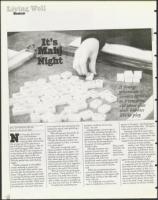
Usually relegated to the bubbie
crowd, mahjong is a game that
involves between three and five peo-
ple who play for themselves, not on
teams. Using tiles with wooden hold-
ers instead of playing cards, the game
is most like gin rummy in that certain
hands are most desirable. While some
concentration is necessary, the better
the players get, the more likely they
I/ 1
1999
are to spend the time shmoozing, thus
making the typical mahj gathering a
very social outlet.
"We're all between 30 and 40, all
married, most have kids," said
Mostyn, an eight-year mahj veteran.
"We play for the same reasons our
mothers played. It is fun, it is social,
it is a great game."
They aren't an anomaly. Julie
Frank, president of Ruach Group (d
Hadassah, and n novice player. ;aid
interest in the game has grown con-
siderably among her group's mem-
bers, whose ages are 25 to 35. The
training sessions they've held a few
times a year are such a hit, organizers
practically have to push people out
the door at the end of the evening.
"We had a hard time getting peo-
ple to leave," Frank admitted. It is a
lot of fun. You really have to pay
attention to what you are doing but,
after a while, you get so wrapped up
in it that you can't stop. It's addictive.
It used to be something your
group, to the game," said Farmington
grandma would do, but not any-
Hills resident Cindy Atler. "The game
more," she said.
is fun and we like to play it."
Mahjong began centuries ago in
Mahjong is played in many ways
China. After spreading through Asia,
like
the card game gin rummy. There
it came to America with Japanese
are
different
suits — cracks, barns and
immigrants in the 1920s. Here, the
dots — within which each tile is
game spread rapidly through the Jew-
assigned a set value from one to nine,
ish American female population,
with four of each number
thousands of whom gathered
within a suit. Other tiles fall
Barns,
cracks
weekly to play.
into three categories: seasons,
and
other
tiles
Although computer and
honor tiles and flowers. Each
need
to
be
Internet versions exist, the
player has 12 tiles that are set
turned
face-
traditional American version
on a rack and hands are played
down to start.
draws a swelling of players
by exchanging tiles. A full
who gather with their own
game
contains
16 hands of play.
groups each week to play hands while
At the end of each hand, the play-
at the same time exchange gossip, dis-
ers vigorously mix the wooden or
cuss current events and, of course,
bone tiles in the center of the table,
nosh.
causing quite a racket. In fact, it is
While the accompanying banter
from the sound of tiles banging into
and snacks (M&Ms, chips and even
each other that the game derives its
veggies) are draws, it is the game itself
name; "mah" means flax or hemp, for
that brings women to the table each
the sound of the plants' leaves click-
week, they say.
ing in the wind, `lone means spar-
"It is definitely very social but
row, to indicate the chatter of birds.
there is a dedication, at least in our