

Tell Me WhY
A Stern Fellow
The Jewish jeweler helps a famous basketball
star count the hours.
Elizabeth Applebaum
AppleTree Editor
I recently returned from a
trip to Israel, and every-
where I looked I saw
amulets and necklaces with
some kind of hand. I saw
both Jews and Arabs mak-
ing use of these. Is it a
good-luck symbol, or is it
supposed to afford protec-
tion from the evil eye? And
is it modern or ancient,
Jewish or Arab, and how
did it get its start?
A: The item you saw is called a
hamza. Although
no one is certain
exactly where
the term came
from, most
believe it was
derived from the
Arab word
hams, or hands.
The hamza is
an ancient sym-
bol which can
be seen on gravestones of the
Phoenicians, so it most certainly is
ancient, though it is one of the most
popular amulets in the Middle East
today.
Many Arabs regard the hamza as
a charm with religious significance:
It is said to represent the hand of
Fatima, daughter of the Prophet
Muhammad. Most hamzas used by
Jews are made of metal and bear
Hebrew inscriptions, usually Kab-
balistic terms. Often, these include
excerpts from Jacob's blessing for
Joseph, followed by the words, "I
am of the seed of Joseph. I am a
tzaddik against whom the evil eye
does not prevail."
The Torah is replete with refer-
ences to hands, which is probably
why the symbol became popular
among Jews. You can read about
Avraham's right hand, the hands of
the infamous Garden of Eden
snake, Michael and Gabriel sup-
porting Jacob's hands. So, too, is
the Torah and Jewish tradition filled
with images of the number five; like
five fingers, there were five layers
of earth, five times Moses asked
God for help to understand Him,
five thrones of Nimrod, and many
more.
Despite the popularity of
the hamza, Judaism is
not a religion of supersti-
tion and no serious schol-
ar advocates "good-luck"
charms as means of
guaranteeing good
health, love or financial
success.
I heard that
Michael Jordan
wears a watch designed by
a leading Jewish jeweler. Is
that true, and if so, who is
the jeweler?
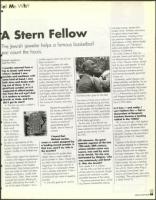
The debonair Mr. Jordan does
indeed wear a watch made by
Jewish jeweler H. Stern, whose ads
you likely have seen on the back of
magazines. Mr. Jordan opts for a
watch face in a rectangular shape
with a stainless steel band. It has a
dark-blue background and a
scratch-proof top made of sapphire
powder.
H. (He only goes by H., but his
Michael _Jordan goes for the steel.
first name is Hans) was a native of
Germany who left during the Holo-
caust and resettled in Brazil, where
he still resides. He founded his jew-
elry company in 1945, specifically
with the intent of creating valuable
and distinctive jewelry, but without
all the flashy gemstones.
By the way, if you like Mr. Jor-
dan's taste and hope to buy one of
these watches for yourself, be pre-
pared to start saving: It costs
and Isidor Loewe, shared Lilli's
maiden name. Similarly, many Jews
throughout history have been
named Lehmann, including Ameri-
can politician Herbert Lehman (a
close adviser to FDR), Reform leader
Emil Lehmann, and 19th-century
author and scholar Rabbi Marcus
Lehmann of Germany.
But unlike Cohen or Katz, for
example, Loewe and Lehmann are
not distinctly Jewish names. They
are, in fact, German names, shared
both by Jews and gentiles. It's kind
of like the last name Schwartz; it
might belong to someone Jewish,
but chances are equally good that
it does not.
Incidentally, while Wagner was
indeed intensely anti-Semitic, he rec-
ognized greatness even in Jewish
musicians. For example, he praised
the playing of Karl Tausig (1841-
71), a Warsaw-born Jewish pianist,
and Wagner lauded the operatic
compositions of Jacques Halevy of
Paris (1799-1862).
and really, I
Is it true
can't believe this — that a
descendant of Benjamin
Cardozo became a leading
radical in the 1960s?
Oh, it's true all right. Nick Egelson
was the son of a gentile father and
a Jewish mother, the former Miss
Cardozo, whose ancestors included
Benjamin Cardozo, the second Jew-
$2,340.
ish justice on the U.S. Supreme
Court.
Lilli Lehmann, the great
Egelson is the former president of
operatic .soprano of the late
the radical Students for a Democrat-
19th-early 20th century,
ic Society (SDS). His parents were
whose maiden name was
political liberals with no religious
Loewe, was said by some
leanings whatsoever. They sent their
to be Jewish. Yet she was
son to a prep school, after which
befriended by Wagner, who
he became active in various Civil
was notoriously anti-Semit-
Rights causes. He was a leading
ic. Was she Jewish?
anti-war spokesman, joining in ral-
From reader R.S. in Canton
lies with Dr. Martin Luther King Jr.
Tell Me Why can find no record
and Stokely Carmichael, later
of Miss Lehmann as Jewish, though
known as Kwame Toure, who once
certainly the confusion is under-
remarked, "The only good Zionist is
standable because of the names.
a dead Zionist." ❑
Numerous prominent Jews, includ-
ing German industrialists Ludwig
12/2::
1998
Detroit Jewish News
49