

Travel
Travelers Aid Society
page 109
generations
:;Scene
travel
Planning the wedding
scene
health
. page 112
Health
Notes on people groups . page 104
A New
Prescription
One of Detroit's older Jewish
organizations tries to revitalize
as its profession changes.
BILL CARROLL
Special to The Jewish News
I
f the Aesculapian
Pharmaceutical Association
(APA) could write itself a pre-
scription, it probably would be
for young blood.
The 70-year-old group of Derroir
area Jewish pharmacists is frail and ail-
ing, and needs a transfusion of
younger members in order to keep up
its charitable work in the Detroit
Jewish community. APA is trying to
accomplish this through a series of
membership meetings preceded by let-
ters to prospective members.
In 1928, 12 owners of Jewish phar-
macies got together at the old Edison
Hotel in Detroit to form a profession-
al association. The objectives were to
promote common interests, hold edu-
cational programs, maintain social fel-
lowship and perform charitable deeds.
The group of independent propri-
etors grew through subsequent meet-
ings that year, established annual dues
at $2 per member, formed a women's
auxiliary', and has been in continuous
operation ever since.
The Aesculapian name was suggest-
ed by the late Ben Bavely, one of the
early members. In Greek and Roman
mythology, Aesculapius, the son of
Apollo, was very skilled in surgery and
the use of drugs, and was revered as
the god of healing (not to be confused
with Hippocrates, the god of medi-
cine).
The association's membership is
down ro 60, compared to a peak of
250 in the 1940s, and almost all the
members are retired and in their 80s
and 90s. Their memories are fuzzy
about the first names and store affilia-
tions of the early members, but they
have a strong zeal and determination
to keep the association alive, and
remain committed to charitable work
for the needy of today, especially
Russian-Jewish immigrants.
As we all know, there was religious
and racial discrimination back in the
'20s, and the local Jewish pharmacists
weren't getting the same assistance
from the state association and various
companies as the other pharmacists,"
said Julius Spielberg, president of the
APA. "They felt they had to band
together as a Jewish group to get what
they needed for their businesses, and
to do good in the community"
Since they could afford only $2
dues — and even suspended dues dur
ing the Depression — the group held
dinner-dances and used advertising
books to raise money for charity work.
The first event, in 1928 at a Vernor
Street nightclub, garnered a $75 profit.
But thousands were raised in later
years when as many as 800 people
attended dinner-dances in such places
as the old Northwood Inn on
Woodward in Berkley.
The profits went to subsidize pre
scription medications for needy Jewish
families and other charities of the
APA. "Of course, the dinner-dances
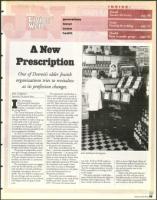
Julius Spielberg in his drugstore.
cost only $2.50 to $3.50 a plate in
those days, and the music and enter-
tainment were cheap," said Spielberg,
"but the average prescription cost only
$1.50, compared to an average of $13
to $15 today."
The group operated a small phar-
macy in the Jewish Home for Aged on
Petoskey Street, beginning in 1937,
then a similar pharmacy' at Borman
Hall on Seven Mile Road. Many of
the members staffed the pharmacy as
volunteers for three or four hours a
day, and the profits went to the
group s charities.
Today, with $10 yearly dues per
member, the APA still gives about
$10,000 annually to Jewish charities.
"Most importantly, we provide $500
each month to the Jewish Family
'
12/18
1998
Detroit Jewish News
99