

Moses At The Movies
changes, how we spiritually look at
only a small fraction of what they
vitalaspect in an animated
things [changes]. This is something that
might receive for a live-action film).
film is the characters' voices,
we've seen in the great movies of yester-
"The first thing I thought of was
which provide an emotional
year, and we haven't had something like
my daughter," said Kilmer. "She goes
foundation for the animators
this in quite a while.
to Sunday school; she'll know Moses.
to build upon. The producers and direc-
"It's a scary subject matter to broach,"
And I was very moved, both personal-
tors began with a form of blind casting:
unidentified tapes of voices
were played and choices were
made based on how they fit
with the characters.
After the decisions were
made, the actors had to
bring these characters to
life. Val Kilmer, as Moses,
had the bulk of the record-
ing time. As with most of
the other actors, he per-
formed alone in a recording
studio.
"I think it's the hardest
form of acting to be done, I
really do," said Katzenberg,
who recruited the voice tal-
ent. It doesn't take a huge
b
amount of time, but I have
to say the time that they're
there is really demanding
on them."
When the actors were
recording the voices on The
Prince of Egypt, "we only
knew it as the idea, not as
you see it now," explained
Kilmer. .
"Acting's always a leap of
imagination," added Jeff
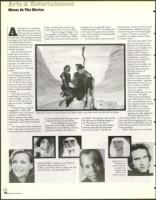
Goldblum, who is the voice Tzipporah becomes the wife of Moses when Moses makes a new home and a new life with her family.
of Aaron. Goldblum, like
Kilmer, equates voice work
she added. "You're going to get criticism.
ly and professionally, by the genuinely
with stage acting, where the actor's
But you have to be daring enough to
magnificent piece of storytelling."
imagination has to fill in the sparse
say, 'We need to tell this story.'"
"It's the retelling of a story that I
set.
Oscar-winning songwriter Stephen
feel needs to be retold," said Sandra
The A-list actors who contributed
Schwartz agrees that the filmmakers
Bullock, the voice of Miriam, "because
their voices were motivated by some-
went out on a limb. "I feel like the
generations change, what affects us
thing other than a paycheck (which is
A
Michelle Pfeiffer is Tzipporah, the Midianite
shepherdess who becomes the wife
of Moses, and Danny Glover is Jethro, the high
priest of Midian and Tzipporaks father.
12/18
1998
72
Detroit Jewish News
directors were very brave to do this as an
animated feature," said Schwartz, who
wrote the songs for The Prince of Egypt.
"Look at it: there are no funny
sidekicks, no talking animals, there's
no [pure] villain.
"It's much more adult, if you
will, or much more true to
life than most animated fea-
tures are, so I thought it was
pretty courageous in that
regard." (Also missing: a
parade of licensed products,
traditionally a lucrative
source of extra income for
most animated films.)
Respect for the subject mat-
ter was high on the list in
early discussions between
the three partners of
DreamWorks.
"We're a secular enterprise,
and we're entertainers and
we're storytellers," explained
Katzenberg. "From the out-
set, we wanted to tell this
story in as entertaining a
way as we could.
"David Geffen gave me the
best advice," he added.
"When Steven [Spielberg]
said, 'Why don't we do the
Ten Commandments as our
first animated movie?' David
said, 'Jeffrey, you know
when you were at Disney,
and you could just slap a
happily-ever-after ending on
The Little Mermaid? You
can't do that [here]. This is not your
story and if you're going to do it, you
must tell this story faithfully, and you
must tell it accurately. And you don't
know anything.'
"That's what sent us out to actual-
Ralph Fiennes is
Rameses, the
prince who suc-
ceeds Seti as
Pharaoh, and
refuses to let
Moses' people go.