

Never Too Late
A Holocaust survivor
celebrates his bar mitzvah
in Israel at the age of 71.
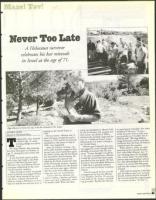
Zyga Allweiss in Israel and, top, at his bar mitzvah on Mt. Scopus
GLORIA GOFF
Special to The Jewish News
T
raditionally, a bar mitzvah
is held at age 13, repre-
senting passage into adult-
hood.
_ For Zyga Allweiss, this meaning-
ful event took place in October, at
age 71, during his most recent trip
to Israel.
It was the third trip he and his
wife, Irma, had made to the Holy
Land. It had been 24 years since
their last visit, and Allweiss did not
anticipate celebrating his bar mitz-
vah during their vacation.
After arriving in Israel, tour guide
David Leshnick encouraged Allweiss
to think about having his bar mitz-
vah there. Leshnick assumed that
Allweiss, being a Holocaust survivor,
had not had his bar mitzvah prior to
coming to the United States in
1949.
He was correct. Allweiss was 12
when Germany invaded his native
Poland in 1939 and his bar mitzvah,
scheduled to take place on May 8,
1940, never happened.
After the German invasion, two
of his older brothers escaped to Rus-
sia and were never heard from again.
His father, Jacob, also left for Russia,
but returned to find his family. He
was subsequently captured and
killed by the Nazis around the time
of the Normandy invasion. Another
brother was drafted into the Russian
army and never seen again. Allweiss
also lost track of his oldest sister
when she was sent to Auschwitz.
Early in the Nv a r, Allweiss, his
motor, Esther, a brother and three
sisters were sent to Biesiatka, where
his mother died. When the labor
camp was liquidated in March 1943,
he and his brother, Sol, escaped, but
their sisters, too afraid to follow,
subsequently perished. Zyga and Sol
were in a Displaced Persons camp
following the war before coming to
the United States.
Allweiss gave Leshnick's bar mitz-
vah suggestion much thought before
deciding to proceed with the cere-
mony. "I never thought I would do
it," he said. In preparation, Allweiss
studied for several days from books
provided by his tour guide. He had
learned to read and speak Hebrew as
a child from a melamed (scholar)
who lived with his family in Jaslany,
Poland.
Lesnick ensured the bar mitzvah
arrangements fit into the Allweiss'
tour schedule. On Oct. 29, services
were held on Mt. Scopus, overlook-
ing Jerusalem. Besides the Allweiss-
es, participants included a few other
members of the tour. "It was a
windy day and I had to hold onto
my yarmulke so I wouldn't lose it,"
Allweiss said. "We sang Hebrew
songs afterwards" and he received a
certificate from the State of Israel to
commemorate the occasion.
When asked to reflect on what
meaning his bar mitzvah had for
him, tears filled Allweiss' eyes. "I
was thinking about all the people
who weren't there," he said of his
parents and seven brothers and sis-
ters. He acknowledged that it was
worth it to survive the Holocaust
and have the chance to see the State
of Israel.
After experiencing the event him-
self, he believes that every survivor
should celebrate his bar mitzvah if
the war prevented the original event.
"It is never too late," he said.
❑
12M
1998
Detroit Jewish News
41