

Mr. Clinton
Goes To Gaza
Netanyahu scores some points, but his
coalition remains fragile.
DAVID LANDAU
Special to The Jewish. News
Jerusalem
Mr
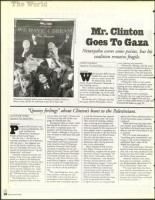
Palestinian schoolgirls hold a poster welcoming President Clinton to
Gaza as they wait for his motorcade to pass by in Gaza City.
bile President Bill Clinton's
Middle East visit is widely
seen as a major success for
the Palestinians, Israeli
Prime Minister Binyamin Netanyahu is
also claiming victory.
But it remains unclear whether these
claimed victories will enable the premier
to survive a knife-edge vote of no-confi-
dence scheduled for next Monday in the
Knesset.
On the face of it, Clinton's visit may
have gone well for Netanyahu, who is
now claiming two successes:
• Palestinian officials, with the entire
world watching, annulled the clauses in
their national covenant that called for
Israel's destruction. This had long been
Netanyahu's demand, and it represented
one of his conditions for further progress
in the peace process.
• Netanvahu made no new conces-
sions to Clinton and succeeded in post-
poning the next redeployment in the
West Bank, which was supposed to take
place Friday.
By making no new concessions,
Netanyahu can now urge hard-liners in
his coalition to support him and not
carry out their earlier threats to side with
CLINTON IN GAZA on page 29
Queasy feelings" about Clinton's boost to the Palestinians.
MATTHEW DORF
Special to The Jewish News
Washington
ro
resident Bill Clinton's visit
to Gaza and Bethlehem this
week solidified the
Palestinians' standing as
friends of the United States.
But the visit — the first by an
American president to the Palestinian
self-rule areas — has triggered con-
cern in the Jewish community that
this new friendship will come at the
expense of America's historic "special
relationship" with Israel.
Clinton's comments and the sym-
bolism of the visit were widely inter-
preted as a boost to the Palestinian
quest for statehood. For the first time
in his administration, the president
adopted the language of the Camp
David accords calling for the "legiti-
mate rights" for the Palestinian peo-
ple. The Palestinians consider the
phrase a code word for statehood.
The Palestinians "now have a
chance to determine their own des-
2/18
1998
28 Detroit Jewish News
tiny on their own land," Clinton said
in Gaza on a trip with all the trap-
pings of a formal state visit.
Turning the tables on Israel, which
had labored for decades to convince
the Arabs to negotiate peace, the
president told the Palestinians they
had "issued a challenge to the govern-
ment of Israel to walk down that path
with you."
The burgeoning U.S.-Palestinian
relationship could mean continued
rocky times for Israel if Palestinian
Authority Chairman Yassir Arafat
continues to capitalize on the cool
relations between Clinton and Israeli
Prime Minister Binyamin Netanyahu.
"For friends of Israel, there is some-
thing very sad" about Clinton's visit,
wrote Henry Siegman, a senior fellow
at the Council on Foreign Relations,
in an op-ed piece in an Israeli publi-
caticn on the eve of the president's
trip.
"The visit should have been a glo-
rious occasion, marking not only
Israel's 50th anniversary but also an
extraordinary relationship between
the world's only remaining superpow-
er and the diminutive but vigorous
Jewish democratic state," he wrote.
"But instead of marking a celebra-
tion, or serving as an occasion for
Israel to express its gratitude to the
American people for the constancy of
their support, and to a president rec-
ognized universally as 'the best friend
Israel ever had in the White House,'
this visit will take place in a con-
tentious and ugly atmosphere that
dramatizes, above all, the deteriora-
tion in the relationship."
Many longtime Jewish activists
have begun to focus on how this
deterioration, coupled with the grow-
ing Araf-Clinton relationship, will
affect Israel. "Ultimately, I think it
will be troublesome," said Abraham
Foxman, national director of the
Anti-Defamation League. "I have that
queasy feeling" that the improved
American-Palestinian relationship
"may be done at the expense of the
special relationship with Israel." In
fact, the American Israel Public
Affairs Committee already has begun
to lay the groundwork to lobby
Congress to serve as a counterweight
against the Clinton administration on
critical final-status issues, including
statehood.
While Israel may lose some short-
term battles, some Middle East ana-
lysts believe the Jewish state's special
alliance with the United States is not
in jeopardy.
The U.S.-Israel relationship is
"something quite extraordinary and
unique in the annals of diplomacy,"
said Daniel Pipes, editor of the
Middle East Quarterly.
In fact, this week's trip is Clinton's
fourth to Israel since becoming presi-
dent. He is the only president to visit
Israel more than once while in office.
the White House pointed out.
"America's relations with Arabs
have gone up and down, and have
not fundamentally affected the U.S.-
Israel relationship," Pipes said.
"I'm concerned about the short-
term tactical relationship but not the
long-term strategic" one, said Pipes,
who is predicting a confrontation
between the United States and Israel
on the peace process. 7