

Mixed Media
An exhibition of the photographs of Robert Capa at Chicago's Terra
Museum of American Art captures both war's cruelties and life's joys.
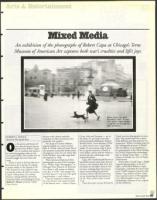
Robert Capa: 'Air Raid,
Barcelona, 1939." In some
of his photos, Capa employs
rx sw0 blur to intensify the
effect of violence.
ROBERT L. PINCUS
Special to The Jewish News
0
n the pomp and heroics of
war, there are better-known
pictures than Robert Capa's.
On its cruelties and sorrows,
he took photography where it had
never gone before. The world's view of
armed struggle has never been the
same.
There is irony in the fact that he is
best known for a picture of a dying
Loyalist soldier in the Spanish Civil
War, because he was so good at cap-
turing the vitality of a face on camera.
Capa's 1948 portrait of a smiling
Picasso, trailing behind a beaming
Francoise Gilot and shielding her from
Robert L. Pincus writes for Copley
News Service.
the sun with a beach umbrella,
embodies the bliss of romantic love
poetically and tenderly.
His image of Chinese children,
playing happily in a snow-covered
field, is a lovely vision of youth. But it
also possesses a powerful undercurrent
of poignancy since the city where they
lived, Hankou, was under siege from
the Japanese in 1938.
These luminous black and white
photographs are part of his retrospec-
tive, "Robert Capa: Photographs," at
Chicago's Terra Museum of American
Art, where it will remain on display
until Jan. 3, 1999. "Like people and
let them know it" was one of his guid-
ing principles and it shows:
Capa has long been celebrated for
his war pictures, and a good number
of the famous ones — taken in Spain,
China, Italy and Germany — are in
this show. It's not hard to see why
Death of Loyalist Militiaman Federico
Borrelli Garcia, Cerro Muriano (1936)
is a 20th-century icon. Capa's light-
weight 35 mm camera made it possi-
ble to capture moments of battle as
never before, and he had the vision to
see how the new technology could
yield profundities.
Capa, who would himself become a
battlefield casualty years later, pictures
Garcia at the moment after he is shot,
but before he has fallen. Even if view-
ers know nothing about the circum-
stances surrounding the pictured
moment, there is still the sense that
we are witnessing the last instant of
his life. War's awful cruelty is made
vivid.
There have been surveys devoted to
Capa's wartime photographs in years
past. The current show has a some-
what different aim than previous ret-
rospectives. While it includes many of
his unforgettable pictures of World
War II soldiers on the battlefront —
his photographs of the Allied landing
on D-Day inspired the cinematogra-
phy in Saving Private Ryan — it also
means to broaden our view of Capa's
achievement.
His brother, Cornell Capa, a highly
regarded photographer in his own
right, and Richard Whelan, Capa's
biographer, assembled this show from
some 70,000 negatives housed in the
Robert Capa Archive of New York's
International Center of Photography.
The Alfred Stieglitz Center of the
Philadelphia Museum of Art originat-
ed the exhibition.
12/11
1998
Detroit Jewish News
97