

OPINION
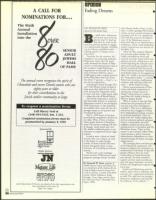
A CALL FOR
NOMINATIONS FOR...
The Sixth
Annual
Installation
into the
Fading Dreams
DR. KENNETH STEIN
Special to The Jewish News
B
OVER
SENIOR
0 ADULT
JEWISH
HALL
OF FAME
The annual event recognizes the spirit of
Chanukah and metro Detroit seniors who are
eighty years or older
for their contributions in the
Jewish and/or community at large.
1
To request a nomination form:
Call Sherry Veal at
(248) 661-0123, Ext. 1-233.
Completed nomination forms must be
postmarked by January 8, 1999.
Sponsored By:
Jewish
Apartments
&services
Media Sponsors:
DETROIT JEWISH NEWS
JI ■ T
Dr. Kenneth W. Stein, professor of
Middle Eastern history and political sci-
mce and director of the Institute for the
St'udy of Modern Israel at Emory Uni-
versity in Atlanta, is author of the forth-
coming "Heroic Diplomacy: Sadat,
Kissinger, Carter, Begin and the Quest
r Arab-Israel Peace" (Routledge Press,
August 1999).
MEMORIES .84C)
2/11
1998
Jewish Apartments & Services alco thanks all the other organizations who
have contributed to the success of
"Eight Over Eighty."
28 Detroit Jewish News
y 2008, will a Palestinian
and Israeli state be living
side by side? Or shall we
find that the Arab world
used the previous decade to engage
in a sophisticated charade, refurbish-
ing its military capabilities while
cajoling Israel to withdraw from
more land?
Certainly, for the moment, the
emphasis is on nurturing moderate
Palestinian voices. But has Israel
really drowned the dream of Pales-
tinian or Arab expectations? Look at
the numbers: Israeli-Palestinian
negotiations are focused on 23 per-
cent of historic Palestine, about
2,300 square miles, namely portions
of the West Bank and Gaza Strip;
the other 77 percent — Israel — is
not up for negotiation.
According to Israeli Foreign Min-
ister Ariel Sharon ; Israel intends to
keep more than half of that 23 per-
cent, leaving the Palestinian entity
or state, less than 1,300 square miles
— about the size of Rhode Island.
And of key importance: much of
the land under present or projected
Palestinian control is not contiguous.
Will Palestinians, in the long haul,
be satisfied with a state the size of a
postage stamp cut in quarters and
enveloped by Israel?
May 4, 1999 looms as the date
promised for completion of final sta-
tus talks. What, if then or before,
Yassir Arafat declares a Palestinian
state? The answer: nothing will real-
ly change, except Israel may view
Mr. Arafat's unilateral action as jus-
tification to suspend all future nego-
tiations.
Is such a state a threat to Israeli
security? No, not without an army
or the ability to make foreign
treaties. If Israel controls the entry
points and goods, there is some
assurance of controllina b anti-Israeli
activity.
Would such a state endanger
Israeli security if Palestinians issued
passports, postage stamps, decided
91k
c-D
what library books to buy, or what
days to collect garbage? Not if Israel
retains security control of access to
Jerusalem and the city remains uni-
fied with free access to all religious
sites. If the Palestinians want ro
hoist their flag on an administrative
building or center, Israel jeopardizes
neither control over nor security of
the Holy City.
After the Wye summit, Palestini-
ans seriously asked whether Mr.
Arafat conceded too much and
received too little. Some of his com-
patriots are livid, calling him a trai-
tor for hijacking the national move-
ment and remaining satisfied with
the few morsels of land that Israeli
Prime Minister Binyamin Netanyahu
periodically drops on the negotiating
table. Mr. Arafat is accused of being
Mr. Neranyahu's lackey — curbing
Palestinian terrorism, confiscating
weapons, and reducing verbal ten-
sions — all for Israel's security'.
Recent announcements of Pales-
tinian and Israeli cooperation in
rooting out a major source of
Hamas' infrastructure is evident
proof that Mr. Arafat is being an
effective deputy sheriff.
What is certain is that the Pales-
tinians face the prospects of civil
war, but so far have intelligently
avoided it. They are in ideological
turmoil as they struggle to revamp
their philosophical outlook and give
it territorial expression. They are
faced with Mr. Arafat's fading days
and an uncertain political successor.
Israel is a dominantly powerful
neighbor; Jordan has more than a
passing interest in Jerusalem and the
Palestinian future. There is little
money in the national coffers; Pales-
tinians possess a paltry economic
infrastructure; dependence on inter-
national foreign aid limits sovereign
independence.
The emerging form and direction
of the Palestinian community will
determine degrees of co-existence or
confrontation with Israel. It also will
greatly influence how the Arab
world relates to Israel during the
next decade. Too little economic
support and too much outside coer-
cion will cause implosion; too little
of both will dangerously stagnate the
status quo.
Israelis and Palestinians must be
realistic about what is sufficient and
necessary for a negotiated settlement
to hold. The right mix can energize
Palestinian moderates and diminish
the influence of the radicals. ^'