

Rules And Responsibilities
Proposed new Reform platform sparks debate over observance
and the movement's future.
DEBRA NUSSBAUM COHEN
Special to The Jewish News
A
further discussion throughout the
movement in an effort to reach son- IL
sort of consensus.
People in the Reform movement
are at this point about evenly split, say
those who have been most involved in
the debate.
Those who keep kosher and
observe other mirzvot say this is the
direction in which the Reform move-
ment is heading. But many who
believe that authentic Reform Judaism
v.
wearing the yarmulke (head cov-
el ing) and tallit (prayer shawl) were
universally eschewed — and one
ir. :reasingly described as "warm
Reform," in which congregants join in
folk-style Jewish singing and many
elect to cover their heads and wrap
themselves in tallitot during prayer.
The transition has been under way
since the 1930s, but never before has
anyone moved to make the more tra-
ditionalist orientation official policy.
In the version published in the
magazine, Levy used Hebrew termi-
nology and focused his 10 principles
on concepts like kedushah, or holiness;
mitzvot, or commandments; and a
sense of being commanded by the
Torah.
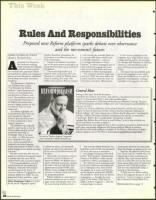
The impact was exacerbated, some
say, by the magazine's cover, which
shows the bearded Levy in a pose of
prayerful contemplation, wearing a
yarmulke and wrapped in the tradi-
proposed new document
that endorses studying
Torah, keeping the Sabbath
and other ritual practices
has couched off a passionate debate
among Reform rabbis and congregants
about just how focused on traditional
Jewish observance their movement
should be.
The document, a draft for a
new platform that is titled
"Ten Principles for Reform
Judaism," urges observance of
mirzvot, or commandments,
Among its key ideas, the draft document:
and devotion ro Hebrew and
• proclaims the Torah as "our center" and calls for a "disciplined commitment at every
Israel. This stands in stark con-
stage of our lives to learn Torah in the widest possible sense";
trast to decades of practice in
• urges a commitment to "observance of the mitzvot of Shabbat" through "the prac-
the Reform movement that
tice
of refraining from ordinary weekday acts" and "welcoming the special Shabbat rit-
placed a higher priority on eth-
uals
into our lives";
ical practice than on ritual
galls
lb! the "creative celebration of the seasonal festivals" and life-cycle rituals;
observance.
•
opens
cLie door to observance of both "mitzvot that have long been hallmarks of
The debate highlights
the
0 0
Reform Judaism" and "other mitzvot new to Reform Jewish observance," including the
divide between those who con-
b
fo
wearing
tefillin, observance of kashrur and going to the mikvah, or ritual bath;
sider themselves "classical
Nev..
•
encourages
"Reform Jews to make aliyah, immigration to Israel";
Reform" Jews and those who
For R:2101-11.1 I
•
pledges
that
Reform Jews will strive to read Hebrew, "to ler it help articulate our
are more traditional in their
i
prayer
and
inform
our study, to speak it."
religious practices.
Those
Reform
Jews
who regard the key to their movement as rooted in ethical choices
The platform was originally
rather
than
commanded
obligations find these guidelines difficult to embrace.
slated to come up for a vote by
The
full
text
of
the
draft
platform is available in the Winter 1998 edition of Reform
Reform rabbis at their annual
Judaism magazine and on the Web at www.ccarnet.org/platforms/tenpri.html . El
convention next May in
Pittsburgh. That is the same
The cover of "Reform Judaism" magazine's
city where, in 1885, the move-
winter
issue features Rabbi Richard Levy.
ment adopted its first plat-
ONEMENOMENEMEENOMMEMMUMATEMOMEC
,?,LVtNgSEMMBSIGVWNANWa.VRZM+:?<, xaatM4batig'
VICAVAUZZA:
form, which discarded all of
Judaism's rules about keeping
is based on ethics, not command-
kosher and customs of dress as "alto-
And now that Rabbi Richard Levy,
tional prayer shawl as he reverentially
ments, say they worry that there will
president of the CCAR, has attempted
gether foreign to our mental and spiri-
kisses the fringes, or tzitzit, on the end.
be no room in the denomination left
tual state."
to do so, the outcry is enormous.
Together, the platform and the pic-
for them.
But the controversy that the pro-
Levy began circulating a first draft
ture caused some to wonder what was
Meanwhile, the executive commit-
of his "Ten Principles" statement last
posed new platform has ignited makes
happening to their movement and
tee of the Central Conference of
March at the Reform rabbis' annual
whether they could remain Reform
it unlikely that the issue will be
American Rabbis, the Reform move-
conference, where it prompted a stir.
Jews. It is clear that some in the move-
resolved before the convention begins.
ment's rabbinical association, decided
But rabbis in every movement tend
ment equate observance of traditional
The proposed platform was dis-
last week to form a task force with
to be more observant and traditional-
practices with Orthodox Judaism —
cussed extensively last weekend in
representatives of the UAHC and
ist in orientation than most of their
and view the traditionalist camp as
Memphis, where the 250-member
Hebrew Union College, the Reform
lay people. So it wasn't until the pro-
moving in that direction.
national board of the Union of
seminary, to further study and redraft
posed platform reached the 300,000
"I could not even finish reading
American Hebrew Congregations was
the proposed platform.
households in which there are Reform
this in the magazine because it was so
meeting. Rabbi Eric Yoffie, the con-
Reform Judaism is a movement in
congregants — through the cover
repulsive," Laurie Livingston, a mem-
gregational body's president, urged
transition between an era in which
ber at Peninsula Temple Beth El in
story in the Winter 1998 issue of
Debra Nussbaum Cohen is a writer
organ music and operatic solos were
Reform Judaism magazine — that the
for the Jewish Telegraphic Agency.
the norm during worship services —
RESPONSIBILITIES on page 12
rumpus began in earnest.
Central Ideas
12/11
1998
10 Detroit Jewish News