
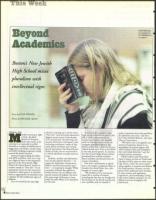

Beyond
Accede
Leah Solomon,
an assistant to
the headmaster,
in prayer:
Boston's New Jewish
High School mixes
pluralism with
intellectual rigor.
Story by JULIE WIENER
Photos by MICHAEL QUAN
Waltham, Mass.
onday morning at eight
o'clock, the Bank
Boston on Prospect
Street here seems to be
catering to an especially youthful
clientele as a stream of adolescents in
baggy jeans and khakis, clunky shoes
and hefty bookbags progresses noisily
toward the bank's entrance.
Instead of approaching the tellers
and ATM machines, they turn to go
up a flight of stairs to the temporary
quarters of the New Jewish High
School of Greater Boston, known to
insiders simply as "New Jew." It's an
appropriate name for this innovative
institution whose goal is to stimulate
both an appreciation for pluralism and
a passion for the intellectual rigors of
Judaism.
One of several Jewish day high
11:
1998
6 Detroit Jewish News
schools to spring up in recent years,
"New Jew" may be Jewish education's
biggest success story of the decade.
In its second year, the thriving com-
munity school not only boasts a sky-
rocketing enrollment, stable of big-
name board members and visiting
Jewish luminaries, like Harvard poet
Robert Pinsky, but an environment
in which pluralism actually seems to
work.
Students, teachers and administra-
tors cite the school's diversity — its
respect for Orthodox, Conservative,
Reform and Reconstructionist prac-
tices — as its greatest strength. While
a number of Jewish day schools in
North America do not affiliate with
specific streams of Judaism, few have
the same range of diversity or have
made the same efforts to be pluralistic
as New Jew.
In Detroit, for example, a new
high school scheduled to open in the
fall of 2000 is led primarily by
Conservative leaders who decided
early on that the school would not
recognize patrilineal descent, the
Reform belief that a child can be con-
sidered Jewish even if his or her father
is the only Jewish parent. In contrast,
the New Jewish High School admits
patrilineal Jews and has students,
board members and faculty from all
streams of Judaism.
New Jew's commitment to plural-
ism is not simply a pragmatic effort to
broaden the school's base, but a phi-
losophy in its own right.
"We decided to be a community
school for a number of reasons,
including the fact that we thought the
fractiousness in the Jewish community
was a problem and we wanted to
make a statement about the possibility
for pluralism and unity," said New
Jew Chair Michael Bohnen, who iden-
tifies as Conservative.
"We believe that a thoughtful com-
parison of opinions, shared in an
atmosphere of mutual respect, will
refine students' ideas and strengthen
their individual identities," says the
school's mission statement.
NJHS students pick from three
types of prayer services on Torah read-
ing days and five types on other morn-
ings. Once a week, the entire school
meets together to examine and discuss
the Torah portion. Minyan runs the
gamut from traditional with mechitza
to more creative and egalitarian
expressions, and membership is fluid,
with many students opting to try out
different services throughout the
school year.