

Unsettling Agreement
In West Bank villages,
settlers worry about being isolated.
ERIC SILVER
Israel Correspondent
Jerusalem
T
he 51 Jewish families of
Ganim are unassuming folk.
Men wear neither beards
nor skullcaps, they raise no
messianic banners. Until Israel began
implementing the Wye agreement last
weekend, their only worries were
whether their soldier sons would come
back safely from Lebanon and how
they would pay the mortgage on their
four-roomed, red-roofed villas.
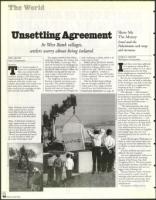
Right: Orthodox Jewish children
watch cement barriers used for
trench-like fortifications being
unloaded at the Israeli settlement
of Maale Amos in the West Bank.
Below: A Palestinian landowner,
right, stands nearby as an Israeli
soldier directs an army-operated
shovel carrying an uprooted olive
tree to a new location near the
Tapuah Junction south of Nablus.
The tree was uprooted and moved
to a new location to make way
for a new Israeli bypass road.
11/27
1998
40 Detroit Jewish News
The people established their hilltop
settlement in Samaria, the northern end
of the West Bank, 15 years ago. They
chose the location for its champagne air,
the view across the patchwork fields of
the Yizre'el Valley to Mount Gilboa, the
affordable housing and the easy com-
mute to jobs in the Israeli towns of
Afula and Upper Nazareth.
The village has no factory and no
farming. It doesn't even boast a gro-
cery store. The resident families, a
cross-section of lower middle-class
Israelis with roots in Yemen and
Morocco, Argentina and Hungary, do
their marketing in Afula, which is 10
miles away by road.
Bolder spirits, like Dinah Achdari,
buy bread or milk or cigarettes in the
Arab town of Jenin, which is two
miles to the west. "We live in peace
with our neighbors," Achdari, a
plump, talkative, 45-year-old mother
of four, explained. 'All we want is for
it to stay that way."
After last Friday's Israeli pullback,
they are no longer confident it will.
Ganim and its twin village of Kadim
were left as a tiny Jewish enclave sur-
UNSETTLING AGREEMENT on page 42
Show Me
The Money
Israel and the
Palestinians seek steep
aid increases.
JAMES D. BESSER
Washington Correspondent
I
srael faces some big roadblocks
as it presses its request Rii-r an
extra $1.2 billion in U.S. aid as
compensation for the West
Bank redeployments mandated by last
month's Wye Memorandum.
But the new congressional leader-
ship, which has cast itself as defenders
of the exchequer, may balk at that big
a boost as well as at a suggested qua-
drupling of the 575 million now
going to the Palestinians.
One obstacle — administration
concern that the money not be used
for building or expanding settlements,
or for the web of bypass roads that
have infuriated the Palestinians —
may be surmountable.
"The administration has a big
dilemma," said Mark Rosenblum,
political director of Americans for
Peace Now. "They want to comply
with their own policy of not provid-
ing money for settlements — and
yet there's an interim agreement in
place that commits us to help lubri-
cate things with new aid. The best
[the administration] can do is
acknowledge that money is fungible,
and simply state that new U.S.
funding should not be used for set-
dements."
Israeli officials agree: Washington is
likely to make stern noises about not
using the money for settlements, but
is unlikely to attach serious strings to
the aid.
Another problem may prove more
difficult: the new Congress.
Any new appropriation will have to
survive scrutiny by the incoming
Speaker of the House, Rep. Bob
Livingston (R-La.). The penny-pinch-
ing lawmaker has been a periodic crit-
ic of Israeli settlements and an even
bigger critic of foreign aid.
Finance Minister Yaakov Ne'eman
was in town for a quick round of
meetings with administration officials
over the weekend, presenting a laun-
dry list of costs associated with the
redeployment.
Scheduled to follow him is
c,
c-7_,