
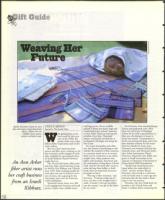

Rachel Newman creates her own
dyes and weaves many functional
objects. Shown here are
challah covers, purses,
runners and place mats.
An Ann Arbor
fiber artist runs
her craft business
from an Israeli
Kibbutz.
11/20
1998
LINDA R. BENSON
Special to The Jewish News
INT ith globalization as the
buzz word for the econ-
omy of the 1990s, few
people think twice when
billion-dollar corporations seek world-
wide markets.
But can a lone American-born
weaver and fiber artist, working on the
lean economic profit margins of crafts
sales, establish her own business from
an Israeli Kibbutz? Rachel Newman
might find out.
The 29-year-old weaver, fiber artist
and Ann Arbor native has been living
on the Ein Dor Kibbutz near Tiberius
since 1993. After working steadily for
more than one year to build an inven-
tory of items, she is gearing for the
next phase, entry into the American
crafts marketplace.
Newman's woven items, over 300
in all ranging from barrettes and small
purses to place mats, challah covers
and large purses, all are carefully
packed in boxes and plastic bags and
warehoused in her parents' basement
in Ann Arbor. They are awaiting the
schedule of art fairs, Chanukah
bazaars, and Jewish arts festivals in
southeastern Michigan and along the
East Coast.
For many aficionados and collec-
tors, the charms of purchasing a craft,
whether the medium is fiber, ceramics,
or a precious metal, are in its accessi-
bility and its connection to an earlier,
simpler time, when products were
highly individualistic, functional and
the culmination of long hours of hand
work. And for the artist who wants to
make the leap from hobby to liveli-
hood, there are important economic
principles to learn.
"Weaving is labor intensive," says
Newman, "A barrette takes me an
hour, and that is the simplest item I
make. In Israel, I can't get anywhere
near the money I can get in the States
for my work."
For Newman, who attended Roeper
School and graduated with a BFA
from the University of Michigan
School of Art with a specialization in
fiber arts, the decision to locate in
Israel was natural. Commitment to
Israel runs strong and deep, and it has
been familiar territory for the entire
Newman family for many years.
Newman's two brothers had their bar
mitzvahs there, and Newman's father,
Ann Arbor businessman Chuck
Newman, frequently visits Hillel cam-
puses at Israeli universities in his
capacity as Chairman of the Board of
International Hillel Foundations.
"Rachel had visited Israel seven
times before she made aliyah in
1993," says her mother, Sharon
Newman, who served as a volunteer
with the Israel army 12 years ago and
estimates that she has made a dozen
trips to the tiny country.
Newman, who now holds dual citi-
zenship in the United States and
Israel, is realistic about comparing the