

The
I (continued from page 81)
•
independent research organiiation
?sponsored by the Jewish Joint Distri-
1 bution Committee and the govern-
: ment of Israel. He was interested in -
comparing the way children's pre-
j ventive health care is administered
in the United States and in Israel.
There are tremendous differences.
One of these is exactly how such
care should be delivered.
In the United States, parents have
'become comfortable with securing
all their child% health care in one
site: the doctor's office. Parents
I meet with the pediatrician-who
does everything from treating seri-
f ous ailments to making certain a
I baby's weight is what it should be.
Israelis rely on public-health nurses
Ito provide routine preventive med-
ical care for their children.
A second difference is that in the
:United States, most citizens prefer to
!keep the government out of their
:health care.
Israel, on the other hand, has sig-
nificant government invok;ement in
1 pediatric preventive care.
Two years ago one American
governor did consider instituting a
Tipat Chalav program. Dr. Freed,
I then working at the University of
I North Carolina at Chapel Hill, was
instrumental in the extensive study.
Gov. James B. Hunt Jr. of North
I Carolina was interested in the
Israeli health system in general, and
ITipat Chalav in particular, as he
considered ways to improve health-
: care delivery in his own state.
Some of the facts about Tipat
Chalav highlighted in the report
I prepared by Dr. Freed and his col-
-
: leagues:
I * The program is not expensive
for families (though it is heavily sub-
1 sidized by the government). In fact,
I parents pay the equivalent of about
$80 a year to participate.
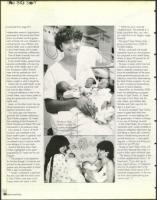
* Nurses' involvement is right from
the start: soon after the child is born,
I a Tipat Chalav nurse goes to the
:happy home and opens a chart.
11/13
1998
86 Detroit Jewish News
,1*-
•""4
* While the clinic is for the
"neighborhood," this extends to a
larger population than, say, who
you might find in Mr. Rogers' neigh-
borhood:
The typical Tipat Chalav clinic
1 serves anywhere from 5,000 to
.
10,000 children.
All that, combined with Israel's
impressive record on immunizations
(as compared to the United States,
where it's about 50 percent for all
children) is the good news.
Yet even in Israel, which has had
1 a tradition of government involve-
ment in pediatric preventive care
1 - since the establishment of the state,
1 some government groups are con-
1 sidering a move from administering
the Tipat Chalav program. It's cost-
ly, and it involves an extraordinary
amount of record keeping.
Meanwhile, as Partnership 2000
looks into establishing a program
1 similar to Tipat Chalav, Dr., Freed,
who lives in Ann Arbor with his
wife, Eileen, and children Ben,
Michele and Ariel, says the first
step is a giant one.
To have a successful Tipat Chalav
1 means a great deal more than
1 paperwork, or even dealing with
1 the government. It means a change
in our way of thinking, he said.
In the United States, the concept of
preventive care" usually translates . to
eating an obligatory salad each day
1 and taking a vitamin pill. It certainly
doesn't include having anyone call
up and remind you — even gently
1 nag you — that you must bring your
1 child in for her DPT shot.
Nurses at Tipat Chalav clinics will
1 do just that, because they make it a
j point to follow each individual . case.
"The beauty of the program is that
it utilizes neighborhood clinics," Dr.
I Freed said. "If you don't go to
Ithem, they'll call you. To implement
1 that kind of program here in the
United States would require a fun-
; damental reorganization in the way
i we think about administering pre-
! ventive care."
i