

EDITOR'S WATCH
Religious Teens Likely To Be Healthier;
Dedication Breeds Successful Book Fair
exercise regularly and get adequate
eading press releases and
sleep. They are less apt to drink and
attending community
drive, use tobacco or marijuana, carry
doings fill a big chunk of
a weapon or get into fights.
my work schedule. I
The researchers, whose findings are
thought it might be interesting to
published in the journal, Health Edu-,
share with you a sampling from each
cation & Behavior, based their study
aspect of a job that keeps me thinking
on the premise that many causes of
and on the go:
adult sickness and death result from
• The press release headline imme-
behavior learned in adolescence.
diately caught my attention: "Reli-
"The fact that churches,
gious teens are more likely to
synagogues and mosques
engage in healthier behav-
have regular access to adoles-
iors, according to U-M
cents, their families and their
study."
peers, suggests that religious
The study, conducted by
institutions are a potentially
University of Michigan
important, albeit often
researchers, found that
ignored, ally in the nation's
American teen-agers who
efforts to promote the health
regularly attend religious ser-
of the youth of today and
vices and believe that reli-
the adults of tomorrow," said
gion is important are more
ROBE RT A.
Wallace.
likely to lead healthier lives
SKL AR
He challenges the
than their non-religious
Ed itor
public health, social
peers.
work, medical and
"Religion does not simply
other helping professions to
constrain behavior," argues John M.
tap the potential "that lies in
Wallace, U-M assistant professor of
partnerships with religious
social work, "it also encourages or pro-
professionals and religious
motes adolescents' involvement in
institutions."
behavior that can protect or enhance
Temple Beth El Rabbi
their health."
Daniel Syme, who became a
Wallace and colleague Tyrone A.
national advocate for teen sui-
Forman polled 5,000 American high
cide prevention after the 1975 suicide
school seniors about their religious
of his 21-year-old brother Michael,
participation and beliefs as well as
vigorously supports that challenge.
about high-risk and healthful behav-
"Without sounding too rabbinical,"
iors.
he said after I briefed him on the
They found that religious teens are
study, "I have a sense that religious
more apt to wear seat belts, eat wisely,
commitment and God's presence in
youth
R
along with his Reform, Conservative,
Reconstructionist and Humanistic fel-
low Jews, will find no home in our
own homeland — only rejection scorn,
disrespect, intolerance and abuse.
Connie Wolberg
Huntington Woods
Portrayals
Misleading
Recently, the National Conference for
Community and Justice reviewed The
Siege, a movie about Islamic terrorism
in the United States.
As with most other recent films
that portray Arabs and the Muslim
faith, the movie shows them in a nega-
tive light. Although one star, Arab
American actor Sayed Badreya, is por-
trayed positively and many Arabs are
shown to suffer innocently at
the hands of governmental
authorities, the overwhelming
message is that every Muslim
is a potential terrorist.
The movie did have a
strong message 'about govern-
ment and opinion setters in this coun-
try not overreacting to the potential of
terrorism. As the movie demonstrates,
overreaction only leads to "profiling"
people who look or wear clothes fit-
ting stereotyped descriptions.
However, the idea that Islam fosters
violence could not be further from the
truth. All religions have had adherents
misrepresent, misdirect and misuse
their religious beliefs. Islam, like the
other Abrahamic faiths (Christianity
and Judaism), preaches and practices a
message of peace and justice.
We call upon moviemakers to begin
groups are far
less likely to engage in
personally destructive
acts, like suicide
attempts or suicides,
he said. "Based on my
observations, youth
groups create the kind
of individual accep-
tance and importance
that gives children a
sense of security. Every
person is included who
wants to be —
whether in a social
action project, in a
worship experience or .
on a conclave."
When he joined the
Beth El family in
1996, Syme intro-
duced Reach for
Hope, an ambitious
teen suicide prevention
initiative that extends
beyond the Jewish community.
Oxford High, for example, went from
five suicides and 20 attempts to no
suicides and few attempts after adopt-
ing Reach for Hope.
"The vast majority of young people
don't want to die," Syme said. "They
just want help."
l
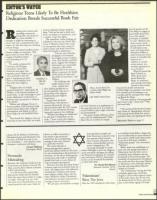
Above: Jewish Book Fair
co-chairs Andi Wolfe and
Sylvia Gotlib.
Left: Rabbi Daniel Syme
our lives function as a supplement to
the super ego and serve as a check on
certain behaviors that might otherwise
be contemplated."
The power of peer influence, Syme
says, can't be underestimated. "Chil-
dren who are involved in temple
showing Islamic people and
Arab Americans in positive ways
that represent their commit-
ment to peace and justice, edu-
cation, strong families and eco-
nomic independence. We
encourage all people in south-
eastern Michigan to join our religious,
racial and ethnic dialogues by calling
the National Conference for Commu-
nity and Justice (NCCJ), historically
known as the Interfaith Roundtable,
at (313) 567-6225.
Dr. Daniel Krichbaum
Executive Director, NCCJ
Detroit
`Palestinians'
Were The Jews
After the 1967 attempt by Arab states
"
• The success of the Jewish Commu-
nity Center of Metropolitan Detroit's
47th annual Jewish Book Fair wasn't a
guarantee. Sure, just opening the doors
RELIGIOUS TEENS on page 37
to annihilate Israel failed, a bogus his-
tory was fabricated to incite hatred of
Jews and to justify Israel's destruction.
It says Jews stole from a Muslim
"Palestinian people" their homeland
"Palestine."
Before Israel was established as a
state, the only people identified as
Palestinians were the Jews, just as
everybody knew Palestine was the
homeland of the Jewish people. The
hundreds of organizations throughout
the world that bore the name Palestine
or Palestinian were all Jewish. Books,
journals and songs about Palestine
related to Zionism.
The "Palestinians" during the Nazi
onslaught against the world that
fought in North Africa against Gener-
al Rommel's tanks, that served with
the British Royal Air Force and took
part in the battles raging in Europe
11/1
199f
Detroit Jewish News 33