

—
1141111.11.1111111.11111111111171
COMMUNITY VIEWS
It's What A Jew Does
N
Whether it was $3,647.50 con-
early a century ago, when
tributed
in 1900 or $29 million to be
our Detroit Jewish commu-
raised by the Allied Jewish Campaign
nity was in its infancy, the
in 1999, this age-old injunction has
first united appeal raised
remained a cornerstone of Jewish life,
nearly $3,648 for Jews in need. A
Kawl Yisrael aravim zeh bazeh ... Every
whopping sum in 1899.
Jew is responsible one for the other.
Years later, Fred Butzel, the
It's what a Jew does.
renowned humanitarian and commu-
In the early years, our founders
nal leader, recalled how the funds were
were concerned primarily with issues
distributed:
of physical sur-
"Miss Hart
vival. The Allied
(Blanche Hart,
Jewish Campaign
supervisor of the
had been in exis-
United Jewish Chari-
tence
only four
ties central organiza-
years when the
tion) was empowered
Depression struck
to give emergency
in 1929. Although
relief up to five dol-
income plummet-
lars without a com-
ed, the Campaign
mittee meeting."
LINDA Z. KLEIN AND
continued to help
It's difficult to
PETER M. ALTER
our
community
imagine today what
Special to The Jewish News
care
for those in
that $5 must have
need, grant inter-
meant to an immi-
est-free loans and provide emergency
grant with no other resources, or how
aid. Support went to families at risk,
that act of kindness and relief would
many of them immigrants.
remain forever etched in the memory
Such assistance-continues. But we
and history of his family.
see
different kinds of issues that
Over the decades, thousands of
require
more sophisticated kinds of
families have been able to relate such
assistance,
intervention and counseling
stories about our Jewish community
— among them, services for children
and the work of its agencies — stories
with special needs, scholarships for
about a community that sheltered and
day and supplementary school stu-
fed the homeless, that cared for the
dents, victims of domestic violence
sick and aged and educated the young.
and families in crisis. Our help to the
Linda Klein and Peter Alter are
elderly covers a much wider range of
chairs of the 1999 Allied Jewish
services, like home health care and
Campaign of the Jewish Federation of
chaplain visits to nursing home resi-
Metropolitan Detroit.
dents.
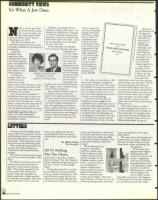
This is a copy of the
first list of centralized
giving in the history
of Detroit. It shows
that in 1900, 247
contributors gave
$3,647.50 to the
United Jewish Char-
ities, the first central
organization of the
Jewish community.
Gifts ranged from
$1, with the largest
single contribution
$115. In 1900,
Detroit's Jewish
community num-
bered 5,000 per-
sons, in a general
population of
about 300,000.
And, yet, at
the University of
Michigan last
oE year, thousands
of Jewish stu-
n dents joined
together in a
FIRST ANNUAL REPORT
=R "Half-Shekel
Campaign," pro-
UNITED JEWISH CHAR I
TIES I
claiming their
DETROIT &DOI-EGAN
Jewish identity
I with
a gift to the
Campaign.
It was
I the largest and
most successful
I campus
appeal ever.
I
As we observe
the effects of eco-
nomic displacement
•••• •
in Russia, we hear
■
an old refrain. We
worry about the
And, today, we must address a dif-
elderly Jews whose worthless pensions
ferent sort of hunger, a hunger for
mean hunger, even starvation. We fear
knowledge of who we are. The search
for the young who have led in the
for identity has turned our communi-
revival of Jewish life but now face an
ty's attention to Jewish education both
uncertain future. We're reminded that
for our children and for us in a way
anti-Semitism lurks around the corner
that will instill self-pride and nurture a
from economic chaos. And we know
love for our Jewish heritage.
that, once again, we will be called
Those who were born after the
upon to help, to feed and care for
Holocaust and the struggle for the
those who cannot leave, and rescuing
establishment of a Jewish state may not
those who can.
share the understanding of a preceding
Half a century ago, we made a
generation. Their life's experiences
promise: through war and peace, we
would not have taught them the lessons
would stand by the State of Israel. In
we learned about anti-Semitism and
the past decade, we've helped nearly
the longing for a homeland. They may
one million Russian, Ethiopian and
not internalize the concept of Jewish
other immigrants begin new lives in
responsibility, that it's what a Jew does.
WHAT A JEW DOES on page 36
OP THE
1849-mo
■••■<■
■
.4111
1
I
0
LETTERS
As some issues are decided, others
are put off for discussion later. It's like
a child asking a parent for something
when the parent wants to say no, but
instead says, "We'll talk about it later."
You can be sure the child will prevail.
What would have happened if that
was how the borders between the
United States and Canada had been
decided?
The Israelis can be pressured to give
up a lot, but never on Jerusalem. Then
what?
The PLO and terrorists exist at the
pleasure of the Arab states that are
opposed to Israel's presence among
them. They are also opposed to the
Oslo accords. They do not want
another Arab state, especially one
whose people have a higher standard
of living than their people. When they
realize that Israel is here to stay, and
11/13
1998
30
Detroit Jewish News
wants to get along with them for
mutual benefit, there can be peace.
World efforts should be in this direc-
tion.
Dr. Sidney Leitson
West Bloomfield
All Or Nothing
Not The Choice
In his letter to the editor ("Taking
Sides In A Feud," Oct. 30), Dennis L.
Green completely missed the point of
the Oct. 16 story "In The Candles'
Glare."
He identifies himself as a "secular"
Jew and falls into the trap of seeing
only , two choices: Orthodoxy or noth-
ing. He does not grasp that the vast
majority of the world's affiliated Jews
are Conservative, Reform, Reconstruc-
tionist and Humanistic, with Jewish
rites and rituals that are rich in mean-
ing for them, but which may differ
from those of strict Orthodoxy. (Even
among the Orthodox, observance
varies.)
We are fortunate to be
living in a time when
there are, indeed, many
ways to express our Jew-
ishness, all valid and all
worthy of respect. At the
Shabbat incident in ques-
tion, I was there when, to
our astonishment, a
bunch of black-hatted
thugs invaded our private
space and attempted to
force us to practice their
version of our religion. They don't
own Judaism; it was they, not us, who
"demonstrated ignorance, total disre-
spect and intolerance of the other
side's beliefs."
This was a private dining room in a
public hotel, not sacred or hallowed
ground; two floors below us in the
same hotel, a disco was blaring, that
they ignored.
We have seen what
happens when religious
fundamentalists take
control of a country such
as Iran or Afghanistan.
They start with forbid-
ding something as small
as the lighting of a match
and they end with for-
bidding women to attend
school. Religious coer-
cion in Israel is an issue
that affects every Jew in the Diaspora.
If the tyranny of a minority is allowed
to rule, then the secular Mr. Green,