

Cr
Researchers race to compile
ate of all Jews on doomed
refugee ship S.S. St. Louis.
MICA SCHNEIDER
Special to The Jewish News
s
Washington
ince 1996, against all odds, a
small core of researchers have
sought to find out what hap-
pened to all 936 passengers
aboard the S.S. St. Louis, the ill-fated
refugee ship that Cuba and the United
States denied safe haven in 1939.
While a few passengers were permit-
ted entry to Belgium, France, Great
Britain or the Netherlands, many oth-
ers were returned to Germany and per-
ished in the Holocaust.
The stories of 40 passengers remain
unknown. Researchers hope to deter-
mine their fate before the 60th •
anniversary of the ship's voyage next
May.
Scott Miller, coordinator of the St.
Louis Project, maintains that "sur-
vivors are harder to find [than victims]
becauie one of the reasons they sur-
vived is that they were hiding."
The St. Louis, manned by non-
Jewish Germans, left Hamburg,
Germany, on May 13, 1939, and
arrived two weeks later in the port of
Havana. All but 22 of the 936 passen-
gers held visas provided by the Cuban
consulate in Germany, but their entry
was denied.
"The first Spanish word I learned
was manana," Herbert Karliner, who
traveled on the St. Louis at age 12,
said in a recent interview. "The
Mica Schneider is a writer for the
Jewish Telegraphic Agency
11/13
1998
20 Detroit Jewish News
Cubans kept saying, 'maybe tomor-
row,' but manana never came."
Despite protests by American
Jewish leaders, the United States also
denied safe haven to the Jewish
refugees after Cuba turned the ship
away.
The St. Louis returned to Europe
just one month after its passengers fled
persecution.
Karliner's family was taken to
France, but when Nazi troops
advanced toward their town, only
Karliner and his brother were sent to a
Jewish children's camp in an unoccu-
pied zone. They hid throughout the
remainder of the war; his parents and
two sisters were murdered.
"To imagine, my family went half
way around the world to end up being
killed at Auschwitz, just 20 miles from
where they were born," Karliner said.
"When we left Germany, everyone
was dancing and celebrating. When
we were returning, everyone was very
much depressed," said Karliner, who
eventually moved to Florida after the
war. "A lot of men on the ship had
already been prisoners at Buchenwald,
so we knew what the Germans were
doing to the Jews. My father's brother
had been killed there in 1938."
The U.S. Holocaust Memorial
Museum, which is coordinating the
St. Louis Project, hopes to use the
story of the St. Louis to educate visi-
tors about U.S. wartime policies. In a
1997 survey for the museum, only 29
percent of respondents knew that the
United States did not grant all refugee
requests to Jews fleeing the Holocaust.
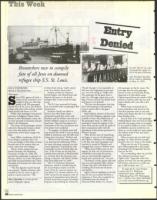
Far left: The S.S. St. Louis
surrounded by smaller ves-
sels in the port of Havana.
Left: Passengers boarding
the St. Louis in Hamburg
on May 13, 1939.
"People thought it was impossible to
find out what happened to each per-
son, but we're doing it," Miller said.
The passenger list has gone from a
plain list of foreign names into a col-
lage of stories of lives led, deaths faced
and lessons to be learned.
"We have the documents, but they
aren't all complete, so the personal,
human contact fills in the gaps,"
Miller said.
Sarah Ogilvie, director of the muse-
um's Survivor's Registry, realized it was
possible to learn what befell each of
the passengers when, in 1996, four
passengers visited the registry in the
same week and she traced the paths of
their companions easily with the
abundance of documents produced in
Western Europe.
"After the first year of researching,
we began to run out of information,"
said Ogilvie. Adding to the challenge
is the fact that many passengers had
married or moved to Palestine and
changed their names to Hebrew ones.
"When Scott Miller came to the
registry, he had a lot of connections
worldwide and turned this project
into an internationally-supported
search and a personal one," she said.
The letters, e-mails, phone calls and
tips now arriving daily offer a flicker
of hope that each could lead to the
checking off of more sets of names
and families.
Ogilvie said the highlight of the last
year for her was a phone call from a
physician in Texas who completed an
unfinished story she shared on
National Public Radio of a 15-year-
old passenger on the St. Louis. The
teen-ager was the only passenger
known to have survived after being
deported to a Nazi death camp,
Ogilvie learned from his relative. He'd
moved to America after the war and
built a family and a new life in the
Midwest.
While many commend the St.
Louis researchers and marvel at the
idea that someone took on the task,
others can't forget that the U.S. turned
their families away.
One of them is St. Louis passenger
Michael Barak, who now lives in Israel
and aids the project team in its search.
In an e-mail to Miller, he wrote "If the
multibillion country would have let
them in, we all could have been spared
the tedious work of lists and many
tears and pain."
Other survivors do not hold such
grudges. In 1950, Karliner proudly
served in the U.S. Army in the Pacific.
Where are the rest of the passen-
gers? What happened to the people
preceding Fritz Zwiegenthal, the last
man on the list?
"It's so rewarding when we can find
the ending of someone's story,"
Ogilvie said. "Especially when that
person survived. You see that person's
full history, and once in a while you
get to talk to them, too."
❑
To assist the St. Louis Project,
contact the U.S. Holocaust
Memorial Center, 100 Raoul
Wallenberg Place SW, Washington,
D.C. 20024-2150; (202) 488-0400;
or e-mail: education@ushmm.org.