
ti t ist
* STAR
DELI
•
IS PROUD TO BE ONE OF
AMERICA'S BEST CARRY-OUT ONLY DELIS!
YOU'LL ENJOY
OUR GREAT
HOMEMADE GOODNESS!
OUR POTATO SALAD
CANT BE BEAT!
REGULAR OR FAT-FREE
EVERYBODY KNOWS
WE HAVE THE FINEST
HOMEMADE TUNA
IN TOWN! REGULAR
OR FAT-FREE!
On The Bookshelf
WE CUT
OUR LOX
BY
HAND!
Author Stephen Dubner grew up in a devout
Catholic household but found his Jewish roots.
OUR TRAYS CAN'T BE BEAT
FOR QUALITY & PRICE!
Meat Tray $5.75 per person $
Dairy Tray $10.50 per person
• Expires 12-31-98
• One Per Customer
DELIVERY AVAILABLE
SANDEE BRAWARSKY
OFF
Special to The Jewish News
• Not Good Holidays
• 10 Person Minimum
STAR DELI
24555 W. 12 MILE, Just West of Telegraph, Southfield
352-7377
I.
DISTINGUISHED
RESTAURANTS OF
NORTH AMERICA
1997 AWARD OF
EXCELLENCE
Private Garden Room
or Fireside Setting for
parties, receptions
wedding rehearsals,
showers, bar mitzvahs,
business meetings,
audio, visual
capabilities
30715 W. TEN MILE RD.
(Just East of Orchard Lake Rd.)
248.474.3033
11/13
1998
110 Detroit Jewish News
.00
a
hen Frances Greenglass
and Sol Dubner con-
verted from Judaism to
Catholicism during •
World War II, it was as though a gate
banged shut; neither looked back.
Embracing Catholicism zealously,
they broke with
their families as
well as their reli-
gion; Dubner's
father sat shiva.
The pair met and
married after
each had convert-
ed independent-
ly; they became
Veronica and
Paul Dubner.
Decades later,
their son
Stephen, the
youngest of their eight children,
unlocked the gate, opening to a
renewed Jewish future.
While it's true that you need a
great story to write a great memoir,
more importantly, you need to be able
to tell it well. Dubner has remarkable
material in his family's dramas and
mysteries, but it's his fine writing and
novelistic style that makes Turbulent
Souls: A Catholic Son's Return to His
Jewish Family (Morrow; $24) stand
out among many recent memoirs.
With respect toward both religions,
he recounts his parents' stories and his
own, finding an authentic and natural
voice to talk about Heaven and souls
and faith as well as things mundane.
"It became a book I had to write,"
Dubner explains, and that urgency is
apparent on the page.
"Family is the best subject to write
about," Dubner, 35, a writer and editor
at the New York Times Magazine, says.
"It's rich in every way a writer wants; it's
a container that holds every curiosity."
The memoir opens with Dubner's
family piling into the car to go to
church, as they would every Sunday,
from their farmhouse in upstate New
York. After mass, they'd come home to
a big breakfast, having fasted until
receiving communion. The author's
father would skip the waffles and fix
himself some matzah topped with
gefilte fish.
Although the children knew some-
thing about the fact that their parents
had been Jewish, it meant nothing.
"For all I knew about Jews, my parents
might well have been Baptists, or Elks,
or carnival workers," he writes. He
didn't know of his extended Jew-
ish family, or that Ethel Rosen-
berg, executed in 1953, was his
mother's first cousin, or even the
names of his grandparents.
Paul and Veronica, then Sol
and Florence, were each born to
parents who had immigrated
from Eastern Europe around the
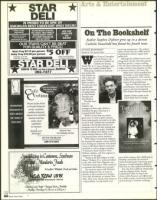
Stephen Dubner speaks at the
Jewish Book Fair on Sunday.
turn of the century; their childhoods in
Brooklyn sound like the stories of
many first-generation Americans, grow-
ing up in a world altogether different
from the one their parents left behind.
Sol, who had a difficult relationship
with his religious father, found
Catholicism while serving in the
Army, while Florence was influenced
by a ballet teacher, and found comfort
and meaning in Catholic teachings.
•■ I
Scanned image of the page. Keyboard directions: use + to zoom in, - to zoom out, arrow keys to pan inside the viewer.
November 13, 1998 - Image 110
- Resource type:
- Text
- Publication:
- The Detroit Jewish News, 1998-11-13
Disclaimer: Computer generated plain text may have errors. Read more about this.