
You Can
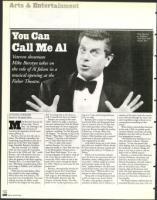
Mike Burstyn
as Al Jolson:
"You Ain't Seen.
Nothin' Yet!"
Call Me A
0
0
Veteran showman
Mike Burstyn takes on
the role ofAl Jolson in a
musical opening at the
Fisher Theatre.
SUZANNE CHESSLER
Special to The Jewish News
NE
ike Burstyn's favorite Al
Jolson song, "Sonny
Boy," has nothing to do
with memories of
watching the legendary Jewish enter-
tainer perform it.
Burstyn, who has, the title role in
_Jolson: The Musical, remembers the
song being sung directly to him by a
great star of the New York Yiddish
stage, Pesach'ke Burstein, his father.
"My dad recorded it in Yiddish
wh6n he was an artist for Columbia
Records in the 1920s and '30s," recalls
Burstyn, who will perform that stan-
dard as well as 21 other Jolson hits
when he appears in the show opening
Tuesday, Nov. 17, at the Fisher The-
atre. "My father recorded many of Jol-
son's songs in Yiddish, and I still have
his records.
"Dad used to watch Jolson when
they worked in the same building,
where there were two theaters. The
men had a lot of similarities. The most
striking was that my father would
whistle-on his fingers the way Jolson
11/13
1998
100 Detroit Jewish News
did. I'm doing that in the show as
well. I learned how from my father."
Burstyn, too young to have seen
"Jolie" (Jolson) on stage, is starting a
one-year national tour with the Broad-
way-bound play. He loves singing the
songs made famous by America's first
superstar, including "Let Me Sing and
I'm Happy," "I'm Sitting on Top of the
World," "Blue Skies," "April Showers,"
"Swanee," "Carolina in the Mornin'"
and "I Only Have Eyes for You."
"This is a play with music,"
explains Burstyn, 53, who has
appeared locally in Those Were the Days
at the Birmingham Theatre-and at
Israel Bond fund-raisers. "It's a very
strong biography of Al Jolson using all
the music that he made famous. It
covers the 1920s, when he was at the
peak of his career, through his death
in 1950. There's no new music for this
production."
Burstyn, who generally divides his
energies between the United States
and Israel, has starred on the New
York stage in Ain't Broadway Grand,
The Rothschilds, Barnum and The
Prisoner of Second Avenue. His roles
build on his varied experiences, start-
ing as a 7-year-old joining both par-
ents on stage.
Burstyn, also an actor in American
and Israeli films and all-around show-
man in concerts and on TV, has won
the Israeli equivalent of two Oscars.
Last year, Burstyn brought his mother,
Lillian Lux, to Israel, where they
marked what would have been his
father's 100th birthday with a musical
performance; Burstyn performed a
role originated by his dad.
Long before being cast in the Jolson
play that won London's Olivier Award
for Best Musical, Burstyn created and
performed the club act 'A Tribute to
Jolson."
"Jolson was an innovator and pio-
neer, the first to do a one-man show on
Broadway, make a talking picture, sell
more than 1 million copies of a record
and entertain troops on the front
lines," explains Burstyn, who has enter-
tained Israeli troops, once with comedi-
an Danny Kaye. "What he did is very
relevant to what is being done now
"Being able to bring Al Jolson back
to life on stage is any actor's dream.
The play is not going to present an
imitation of Jolson, but it will be a re-
creation of his spirit, both the way he
was in life and through his voice. You
can't sing Jolson songs and not try to
communicate something of that
sound."
When Jolson entered show business
in the early 1900s, he picked up the
common theater convention of using
blackface, but that will not be part of
this biographical musical.
"We decided that blackface is not
what this show is about," Burstyn
explains. "In the time period that
we're dealing with, he stopped using
the [makeup]. It doesn't change the
story in any way to omit it, and we
didn't want to offend anyone."
Burstyn, a trustee of the American
Friends of Hebrew University and
honorary chairman of the Cystic
Fibrosis Foundation of Israel, had to
set aside a lot of commitments to
take on the Jolson tour, which
requires eight performances each
week. His only appearances outside
the play will be three February con-
certs at the University of Judaism in
Los Angeles.
The family theater tradition has not
interested Burstyn's two sons. One is a
Scanned image of the page. Keyboard directions: use + to zoom in, - to zoom out, arrow keys to pan inside the viewer.
November 13, 1998 - Image 100
- Resource type:
- Text
- Publication:
- The Detroit Jewish News, 1998-11-13
Disclaimer: Computer generated plain text may have errors. Read more about this.