
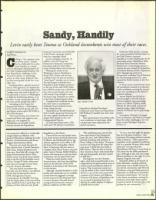

Sandy, Handily
Levin easily bests Touma as Oakland incumbents win most of their races.
C ailing it "the sweetest victo-
ry of my career," Sander
Levin celebrated his re-elec-
tion Tuesday to a ninth
term as Michigan's representative of
the 12th Congressional District. He
beat Republican challenger Leslie
Touma by almost 17 percentage
points in what many political veter-
ans had anticipated would be a very
tight race.
Standing before a gleeful crowd of
about 100 supporters, he thanked his
constituents for not being deflected by
,,
"wedge issues that tried to divide us.
He promised to return to Washington
to fight for fundraising reform, so in
the end "it isn't money that talks, it's
the voice of the people that talks."
According to the Center for
Responsible Politics, a Washington,
D.C.-based research group, the aver-
age House winner spent $673,000 in
the 1996 elections.
The Levin-Touma race, hotly con-
tested and filled with negative cam-
paign ads, was targeted by
Republicans as winnable. Public
records showed the Republican
National Committee sent $500,000
to the Touma campaign, half of
what her campaign raised.
Levin's campaign raised $1.13
million, none of it from the
Democratic National Committee,
but about half of it from PACs,
many of them labor-union financed.
Waiting for results at the
Washington Square Building in
Royal Oak, Touma said she was
confident that she got her positive
"issue-based" message out to voters.
She had hoped to benefit from
Republican John Engler's presence
at the top of the state GOP ticket,
but while he swept into a third term
by a two-to-one margin, his coat-
tails weren't long enough to carry
the Lear Corp. executive to victory
in her first Congressional outing.
Complete but unofficial returns
Rep. Sander Levin
for other races in southeastern
Oakland County showed incum-
Republican Michael Bouchard,
bents ruling the day.
Republican Joe Knollenberg had
Democrat Gary Peters and Republican
little trouble, garnering 64 percent of
Bill Bullard Jr. handily beat their chal-
the vote, against Democratic chal-
lengers.
lenger Travis Reeds in the 11th
State sepresentative incumbents also
won re-election in local races, while
Congressional District.
In local state Senate races, 13th,
vacated seats were replaced by the
14th and 15th District incumbents
party's successors.
Democrat Gilda Jacobs, running
for a seat vacated by David Gubow in
the 35th District, trounced
Republican Cecilio Maldonado by 50
percentage points. Republican Marc
Shulman beat Democrat Maxine
Brickner by 15 percentage points to
replace the seat vacated by Republican
incumbent Barbara Dobb. Republican
John Pappageorge easily beat
Democratic candidate David Richards
by 29 percentage points for a seat
vacated by Shirley Jordan in the 41st
District.
In local county commissioner races,
all incumbents waltzed to re-election,
while candidates running for vacated
seats won according to the district's
political makeup.
Steven Kaplan lost his bid to
become judge in the 6th Circuit
Court, losing by nine percentage
points to Colleen O'Brien, while
Martin M. Doctoroff, a Court of
Appeals judge, edged challenger
Pamela O'Sullivan by five percentage
points.
Incumbent Michael Cavanagh
won re-election, and Maura Corrigan
beat five other challengers, for two
seats on the Michigan Supreme
Court.
was returned to office by a comfortable
margin despite an effective, well-
financed Republican challenge by Leslie
Touma, a businesswoman and former
Reagan administration official.
The story was much the same for
Rep. Martin Frost, a Jewish Democrat
from Texas. Despite predictions of a
close race, Frost held off a strong chal-
lenge by businessman Shawn Terry.
Frost's victory was all the more remark-
able in the face of the landslide victory
of Gov. George W. Bush, whose coat-
tails were not enough to boost Terry
over the 10-term incumbent.
The only Jewish incumbent who
lost: Rep. Jon Fox (R-Pa.), was defeated
by the man he beat by 84 votes in
1996, Montgomery County
Commissioner Joe Hoeffel. Fox's loss,
and the death earlier in the year of Rep.
Steve Schiff (R-N.M.), leaves Rep. Ben
Gilman of New York the only Jewish
Republican in the House.
There will be two new Jewish mem-
bers, both women and both Democrats.
In Illinois, Jan Schakowski had no sig-
nificant opposition in her effort to fill
the shoes of the retiring Rep. Sidney
Yates, a Democrat who first came to
Congress when Harry Truman was pres-
ident. And in Nevada, Shelley Berkley, a
lawyer with strong ties to the pro-Israel
movement, won an open House seat.
Observers noted another trend:
American Jews, who have been drifting
slowly in the direction of the GOP,
seemed to come back to the Democrats
in this election.
Although a detailed breakdown of the
Jewish vote nationwide was not available,
several observers suggested a stronger
Jewish turnout for the Democrats than
in recent elections. Exit polls showed
strong Jewish Democratic voting in
Illinois, California and New York.
"The underlying story may be that
Jews came home to the Democratic
party this year," said Gilbert Kahn, a
political consultant and professor at
Kean College in New Jersey "Economic
security was a big factor for many. But
even more, I think Jews have faith in
Bill Clinton. They saw him as having
their interests at heart, both internation-
ally and domestically, and they wanted
to help him."
One big loser was the Christian
right, which had invested heavily in key
congressional and gubernatorial races, as
well as several anti-abortion ballot ini-
tiatives. That investment turned sour
with the defeat of Sen. Lauch Faircloth
(R-N.C.), one of the most conservative
members of the Senate, and Alabama
Governor Fob James, a Republican who
was accused of spending more time
fighting for public displays of religious
symbols than for jobs.
"It was a very bad night for groups
like the Christian Coalition," said
American University political scientist
Allan Lichtman. "They expected to
capitalize on the president's problems,
but in a number of races, their candi-
dates lost. It means that the
Republicans will have to come back to
the center for the 2000 presidential
race, although it also may encourage
House members on the right to try to
depose Gingrich next year."
Faircloth's defeat at the hands of
John Edwards, a wealthy political
newcomer, was a double victory for
the Jewish community, said Howard
Friedman, a top pro-Israel activist in
Baltimore. In addition to Faircloth's
domestic conservatism, "he was the
only Senate incumbent running for
reelection who didn't have a good
record on Israel. So his loss was a nice
pickup for our community."
HARRY KI RS BAUM
Staff Writer
❑
❑
11/6
1998
Detroit Jewish News 11