

41,
•
'4- 4
MOSolvfroglo,
The Photographer
As Social Anthropologist
Through his camera lens, French photographer Frederic Brenner discovers
ways in which American Jews reinvent themselves.
SUZANNE CHESSLER
Special to The Jewish News
O
0
nly non-Jews fill one of
Frederic Brenner's most dra-
matic photos capturing
Jewish life in America. The
French photographer selected people
from the small town of Billings,
Mont. — ministers, a sheriff, cow-
boys, a cheerleader — and posed them
with menorahs. The idea was to repre-
sent the townspeople's response to an
anti-Semitic incident that happened
there.
Brenner staged his picture a year
after Billings citizens of many faiths
put pictures of menorahs in their
home windows to protest the throw-
ing of a brick through a window that
displayed a real menorah.
The photo, introduced in Brenner's
1996 book, Jews/America/A
Representation, will be among many
examples of Brenner's work exhibited
•
at the Janice Charach Epstein
Museum/Gallery through the end of
the year.
Other images — all with a theatri-
10/30
1998
cal mood — include a group of psy-
choanalysts seated next to a couch sur-
rounded by books, Jewish cab drivers
from the Soviet Union working on
Coney Island and a seder at a maxi-
mum security prison for women.
"What I'm showing in Detroit is
one fragment of a big jigsaw puzzle
that I've been piecing together over
the past 20 years," says Brenner, who
will be at the gallery on Thursday,
Nov. 5. He will discuss his photos and
latest book, Exile at Home, a picture
essay of Jews from many countries set-
tling into Israel.
"My photos show a journey
through the . Jewish Diaspora, which
includes about 40 different countries.
I see diaspora as a mecca for fertiliz-
ing, which means how much we have
been fertilized and how much we fer-
tilize in return. I went to the United
States to see how the most important
Jewish community in today's world
has been able to reinvent itself."
Brenner, 39, says he plans images to
express how much American Jews
remain Jewish and how much they
became Americanized.
"What is incredible is that Jews in
the United States have reinvented
themselves in so many forms," says
Brenner, who leaves a wife and chil-
dren in France as he travels to distant
shores. "There's not a single other
country where Judaism is Judaism a la
carte. My intention was to show the
diversity. I included photos of 39
major figures — Stephen Spielberg to
Mark Spitz, Ruth Bader Ginsburg to
Henry Kissinger — who shaped
American and Western culture in the
20th century."
Brenner did not pick up a camera
to be a professional photographer.
Rather, it was to be an instrument for
his studies as a social anthropologist.
"The form is never a given,"
Brenner says of his artistic approach.
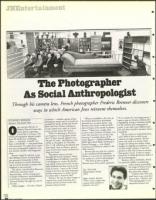
Top: "New York
Psychoanalytic Society"
1994.
Right: Frederic Brenner:
"There is not a single other
country where Judaism is
Judaism a la carte."
"It is a result of a very long process. I
spent a year in America without pho-
tographing, trying to immerse myself iv
in the country and understand its
pulse. I met with many different peo-
ple and then started'to envision what I
would do.
"All my work is a huge production,
and I believe that we exist in our
capacity to stage ourselves, We live
more and more in a society where
images are taking over reality, where
images are shaping our behavior. I try •-
to look inside a person. I want the
person to talk, and I want to see how
that person moves. I want to under-
stand the invisible dimensions before I
do the photograph."
Brenner, who is Orthodox, found
no personal conflict in presenting
nude women, particularly
his image of breast cancer qp.
survivors revealing how
they look after surgery.
"I believe that what you
don't have to see, you don't
have to face," Brenner says.
"This photograph is very
important because one