

attire Life
ALICE BURDICK SCHWEIGER
Special to The Jewish. News
ooking as glamorous as ever,
world-famous fashioner
designer Diane Von
Furstenberg shows this visi-
tor around her exquisitely decorated
19th-century-era converted carriage
house in New York City. There is an
attention to detail in the colorful,
eclectic furnishings, accented by arti-
facts and carved wooden sculptures
from Von Furstenberg's travels. The
three-story showroom/headquarters is
where she both lives and operates her
business.
On an unseasonably warm October
afternoon, Von Furstenberg leans back
on the posh sofa in her sunny family
room and talks about her life and rea-
sons for writing her soon-to-be-
released autobiography, Diane: A
Signature Life (Simon & Shuster;
$25). She will be the opening speaker
8 p.m. Saturday, Nov. 7, at the 47th
annual Jewish Book Fair in West
Bloomfield.
"I wanted to write about the amaz-
ing American dream that I got to live
and the subsequent ups and downs in
my personal and professional life,"
says Von Furstenberg. "I hope my
book will be an inspiration to people.
Although I feel strange about reveal-
ing my feelings, if I can help some-
one, then it's worth it."
Von Furstenberg begins her
memoirs with the recent come-
back of her famed wrap dress,
then looks back at her intro-
duction to the fashion world,
the obstacles she faced and
how she built an empire. She
also tells of her marriage to a
prince, her family and the
impact her mother, a
Holocaust survivor, has had
on her life.
Born in Belgium to Lily
Nahmias and Leon Halfin in
December 1946, Von
Furstenberg says she was a mira-
cle child. "My mother had been
in Auschwitz-Birkenau and
Ravensbruck and weighed only 49
pounds when the Russian troops
Alice Burdick Schweiger is an Ann
Arbor-based freelance writer.
L
10/ 3 0
1998
to New York, where
she was reunited
with Egon and
introduced to many
influential people in c
the fashion industry,
including Halston
and Vogue's Diana
Vreeland. She also
did some modeling
at charity balls.
"Many of my
friends were design-
ers, so fashion was c
on my mind," says
mother moved with her. But another
Von Furstenberg, who has maintained
officer grabbed my mother, hit her
her youthful figure and creamy corn-
hard with his baton and forced her to
plexion.
join the line on the right.
After two months in New York, she
"She had never experienced such
traveled to Italy and apprenticed with
violence, but, in fact, he saved her life.
Ferretti, where she learned the ins and
The group on the left was sent to the
outs of clothing design. On a visit to
gas chambers. My mother became
Rome, Egon presented her with an
aware that what you may think is bad
engagement ring. In July 1969, after
for you, may turn out to be good.
learning she was pregnant, she and
This was a lesson she passed on to
Egon were married in the town hall
me.
outside of Paris.
Von Furstenberg grew up in
"My pregnancy barely showed in
Brussels with her brother, Philippe,
the Christian Dior wedding dress
who was born when she was 6. "My
Marc Bohan designed for me," she
mother pushed me toward indepen-
writes in her book. "Five hundred of
dence and freedom," says the fashion
our friends and relatives came to the
designer. So at age 13, Von
reception afterward at a charming
Furstenberg went off to boarding
provincial inn and restaurant."
school in Switzerland, and at 15, was
Noticeably absent from the wed-
sent to boarding school in England,
ding reception was Egon's father,
where she learned to speak English.
Tassilo, who had been pressured by
During that period her parents
the family patriarch not to attend.
divorced.
Many of the Furstenbergs, blue-blood-
During her university years,
ed European nobility, were outraged
Von Furstenberg studied
that one of their heirs would marry a
Spanish at the University of
Jew.
Madrid, and a year later, relo-
"Egon's mother and father really '-
cated to Switzerland, where
didn't care that much; it was Egon's
she moved in with her mother
grandfather who disapproved the
and her mother's boyfriend,
most," says Von Furstenberg, who,
Hans, and studied economics
though not raised with religion,
at the University of Geneva.
always has thought of herself as
"Those were happy times,"
Jewish. Both of her parents had been
she recalls.
raised as observant Jews, but because
A year later she met Prince
of the Holocaust chose not to practice
Eduard Egon von and zu
Judaism.
Furstenberg at a nightclub in
In 1969, the royal couple settled in
Geneva. She fell in love with the
Manhattan and soon became a part of
5 -5 prince, but determined to carve
American society. Von Furstenberg's
out her own niche, she moved to
son Alexander was born in January
Paris and landed a job working for
1970, and in April of that year she
..;.9
the
agent
who
represented
the
hottest
made
her first dress sale. In February
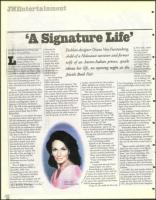
Diane Von
1971, she gave birth to her daughter,
Furstenberg today N fashion photographers.
At age 2 1 , she made her first trip
Fashion designer Diane Von Furstenberg,
child of a Holocaust survivor and former
wife of an Austro-Italian prince, speaks
liberated the
camp," Von
Furstenberg says
somberly, as she
pushes her thick,
black shoulder-
length hair aside
and leans back.
"So it was a mira-
cle that she sur-
vived and gave
birth to me."
Von Furstenberg
says her mother
didn't talk much
about the horrors she endured. "She
only spoke of positive things, like the
camaraderie she had with others, or
the time she traded a piece of bread
for a comb. There was one story, how-
ever, that stuck with me.
"During the train ride to the camp,
my mother had attached herself to an
older woman. When they arrived at
the camp, she stood next to the
woman as they were forced to form a
long line to await selection. A German
soldier directed the older woman to
join the group on the left, and my
about her life, on opening night at the
Jewish Book Fair.
)7