

•
_744
Editorials
Your Vote Matters
"The basis of a democratic state is liberty"
—
Aristotle
lf you don't vote Tuesday, Nov. 3, don't
V
expect a sympathetic ear if you complain
about who's elected.
For Americans, voting is more than a
privilege. It's also a responsibility. In dictator-
ships, people yearn for a chance to vote, some-
thing many of us take for granted.
There's virtually no legitimate reason not to
vote next week — unless you aren't registered.
You can vote in person or by absentee ballot.
Polls are open 7 a.m. to 8 p.m.
Voters will choose from among Republican,
Democratic, Libertarian, Reform and Natural
Law Party candidates for a slate of federal,
state, county and judicial offices. Races include
U.S. representative, governor, secretary of state,
attorney general, state Senate, state university
boards, county commissioner, state Supreme
Court, state appellate courts, circuit courts,
probate courts and district courts.
The ballot also contains three propOsals: A)
"to change the word handicapped to disabled
in the state constitution"; B) "to legalize the
prescription of a lethal dose of medication to
terminally ill, competent, informed adults in
order to commit suicide"; and C) "to authorize
bonds for environmental and natural resource
protection programs."
General elections in non-presidential years
seldom stir great interest.
Since 1988, 60 percent of Oakland Coun-
ty's registered voters have typically voted in
general elections — which means 40 percent
have ignored a precious constitutional right!
Statewide, the average turnout is a meager 51
percent. In some European countries, turnouts
top 75 percent.
Your informed vote does make a difference,
as candidates who have lost by a handful of
votes can attest. For a candidate, there's noth-
ing as important as getting out the vote
because, in the end, the only thing that mat-
ters is who got the most votes.
If you don't know where to vote, or you
want to vote absentee, call your city or town-
ship clerk.
Citizen participation in gOvernment is the
hallmark of the democratic ideals we so cher-
ish. We as a people are only as strong as the
representatives we elect to govern us.
So don't let others represent you through
your lack of participation come Election Day.
Have your say — vote Tuesday, Nov. 3. ❑
Assessing Wye
•
ill Wye work? That's the looming
question left in the wake of last
week's White House signing of
what's now known as the Wye
Memorandum. It details — exactingly — the
steps that Israel and the Palestinian Authority
must take to revitalize what has became a dan-
gerously stagnant effort toward the historic reso-
lution of the 100-year-old Arab-Jewish conflict
west of the Jordan River.
Among the document's highlights are that
Israel will relinquish full control of yet another
13.1 percent of the West Bank, and partial con-
trol of 14.2 percent more of the territory. The
Palestinians will further clamp down on anti-
Israel terrorist groups, shrink their Kalishnikov-
armed police force from 40,000 to 24,000 and
have the Palestine Liberation Organization char-
ter no longer demand Israel's destruction.
And then there's the role of the U.S. Central
Intelligence Agency. It, as an observer, will moni-
tor both Palestinian and Israeli compliance
efforts. Many of Israel's friends are concerned
that the CIA will become embroiled in deciding
what is acceptable Israeli behavior. That, they
say, will force President Bill Clinton to pressure
Israel. That could put American Jewish groups
in the uncomfortable position of being asked by
Jerusalem to pressure the Clinton administration
to get off Israel's back. In fact, that's about what
W
happened last weekend; Israeli Prime Minister
Binyamin Netanyahu called U.S. Jewish leaders
and asked for their support if he unceremoni-
ously left the Wye talks.
None of us can gaze into the proverbial crys-
tal ball and predict what will happen. However,
we are left with this reality: The Israelis and
Palestinians may not trust one another, but they
must continually test one another on behalf of
peace. This process is not about friends amicably
working out a disagreement, or simply agreeing
to disagree. It is a life-and-death struggle by
adversaries whose generations have been raised
on violent conflict — as the murders of Pales-
tinians and Jews at week's start showed. It is a
nasty, ugly divorce that cannot be achieved with-
out the authoritative role of an interested third
party Only the United States can play that role.
There are potential pitfalls in the Wye Memo-
randum, but it is not pre-doomed to fail. Rather,
it must be given an opportunity to move for-
ward. The alternative is disastrous for all.
We caution against jumping to conclusions
with every statement made — such as Binyamin
Netanyahu's pledge to continue expanding settle-
ments and Palestinian leader Yassir Arafat's
pledge that statehood is near. The rhetoric of the
Mideast is not expected to go away so soon.
Instead of listening for it's often shrill pitch, we'll
be looking at the actions of all involved. ❑
IN FOCUS
Partnering Ways
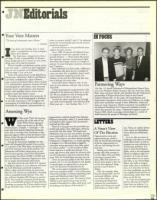
On Oct. 15, Jewish Federation of Metropolitan Detroit Exec-
utive Vice President Robert Aronson, left, met with Yoav Ende,
Shira Gray and James Demb, who thanked him for Federation's
sponsorship of Project Roots Day Camp in the Central
Galilee's Nazaret Illit. At the camp, 50 young Russian and
Argentinean immigrants, both secular and religious, are taught
about their similarities instead of their differences. Ende and
Gray are camp volunteers. Demb is executive vice president of
the Masorti Foundation for Conservative Judaism in Israel,
which also sponsors the camp. Federation's support is part of
Project 2000, which encourages relationships in a variety of
fields between the people of Michigan and Israel.
LITTERS
Voter's View
Of The Election
Opportunities come and
opportunities go, which is
why we should take advantage
of all the opportunities we
will run into during this elec-
tion year.
During every election year,
people with ideas emerge to
run for office. They are likely
running to propose their
ideas, offer their solutions or
discuss their gripes to the vot-
ers for their approval, disap-
proval or just to foster a
debate.
Take, for example, ideas
like providing health care for
uninsured children, taking
care of the elderly and
expanding developmental
programs for preschoolers,
along with hiring more quali-
fied teachers to reduce class
size. These are neither Demo-
cratic issues nor Republican
issues; they are community
issues.
It is our job, as voters, to
challenge such ideas or at least
think about them, as well as
propose our own solutions to
community problems. It is
time to move beyond party
labels, such as tax-and-spend
liberal or religious-right con-
servative. It is time to focus
on areas where we, as voters,
and they, as our elected legis-
lators, can strike a compro-
mise rather than a confronta-
tion. It is time that we focus
on what candidates can do for
my neighborhood and for my
community, rather than what
they can do for me.
It is time we recognize peo-
ple for who they are and for
what they can achieve. It is
time we move beyond party
10 /30
1998