

Jewry's Role in
Human Affairs
Week
MASTERS OF THE MUSICAL MEDIUM
The 19th century was a time of rebirth for recently emancipated Jews of
Europe who sought assimilation into a more accepting and benign
society. As ghetto doors swung open, long dormant talent flooded forth
into popular culture, as in the realm of music. Two of the most gifted
classical musicians of the times were among the many who embraced
Christianity for professional advantage but without doctrinal commitment:
Felix Mendelssohn, a leading figure of early romanticism, and Gustav
Mahler whose towering compositions announced a new symphonic age.
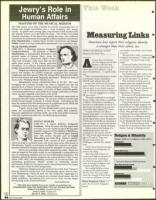
FELIX MENDELSSOHN
(1809-1847) b. Hamburg, Germany Composer/
Conductor/Pianist
The grandson of Moses
Mendelssohn, a distinguished philosopher and
spiritual leader of German Jewry, wrote his
inspired overture A Midsummer Night's Dream
when only seventeen--eight years after his first
public piano recital. In the vibrant, cultivated
atmosphere of an affluent household, the young
prodigy blossomed intellectually and musically.
Despite an exhausting schedule as a much sought-after conductor,
pianist and teacher, the prolific composer completed five orchestral
symphonies; the Reformation (1830-32), Italian (1833) and Scottish (1842)
are the best known and most frequently performed. Within his body of
music is the "Wedding March" familiar to all.
Mendelssohn earned considerable fame in his day. His tours
throughout the Continent brought him often to England and into the
personal favor of Queen Victoria who deeply admired his genius. He also
helped revive interest in the century-old works of Bach, raised the quality
of orchestral performance, and founded the Leipzig Conservatory of Music
which was then regarded as the finest in the world.
Musicologists consider Mendelssohn's choral and organ music as
among the best the century produced. By the early 1840s he was the most
acclaimed and popular composer in Central Europe. And taking up the
baton he conducted the first performances of symphonies by his friend and
colleague, Robert Schumann, and by Franz Schubert.
Tragedy struck at age 38 when Mendelssohn's much adored sister,
Fanny (an accomplished pianist in her own right), died suddenly.
Physically depleted and in failing health, one of the most gifted musicians
of his day expired soon after his overwhelming bereavement.
10/30
1998
GUSTAV MAHLER
(1860-1911) b. Kalist, Bohemia Composer/
Conductor While his music was less appreciated
in his day, he is now hailed as one of the last great
romantic composers in the tradition of Beethoven,
Brahms and Wagner. His musical legacy inspired
early 20th century disciples such as Arnold
Schoenberg and Alban Berg. Mahler's nakedly
emotional work consists of nine symphonies
which are huge in orchestral scale, and seven song cycles often based on
folk elements. Equally as prominent was Mahler the conductor who greatly
enriched orchestral resources and elevated the standards of musical play.
He too was a prodigy whose father supported his talent. Barely ten
when he staged his first piano recital, he soon graduated to composition by
way of conducting operettas and ever-more demanding repertoires. His
reputation behind the podium peaked as the musical director of the Vienna
Opera (1897-1907), the outstanding institution of its kind and time. An
unrelenting perfectionist, Mahler insisted on technically precise
performances faithful to the original scores--demanding much of his singers
and musicians whom he often antagonized.
. Malicious intrigues and anti-semitism drove him from Vienna to
America where he led the New York Metropolitan Opera; then the New
York Philharmonic which he built into the world-class organization it
remains today. Among his classics are colossal choral pieces like his
eighth symphony, the haunting Das Lied von der Erde, and the deeply
moving song cycle, Kindertotenlieder.
- Saul Stadtmauer
Visit many more notable Jews at our website: www.dorledor.org
COMMISSION FOR THE DISSEMINATION OF JEWISH HISTORY
Walter & Lea Field, Founders/Sponsors
Irwin S. Field, Chairperson
Harriet F. Siden, Chairperson
24 Detroit Jewish News
Measuring Links
American Jews report their religious identity
is stronger than their ethnic ties.
and whether most of their close friends
are Jewish.
`Being Jewish is really a combination
of religion and ethnicity," Cohen said ink
an interview. "It's about being 'a holy
DEBRA NUSSBAUM COHEN
Special to The Jewish News
New York
A
merican Jews' connection
people.'
with the religious part of their
Communal leaders who believe that
identity is solid but their
more resources should be invested in
sense of connection to the
Jewish education should find encourage-
ethnic aspect of Jewishness — their
ment from the study.
sense of peoplehood — is rapidly declin-
The findings also show, Cohen said, .
ing.
that "identity can be formed by inten-
That is the central finding of a Jewish
sive Jewish education" in any form.
Community Centers Association
That conclusion is borne out in a
(JCCA) study released this week.
separate study, also released this week,
It may seem axiomatic, but another
that Cohen conducted for Young
major finding of the study is that those
Judaea, the Zionist youth movement of
who are active in one Jewish organiza-
Hadassah — the Women's Zionist
tion are likely to be involved in others as
Organization of America.
well — that any engagement in Jewish
In his survey of Young Judea alumni,
life spurs more.
Cohen compared their responses ro
The study conducted by sociologist
those in the JCCA study.
Steven Cohen, who works as a professor
Young Judea alumni are inherently
at Hebrew University in Jerusalem, is
more likely to be highly engaged with
the first one underwritten by the JCCA
Jewish life than are the statistically aver-
that focuses on broad communal con-
age Jews who responded to the JCCA
cerns rather than internal JCC issues.
survey. They generally come from
It is part of the JCCNs effort to
Conservative movement-affiliated homes
become a key player in Jewish education
in which there is a sufficiently strong
and scholarship at a time when many
Zionist bent to prompt them to seek
Jewish organizations across the spectrum
out an ideologically based youth group.
of American Jewish life are clamoring to
The JCCA analysis focuses more
make an impact on those issues that are
intensively on measures of ethnic identi-
considered central to Jewish continuity.
fication. Among its findings are that:
Cohen analyzed the findings of a
mailed questionnaire that was
completed in the summer of 1997
by 1,005 Jewish adults between the
ages of 25 and 65. They were
Younger adults are as idigious as older adults...
selected randomly by the
,,,,tomfttumit
Washington research firm Market
Facts.
Cohen found that the youngest
respondents are as religiously ori-
Ritual Observance
ented as the oldest.
More than half of those sur-
veyed scored high on measures of
ritual observance, as did about
one-third of respondents when it
...but score lower on ethnic measures
came to feelings of religious com-
Most Chum Friends Jewish
mitment and faith in God.
But marked declines among
younger Jewish adults became
obvious when they were asked
Commitment
about the strength of their ethnic
ties, such as attachment to Israel
boa & EthltiCity
;
Debra Nussbaum Cohen is a
writer for the Jewish. Telegraphic
Agency
111312:12
ADULTS 55 — 64
Sou ccv: Stud), for Jewish Commimity Center& Assotiatioti of