

Aidwest Tremier
of "eke Jew in the
Paula Cooper Gallery in New York.
What was most novel about his
approach at the time was that he drew
Cl directly on the wall, rather than on an
object that would be placed on the
wall.
Eventually, when the LeWitt exhi-
bition comes to a close at the BBAC,
the walls will be painted over. "The
temporary nature of most of
LeWitt's wall drawing installations
challenged the idea of permanence
C so important to art historians, art
dealers, curators and collectors," says
Miller-Keller.
"The owner of a Sol LeWitt wall
drawing has not purchased an actual
object. Rather the museum or collec-
tor has pur-
chased the use
of an idea."
Miller-
,11)
Keller says
that unlike
many artists,
LeWitt's focus
is not on "the
visual or per-
ceptual appeal
of the idea,
but rather on
c. the content of
tional outdoor sculpture exhibition in
Munster, Germany, Miller-Keller says,
"it was a very powerful image centered
in front of an 18th-century building.
When he wrote the title, he was think-
ing of all the Jews that had never been
born. It represented his sadness about
not only those who had been killed,
but about those lives that had never
been."
Referring to LeWitt's Jewish her-
itage, she adds, "Sol didn't want to do
a piece that would glorify the city
without some reference to the past."
In conjunction with the BBAC
exhibition, there will be a special
lecture given by Miller-Keller 7:30
p.m. Thursday, Oct. 22, at the
the initial
idea itself
"He sees
the artist in
a role anal-
ogous to
that of a
composer
who writes
the score
but doesn't
necessarily
perform it,
or to that
of an architect who designs a build-
but does not build it," she
explains.
LeWitt's earlier graphic work for
architect I.M. Pei was a major influ-
ence in the direction of his work.
Intuition is also paramount in
LeWitt's work. "Sol believes that if we
think only rationally, we only get to
places that we can predict. But, if we
-yield to intuition, we're more inclined
to make a leap to a new area of discov-
ery," says Miller-Keller.
Although LeWitt's titles generally
bear no resemblance to the work itself,
For The Missing Jews is an exception.
Created by LeWitt for an inferno-
BBAC. It is co-sponsored by the
Friends of Modern Art at the
Detroit Institute of Arts.
"I'm going to try to put this work
in some perspective so that people can
see where wall drawings came from
and their significance," says Miller-
Keller.
"Sol is one of the most important
artists working in the world today. His
influence over the last 30 years has
been extraordinary."
Preceding the lecture, patrons of
the art center will join together at 6
p.m. for the unveiling of a donor wall
to celebrate those who assisted in
Phase II of the Birmingham Bloom-
field Art Center project. Ell
Sol LeWitt scholar Andrea Miller-
Keller will deliver a lecture focusing
on works by Sol LeWitt, including
the BBAC's current wall drawing,
Bands of Lines, and pieces in the
collection of the Detroit Institute
of Arts, 7:30 p.m. Thursday, Oct.
22, at the Birmingham Bloomfield
Art Center, 1516 S. Cranbrook
Road, Birmingham. A $5 donation
is suggested. (248) 644-0866.
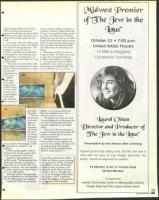
October 22 • 7:00 p.m.
United Artists Theatre
14 Mile & Haggerty
Commerce Township
turef Chiten
irector and Troducer of
7Fie Jew in the (-)kItts"
i
Presentation by the director after screening
Inspired by the best selling book, the film The Jew in
Lotus tells the story of how Rodger Kamenetz, the
skeptic, found his way back to Judaism.
$5 Member of JCC or Temple Israel
$8 Non-Member
Co sponsors:
Jewish Community Center of Metropolitan Detroit,
Temple Israel and The Detroit Jewish News.
I
10/16
1998
Detroit Jewish News 83