

`Revolution' In Rome?
Pope John Paul II marks 20 years of change
in church relations with Judaism.
Vatican document on the Shoah released
in March. It expressed repentance for
individual Catholic failings during the
Shoah but absolved the Church itself
Rome
from any responsibility and strongly
ope John Paul II marks the
defended wartime Pope Pius XII against
20th anniversary of his elec-
the decades-old criticism of his silence in
tion as pope Friday, Oct. 16.
the face of the Holocaust.
The two decades of his
Further straining Jewish-Catholic
papacy have revolutionized relations
relations was a bitter conflict in the late
between Roman Catholics and Jews.
1980s and early
With milestones such as the first
1990s over the
papal visit to a synagogue and the
establishment of a
establishment of full diplomatic rela-
Carmelite con-
tions between Israel and the Holy See,
vent in a building
John Paul has instituted an official
adjacent to the
Catholic opening to Jews, their sensi-
site of the
tivities and their causes unprecedented
Auschwitz death
in 2,000 years of church history.
camp.
"John Paul has placed those relation-
And although
ships squarely in the mainstream of
the Vatican estab-
Catholic teaching, preaching, liturgy —
lished full diplo-
indeed, in all forms of church life," said
matic relations
Rabbi A. James Rudin, director of
with Israel in late
interreligious relations for the American
1993, the status
Jewish Committee.
of Jerusalem,
The process has not been without
which the Vatican
serious ups and downs, particularly
wants to see put
regarding the Vatican's handling of
under interna-
some issues stemming from the
tional mandate,
Catholic Church's actions — or inac-
also creates prob-
tion — during the Holocaust.
lems.
"Whenever we get to the core issues
Nonetheless,
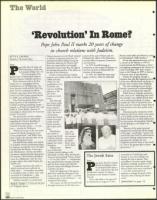
Pope John
around the Shoah, things get much
the strides in
Paul II led
more complicated," said Rabbi Abra-
improving Jewish- the canoniza-
ham Cooper, the associate dean of the
Catholic relations tion service
Simon Wiesenthal Center.
under John Paul's for Edith
The beatification earlier this month
papacy have been Stein, inset,
of Croatia's wartime Archbishop Alojzi-
in St. Paul's
enormous.
je Stepinac, accused by critics of collab-
Square.
Official sanc-
orating with the fascists, is one exam-
tion of full-scale
ple. Beatification, the last step before
Catholic-Jewish dialogue only
sainthood, appeared hardly appropriate
dates back to 1965, when the Second
for Stepinac, who has been reviled by
Vatican Council issued "Nostra Aetate"
some as a collaborator with the Nazi
— or "In Our Times" — a declaration
puppet regime that ruled Croatia dur-
that repudiated the concept of Jewish
ing the war.
guilt for Jesus' death and called for
A separate ceremony this week, in
mutual respect and dialogue between
which sainthood was conferred on
Catholics and Jews.
Edith Stein — a Carmelite nun killed
From the beginning of his papacy,
at Auschwitz who was born a Jew and
John Paul made the bettering of rela-
converted to Catholicism — also
tions with the Jewish world — and the
strained some Jewish sensibilities.
condemnation of anti-Semitism — cor-
Another example is a controversial
nerstones of his policy.
One reason was that he himself lived
Ruth E. Gruber is a writer for the Jew-
through
the horrors of the Nazi occu-
ish Telegraph Agency.
RUTH E. GRUBER
Special to The Jewish News
p
pation of his native Poland and saw
firsthand the effects of the Holocaust
and the effects of postwar Communist
anti-Semitism.
In 1979, he paid homage at •
Auschwitz to the victims of Nazism, on
his first trip back to Poland after his
election to the papacy
In 1987, he visited the main syna-
gogue in Rome, where he embraced
0
!"-
>
"
10/16
1998
116 Detroit Jewish News
Rome's chief rabbi and referred to Jews
as Christianity's "older brothers."
He has also sponsored events such as
a concert at the Vatican in 1994 to
commemorate the Holocaust, a meno-
rah-lighting ceremony at the Vatican to
mark Chanukah 1997 and a sympo-
sium at the Vatican in 1997 to discuss
Christian roots of anti-Semitism.
Despite the progress, though, it
remains clear that the implementation
of the new, official church teachings on
Jewish issues remains a key challenge.
The new teachings are not always
heeded, transmitted or acknowledged
— and are sometimes even rejected.
Polish Roman Catholic extremists
who
claim to be "defending the cross,"
U
0 for example, have defied church lead-
ers in erecting hundreds of crosses
f outside the walls of Auschwitz since
July, and have injected a heavy dose of
0
anti-Semitism into their public state-
ments.
Maintaining the momentum estab-
lished by John Paul will be a key priori-
ty in Catholic-Jewish relations as the
church heads into its third millennium,
but the process of expanding Catholic-
( "J
Jewish dialogue is not likely to be
reversed.
"Because of the pope's personal
background and because of the length
of his reign," said Rudin, "history will
record that John Paul II's achievements
are epoch-making; achievements that
permanently changed the way
Catholics and Jews relate to one anoth-
er. That is his greatest gift to future 0
generations."
The Jewish Saint
Rome
p
ope John Paul II irritated
Jewish sensibilities when
he declared Edith Stein a
saint, making her the first
Jewish-born woman to achieve
sainthood in the Roman Catholic
Church.
Stein, who died at the age of 51
in Auschwitz on August 9, 1942,
converted to Catholicism and
became a nun just as Hitler was
starting his rise to power. That
coincidence of events raised a large,
doubtless unasked, question at Sun-
day's ceremony: Does the martyr-
dom of Stein truly merit sainthood
— or is her canonization an
attempt to assuage the guilt of the
Vatican's silence during the Holo-
caust?
JEWISH SAINT
on page 1 18