

Shabbat Hol HaMoed
Sukkot: Exodus 33;
12-34:26• Numbers
29:26-34; Ezekiel
38:18-39:16
RABBI NORMAN ROMAN
Special to The Jewish News
I
BEGINNING WEEK OF
OCTOBER 24TH
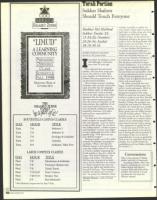
SOUTHFIELD CAMPUS CLASSES
HOUR
TITLE
7-8
Hebrew I
7-8
Hebrew II
7-8
Ecology & Judaism
8-9
Genesis
HOUR
TITLE
7-8
7-8
7-8
7:15-8:45
7:45-9:15
8-9
Mysticism & Kabbala
Parashat Hashavuah
Torah Tunes
Don't Grieve
Broken Ties
Beit Midrash*
* Beit Midrash Cosponsored by Eilu V'Eilu
remember the dialogue session
well although it took place
more than 30 years ago.
Two respected, learned Jewish
scholars, who had been study part-
ners at the yeshiva in New York,
came together in Cleveland for a
Shabbat afternoon presentation dur-
ing the festival of Sukkot.
One of them was now a leading
Orthodox rabbi and day school prin-
cipal; the other was my congrega-
tion's Reform rabbi. As old friends,
they reminisced a little as friends
tend to do; they argued a lot, l'shem
shamayim (for the sake of heaven).
The conversation moved quickly
from the stories of Chasidim to bib-
lical criticism, the credibility of cul-
rural versus political Zionism, to
how the Jewish community should
respond to American civil rights
issues and our responsibility to
Soviet Jewry.
The hour grew late and people pre-
pared to depart the temple's library.
One voice pleaded, "Can't we contin-
ue this a while longer? For me, this is
real `Sukkat shalom,' a shelter of peace
and friendship!" Another voice began
to sing a. supporting lyric from a then-
popular song, "Why don't you stay
just a little bit longer?"
Smiling broadly, one of the rabbis
restarted the dialogue by paraphras-
ing Rashi, "What is the basis for
Shemini Atzeret at the end of the
seven-day Sukkot festival? It's almost
as if God is politely requesting the
Jewish people to 'stay just a little bit
longer' after Rosh Hashanah, Yom
Kippur and Sukkot. The Eternal
One has seen so much of us lately
that it will be difficult to be without
us." Rashi interprets the verse con-
cerning the eighth day Sukkot sacri-
fices as if God says, "Your leaving is
hard for me; please stay one more
day. He quotes the Midrash, which
Norman Roman is rabbi of Temple
Kol Ami. - -
includes a parable to explain the
term atzeret, which means to stop or
hold back; it is like a king who invit-
ed guests to a-feast for a certain
number of days. At the end of the
designated period as the guests were
ready to leave, the king pleaded with
them to 'stay one more day. "It is so
difficult for me to see you leave."
On that Shabbat Hol HaMoed in
Cleveland, the second rabbi gave a •
further interpretation of this thought
which has remained with me ever
since. In the Midrash, God admits, "It
is so hard for me to see you leave."
But the phrase could also be legiti-
mately translated as, "It is so hard for
me to see you separated from each
other." Shemini Atzeret should com-
bat the divisiveness and conflict which
is all too characteristic of our commu-
nity. The last and greatest act of
Sukkot must be a gesture toward soli-
darity and mutual respect.
My rabbis continued their dia-
logue, excitedly building upon the
other's words and passion. All of us
know the talmudic story of the
prospective proselyte who wants
Hillel to teach him the entire Torah
while he stands on one foot. But did
we also remember that regel means 4 ►
holiday? Perhaps the proselyte was
asking the true reason for Shemini
Aztzeret, for Torah does not actually
give us a reason in the text. So the
kind, gentle and wise Hillel answers
with the familiar phrase, "What is
hateful to you, do not do to others."
In other words, let us remove those
aspects of our relationships which
cause hatred because God is saying,
"Your separation is painful for me.
In this new year of 5759, let us
recognize how hard it is for God to
see us leaving the divine presence at
this season of joy. Let us also be
reminded that it is just as painful for
God to see our separation from one
another. Let us work toward the
establishment of true Sukkat shalom
for all Jews. El
•
"
Conversations
What is the meaning of `Sukkat
shalom' and why is it important?
According to Rashi, what is the
basis for concluding the seven-day
Sukkot festival with Shemini
Aztzeret? What did Hillel tell the
proselyte who seemed to be ask-
ing about the true reason for
Shemini Aztzeret?