
s
t'ec e
O l o tte, .1 Kri 1/4 I M it
1t
All"nks or
iYtar{
rrankiin
t his
Oaki andl(;" 1 was th e 011 : v ". For tie
cOuld set , -0Ortl y
w ,„ gristra iii
eA
.
potashe“rywh,se, at for, c7a4:shh 't ,f;Ictornme7
re4r
i?s erected ill
838
evidence tondiay.111111' but is °1'
F e cider press
bieneVed tO have currently in use im
been moved from
inOther Mill located
further (lown-
4.
a rea Irk
.r olortel Van Eve
built a distillery
r t street f
1837 acrosst the
°n' the
h as. since disappeared,
tIthough this mill was located
it has always ,
JitSide the village,
part
of FrnKlin
a
e 1 considc....red Va Evr's home
•!;C3USC Colonel the
!Ocac ed in
A Franklin resident
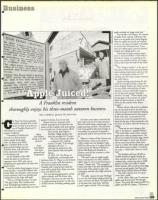
thoroughly enjoys his three-month autumn business.
BILL CARROLL Special to The Jewish News
period. It's hectic, but it's not bad.
ol. Peter Van Every probably
Palmer laces his comments with
would be shocked if he could
Yiddish expressions as he describes the
return to what is now the cor-
history of the Franklin mill, and explains
ner of Franklin Road and 14
he is actually one of nine owners, all of
Mile Road on a typical
them Jewish. But Palmer, a
autumn weekend.
Franklin Village resident, has
ye:
Abo
Thousands of vehicles jam
been the manager for 35 years.
Palmer
Jack
the area in a festive atmos-
"All of my partners are silent
stands at his fall
phere, people drink apple
— as long as we're making
favo rite.
cider, eat donuts and other
money," he said. "I do enough
c) treats. Children frolic on the
Inset:
talking for all of us" —
grass and the bridge over the
Jack Palmer
although he declined to talk
Franklin River, and old-timers
sells them
about specific sales and profit
relive memories of past visits
squeezed and
figures.
to the historic site.
unsqueezed.
In 1837, Col. Van Every, an
It's the Franklin Cider Mill,
Englishman, occasionally rode
which has been in continuous
his horse from Ft. Wayne on the Detroit
operation since 1895, and now is
River out to a grist mill that stood on
delighting new generations of cider-and-
the three-acre site of the current
donut lovers.
Franklin mill. Local farmers used the
And the whole thing happens in just
grist mill to grind their wheat, oats and
three months," mused Jack Palmer (for-
corn into flour for sale.
merly Peitz), the cherubic, white-maned
The next farming generation started
owner-operator, who is as colorful and
apple orchards, and Van Every, who
well-known as the cider mill itself.
remained in the area, saw the need for
"This is a 90-day business," he said.
an apple-pressing operation to take care
"We open Labor Day weekend and
of their harvest, including making apple
close Thanksgiving weekend, and we
sauce.
cram all of our sales and profits into that
Van Every and others converted the
grist mill, built the five-story structure
that still stands today, and brought in an
apple-pressing machine. The operation
was interrupted by fires and changes in
ownership, but survived to become a
permanent mill by the end of the centu-
rY-
Palmer, a veteran of the Detroit area
food business, came on the scene in
1963 to help turn the Franklin Cider
Mill into the success it is today. He for-
merly owned the House of Foods at
Seven Mile Road and Schaefer in
Detroit, and still has interests in other
food businesses.
"We used to get our apple supply
from local farmers, but their children
didn't want to carry on the farming tra-
dition," Palmer said. "The youngsters
today don't like to do that old-fashioned
farm work. They prefer to play with
computers and the other high-technolo-
gy stuff
"It's really a shame because Michigan
is now the third-largest apple-producing
state, and there are about 150 cider mills
in the state that need those 'old-fash-
ioned' apple orchards. The very large
apple orchards no longer exist here."
The Franklin mill obtains 20 varieties
of apples from a group of farmers who
form a co-op based near Grand Rapids.
After the apples are sorted and washed
at the co-op, they are hauled to Franklin
in trucks with 20-bushel bins. There,
they are washed again, ground, pressed,
bottled and refrigerated in vats.
Watching the apple pressing opera-
tion on the second floor of the mill is a
favorite of visitors, as is peering at the
huge water paddle machine (no longer
functional) inside the back of the build-
ing.
The "antique window" at the top of
the stairs in front of the structure shows
cider-making implements used over the
years. A continuous video on a TV
monitor near the main counter recounts
the mill's history.
Apple pressing stops during the day
when the crowds dwindle, as does the
donut baking. Palmer can watch activity
on every floor with the help of video
cameras "and our chief baker keeps an
eye on the main counter through a
monitor," he said. "When there's a big
lineup again at the counter, the baker
bakes the donuts faster, so they'll be
fresh and hot exactly when they're
bought."
Palmer, whose wife and two children
are not involved at all in the mill, can
often be found in the basement helping
to bake the famous donuts that go per-
fectly with cider. Customers love the
donuts, but must be prepared to have
them hit the pits of their stomachs with
the force of a Mark McGwire home run
wallop.
"There are no such things as diet
cider or lite donuts," quipped Palmer.
"The word cider means sweet, natural
apple juice, with no preservatives. The
donuts are made from plain eggs, butter
flour and sugar. It won't ruin anyone's
diet to come out and eat these treats
once in a while. Your body needs a good
cider donut every so often. I eat about
six a day — that's why I have so much
hair."
The Franklin mill uses 30,000 to
40,000 bushels of apples during the
three months of operation. On a busy
weekend day, visitors buy about 3,000
gallons of cider and 3,000 to 4,000
dozen donuts. Also on sale are hot dogs,
pies and carmel apples, beef bars and
cheeses from Hickory Farms of Ohio.
The mill is open 8 a.m. to 6 p.m.
seven days a week.
In the 1960s, cider cost 75 cents per
gallon and donuts were 50 cents per
dozen. The prices this season are $4.75 a
gallon and $4.50 a dozen. "Of course, I
c.)
10/9
1998
Detroit Jewish News 133
Scanned image of the page. Keyboard directions: use + to zoom in, - to zoom out, arrow keys to pan inside the viewer.
October 09, 1998 - Image 133
- Resource type:
- Text
- Publication:
- The Detroit Jewish News, 1998-10-09
Disclaimer: Computer generated plain text may have errors. Read more about this.