
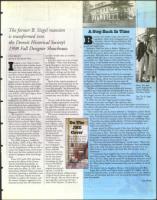

The former B. Siegel mansion
is transformed into
the Detroit Historical Society's
1998 Fall Designer Showhouse.
LISA BRODY
Special to The Jewish News
I
magine a time when it wasn't
unusual to have a butler answer
the door; when ladies, dressed to
the nines, had time to visit for
afternoon tea; when people didn't go
anywhere without being squired to the
door by their chauffeurs.
Next month, we can glimpse this
elegant past at the former home of
fashion retailers Benjamin and Sophie
Siegel, the late founders of B. Siegel
Co. Their former house will be show-
cased as the Detroit Historical Soci-
ety's (DHS) 1998 Fall Designer Show-
house from Oct. 3-25.
An opportunity to raise funds and
visibility for the DHS, the showhouse
is the society's first such project. Its
refurbishing has been undertaken in
partnership with the Michigan Chap-
ter of the American Society of Interior
Designers (ASID).
The exquisite 13,000-square-foot,
27-room Italian Revival mansion was
built in 1913 and designed by the
famed Detroit architect Albert Kahn,
whose works include the Fisher Build-
ing and many industrial structures for
the area's automobile companies. The
home sits on three acres of magnifi-
cently landscaped grounds, encom-
passing a full half-block of Detroit's
historic Boston Edison district.
The ASID designers, headed by
Roy Hankis, ASID, of Roy Allen Han-
kis Interiors in Troy, sought to recap-
ture the magnificence of the era and to
restore the original luster of the home.
Each room has been updated and dec-
orated by designers from local design
firms.
From 1957 until 1997, the house
served as the offices of the Greater
Detroit Interfaith Roundtable, to
whom Sophie Siegel had willed the
home upon her death. In 1997, local
businessman Michael Fisher purchased
the house, planning to refurbish it and
make it his home. Hankis was hired
by Fisher to update the mansion, and
the interior designer suggested to the
historical society that the refurbished
mansion would make an excellent
showhouse.
But, first, there was a lot of work
to be done. "There were florescent
lights throughout the house, because
the Roundtable used these rooms as
offices," explains Hankis. "The beau-
tiful plaster ceilings and the dark
wood floors throughout the entire
home needed a great deal of restor-
ing."
Much of the original grandeur of
the home has been recaptured. In the
kitchen, butler's pantry and dining
room, for example, "we discovered the
original light fixtures. They were
black, but after cleaning them, we dis-
covered they were all silver," says Han-
kis.
On two walls of the large dining
room, Hankis used walnut carved buf-
fet tables that belonged to the Siegels.
He added Fisher's own mahogany
Chippendale pedestal table and chairs,
which sit beneath crystal chandeliers.
The room's ornate floral woodwork
and perfectly
matched walnut
paneling also have
been restored, and a
trompe l'oeil ceiling
of a sky with
cherubs and nudes
has been newly
added, handpainted
by Alexander at
Dynamic Visions.
Other rooms
have undergone
greater changes. The
former billiards
room has been con-
verted into a library
for the new home-
owner with show
furnishings by Hud-
son's in Southfield.
However, the
original wood panel-
ing and a carved flo-
ral-patterned plaster ceiling remain.
Original French doors open to the
front veranda. Also on view is the say-
ing originally carved into the lime-
stone of the fireplace: 'A clean fire, a
B
enjamin and Sophie Siegel, who built the
magnificent Albert Kahn-designed home that
is this year's Detroit Historical Society's Fall
Designer Showhouse, didn't start out living
grand and elegant lives.
Benjamin Siegel was born in Baden, Germany, in
1860, and came to the United States in 1876, at the age
of 16. His first job, in Selma, Ala., was as a clerk in a
general store. Five years later, he struck out for Detroit.
Sophie Siegel also came to this country as a child, liv-
ing initially near Tiger Stadium. She worked hard to
earn a living, as she worked hard in later years to help
others. She served as a member of the National Council
of Jewish Women, the Founders Society, the National
Conference of Christians and Jews and the Detroit His-
torical Society.
After Ben Siegel moved up to Detroit, he managed,
and later owned, the women's ready-to-wear department
in the Heyn's Bazaar, which was located near the Majes-,
tic Building. By 1895, he opened his own store, B.
Siegel Co., which was devoted entirely to selling ladies,
Above: Ben and
misses, and children's outerwear and furs.
Sophie Siegel at the
The idea of a department store selling only women's
Grand Hotel on
apparel, rather than a full line of merchandise, was revo-
Mackinac
Island.
lutionary. Many thought the concept would fail. Instead,
Ben Siegel's success led to the creation of many other
Top: The B. Siegel
"specialty" stores around the country.
mansion
In 1904, the year Ben Siegel married Sophie Siegel
(her maiden name also was Siegel); Ben opened a store
at Woodward and State, which was then one of the busiest intersections in
the country. He personally managed the store until 1931, when his brother-
in-law, Leo Siegel, took over.
"They enjoyed life, and the house reflected it," reminisces nephew Marty
Mayer, who grew up across the street from Sophie and Ben. "On the ground
floor, they had a pool and card room where my Aunt Sophie taught
me how to shoot dice and play poker. She was not a shrinking violet,
"Uncle Ben was always nattily dressed. He had a barbershop room,
with a barber chair. And he always ate a monstrous breakfast, no
lunch and a late dinner."
As was typical for affluent people of that time, the Siegels, who were
members of Temple Beth El, had a maid, cook and chauffeur; Sophie
never learned to drive. "She had a Lincoln Touring Car, ancrevery time
President Roosevelt came to town, the Secret Service would borrow it for
the parades," remembers her nephew. "Aunt Sophie loved it because they
would'put new tires on the car and fix it up.
"The house was beautiful and elegant," recalls Mayer. "There was
beautiful wood paneling, and instead of wallpaper, there was damask
silk on the walls. The house was very well taken care of, but it was
really lived in. Aunt Sophie and Uncle Ben did not treat it like a
showhouse.
"I remember Aunt Sophie's New Year's Eve parties in the dining
and living rooms," says Mayer. "Most of it was just the family. There
were a lot of us then, and we would fill the house up. Everyone would
get all dressed up. The house was immaculate, and it would just glit-
ter. When [Aunt Sophie] entertained, there was no halfway. It was all
first-class."
The Siegels had one daughter, Eleanor, who is now deceased. Ben
Siegel died in 1936, and Sophie lived on until 1955. Inlet will, she
donated her beloved house, as well as money to maintain it, to the National
Conference of Christians and Jews, now known as the Greater Detroit Inter-
faith Roundtable. [11
— Lisa Brody