

Global Digest
-76
•
•
DC Rally For
Oslo Accords
Washington (JTA) Five years
after the signing of the Oslo
peace accords, Jewish activists
gathered here this week to try
to reignite the hope generated
by the euphoria that sur-
rounded the White House cer-
emony.
More than 400 people
marked the Sept. 13 anniver-
sary at a rally at Washington's
Adas Israel synagogue — join-
ing with Prime Minister
Yitzhak Rabin's widow, Leah,
the Clinton administration's
top Middle East diplomat,
Martin Indyk, and an array of
Jewish leaders — by rededicat-
ing themselves to the cause of
peace.
A coalition of more than 25
organizations convened the
event.
The groups, including the
Reform, Conservative and
Reconstructionist movements,
as well as Americans for Peace
Now, the National Council of
Jewish Women and the New
Israel Fund, said they repre-
sent the vast majority of the
organized American Jewish
community.
Slave Labor
Issue Discussed
Berlin (JTA) — The opposi-
tion candidate in Germany's
race for chancellor said he
believed German companies
that used slave workers under
the Nazis had a moral obliga-
tion to compensate them.
Gerhard Schroeder said the
firms should follow the exam-
ple of Volkswagen, which is
creating a fund to compensate
former slave laborers.
Holocaust survivors filed
two class-actions lawsuits last
week in the United States
against several German firms
accused of profiting from such
labor.
9/18
1998
68 Detroit Jewish News
OIRretNeeMakk: ,
Pragmatic Bear
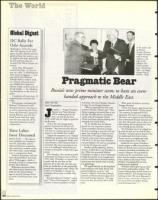
In his earlier role
as Russian
Foreign Ministe';
Yevgeni Primakov
tried to build
influence with
trips to the
Mideast. His
Israeli counter-
part, David Levy,
right, was happy
to greet him in
October, 1996
Russia's new prime minister seems to have an even-
handed approach to the Middle East.
ERIC SILVER
Israel Correspondent
erusalem — Yevgeni Primakov,
Russia's new Prime Minister,
will be neither good for the
Jews, nor bad for the Jews.
With a little luck, he might be good for
the Russians.
That is the view among Israeli
experts who know the 68-year-old
Primakov. They discount fears that he
will revert to a Soviet-style pro-Arab
posture in the Middle East conflict.
Despite his reputation as an "Arabist"
Middle East specialist, they testified this
week that he is a pragmatic leader, who
is pro-Russian, rather than pro-Arab or
anti-Israel. His main international con-
cern is to challenge United States pre-
tensions to being the world's only super
power.
Aliza Shenhar, who served as Israel's
ambassador in Moscow from 1994 to
1997, said: "Primakov is a person who
stands with his two feet on the
ground. He is the only one who was
close to Gorbachev in the perestroika
period who survived under Yeltsin. He
is able to be flexible, to change his
attitudes and to come to terms with
reality."
But what about his "Arabist" reputa-
tion? "That is Israeli paranoia," replied
Shenhar, a former president of Haifa
University who met Primakov frequent-
ly when he was Foreign Minister.
"What is important for him is the
interest of Russia," Shenar said. "That
Russia is going to be second best is not
his idea. He talks about a multipolar
world, with the European Union,
China and Russia playing leading roles
alongside the United States.
"In the Middle East, he believes
Russia has very important interests.
These contradict American interests.
But he's not going to start the cold war
again, he's not going to adopt an anti-
Israel policy. His support for Saddam
Hussein in his most recent stand-off
with the U.S. did not mean Primakov
was pro-Saddam. He was just not going
to let the US shape the world."
Another scholar-diplomat, Shlomo
Avineri, recalled that it was Primakov in
the 1980s who persuaded Mikhail
Gorbachev to adopt a more evenhanded
Middle East policy. Even though Israel
and the Soviets had no formal relations,
Avineri met him several times at acade-
mic gatherings.
"He argued that by not having diplo-
matic relations with Israel, Russia had
painted itself into a corner," said
Avineri, a Hebrew University political
scientist and former director-general of
the Israeli Foreign Ministry. "His argu-
ment was that you had to talk to both
sides."
What about Primakov's record as
Foreign Minister?
"There was always a gap between his
rhetoric and his deeds," Avineri noted.
"For instance, he opposed NATO
expansion. He took a very tough line.
He said it was a return to the Cold War,
that it threatened Russia's essential inter-
ests. But when push came to shove, he
did nothing. He recognized that there
was nothing Russia could do.
"So, Primakov has to be judged not
by what he says, but by what he does.
Primakov uses great-power rhetoric, but
he understands the limits of what
Russia can do as a fragile and weak
country dependent on the West."
Israelis do not expect Primakov's
Jewish origins to affect his attitude to
either the Jewish state or his own Jewish
minority. According to Shenhar, the
word in Moscow was that both his
mother and his natural father were
Jews, but his mother remarried when he
was a child and the future Prime
Minister was adopted by her non-
Jewish second husband.
"Primakov didn't grow up as a Jew,"
the former ambassador insisted. "He
knows nothing about Jewish history or
Jewish tradition. This background says
nothing to him. We never discussed it
when we met, and as far as I know he
has never shown any fellow-feeling
towards Russian Jews." ❑