

verge on the abstract. She also
has painted on black to give
contrast to the colors.
Painting has been a very
commercial venture for Rosen,
who also uses it as a means of
expressing very deep feelings.
Working under her Jodash label,
she hand-painted clothing,
mostly scenes on sweatshirts. In
contrast, she has used angel
images to communicate a sense
of spiritual peace.
"Painting sweatshirts was a
big fashion trend in the early
'80s," says Rosen, who still gets
an occasional call for personal-
ized wearables, although the
trend has faded.
Educated as an early elemen-
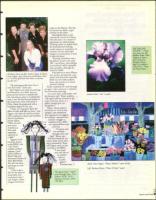
Clockwise from top left, Andrea Tama, Jo Rosen, tary teacher, she directed a pre-
Patti Tapper, Joan Schwartz and Barbara Mess- school and found she especially
er: "A circle of friends who share a common
liked arts and crafts projects.
love for art."
Soon, she moved on to hand-
painted clothing.
"My paintings really show how I
Rosen
marketed her work through
view the world," Tama says.
an
agent,
who continues to represent
Patti Tapper uses color in paintings
her
watercolor
paintings.
and furniture. As a child, she was
"I've
never
been
comfortable with
given private lessons in pastels and
the
business
end,"
Rosen
explains.
oils, learning to paint in a traditional
"My
agent
sold
my
artwork
to gal-
style. Later, she had formal studies at
leries,
and
once
you're
in
a
Bowling Green State University in
gallery, people give you
Ohio, where she graduated with a
recognition."
bachelor's degree in fine arts.
Rosen, whose projects
"I draw my inspiration from the
have
been on view at area
effect of color and light on form," says
temples,
uses symbolism.
Tapper, who kept up with her artistry
The
appearance
of jugglers,
while working as a buyer and merchan-
for
example,
represents
her
diser for Jacobson's
constant
struggle
to
jewelry salons.
schedule all her differ-
"Often my sub-
ent responsibilities and
jests are as
activities.
mundane as
" I express pose-
fruits and
tive attitudes
vegetables
through color and
scattered on
light," Rosen says.
a table."
The five friends do not
Ta pper 's work
restrict
their artistic shar-
shown
has b
ing to themselves. Tama
at the BBAC, the
and Tapper reach out by
"Our Town"
teaching at the BBAC.
exhibits in Birm-
"A year from
ingham, Carol
now wed like to
James Gallery in
do another
Royal Oak and
Sherwood Studios in show at
another
West Bloomfield.
She also has done gallery,"
Schwartz says.
paintings on com-
mission.
"I like to get a
The group show "Color"
feel for the person's
runs through Sept. 29 at
personality and
Gallery, XVIII, 18 N.
work from there,"
Saginaw, Pontiac. (248)
says Tapper, whose
745-8875.
images sometimes
❑
ON THE JNE
COVER — Clock-
wise from top left:
Andrea Tama, Patti
Tapper, Jo Rosen,
Joan Schwartz,
Barbara Messer
and her sculpture,
"Bea-Hive. " Photo
by Krista Husa
Andrea Tama: "Iris," acrylics.
Above: Patti Tapper: "Flower Market," saran d'ache.
Left: Barbara Messer: "Heart 6 Soul," wood.
9/1
19
Detroit Jewish News
9