

out a character in a film," Schreier
says.
The author's interest in fashion
dates back to her Detroit childhood,
when she visited her father, Edward
Miller, at work as a furrier in a pricey
department store.
Soon, she was reading fashion mag-
azines, hunting for additional infor-
mation and beginning a quest for
designer clothes.
Being asked to regularly discuss
Hollywood costumes on a local TV
show served as the incentive to do
firsthand information gathering in
California.
"I realized I didn't know enough
about the movers, shakers and cast of
characters, and that really started my
detective work to find out all that I
could," Schreier recalls.
"I learned that; clothing was more
critical to early films, which allot-
ted a higher percentage of bud-
gets for costumes, and I found
out about all the Jewish designers
whose ideas made a strong impact
— from Adrian Greenberg,
known only by his first name in
the '30s, to Deena Appel, who
sits in the front row at all my
L.A. speaking engagements."
The late Edith Head, one of
the best-known Hollywood
designers, met with Schreier
more than 20 times. The late
Jean Louis introduced her to
acclaimed performers.
`lean Louis gave me Lana
Turner's number, and I called
her up," Schreier says. "She
invited me over for lunch and
into her closet to see the dresses she
kept from Imitation of Life."
Designer Albert Wolsky, who won
Oscars for All That Jazz and Bugsy, has
met with Schreier over many years.
"Sandy approached me with a lot of
questions, and I was very flattered,"
Wolsky says. "She's created her own
niche.
"Both of us were on the AMC pro-
gram 'The Hollywood Fashion
Machine.' A lot of people collect, but
I'm sure she's devoted a lot more time
and energy."
While advancing her long-distance
career, Schreier also stayed close to
family, which includes her husband,
attorney Sherwin Schreier, and their
four, now-grown children.
Last year, the author spent a week
at the home of one of her film idols,
actress Loretta Young. When Schreier
asked Young to write an introduction
to her book, the actress wanted to get
to know her first.
"I know that movie stars
are beloved, and I'm going
to make them more beloved
by telling some of their sto-
ries," Schreier says.
As the book release date
gets closer, the author is
arranging a book signing
tour, which includes many
Jewish book fairs around the
country, including the
Detroit fair in November.
She is national spokesper-
son for the American Film
Institute/Blockbuster
Entertainment "Legends"
Tour, which brings a muse-
um-on-wheels display of
Hollywood memorabilia
into numerous cities.
Detroit's visit is set for
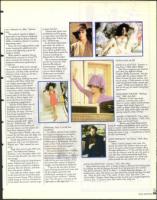
Clockwise from top left:
ANGELICA HUSTON:• "Enemies, A
Love Story," 1989, Albert Wolsky.
"Ron Silver's character gets involved
with three very different women.
Designer Wolsky commented, 'Very few
projects offer the costume designer the
chance to create for three women, each
one an entity: a Polish peasant, an edu-
cated concentration camp survivor and
a sexpot.' Wolsky based Angelica's '40s
look on the way his mother dressed dur-
ing the war:"
SIGOURIVEY WEAVER: "Working
Girl," 1988, Ann Roth.
"Romance in this scene means
underwear, courtesan style, with a
return to corsets, teddies and femininity.
Designer Roth bought Sigourney's
undies in Monte Carlo after waiting in
line with 'ladies of the night' who were
getting ready for a busy evening."
Wednesday, Sept. 9, at the Star
Southfield.
An exhibit calendar keeps Schreier
on target as she prepares to display
Oriental fashion-:influences at the
Fashion Instituro: of Technology and
_ 1960s styles at tile Katonah Museum,
both in New York, and American
ready-to-wear at the Los ; Angeles
County Museum of Art.
For somebodY'ep sthralled with film,
the most excitingipSject is just
around the comr -,-,1S.dreier is ab*.t. to
-;have,,smlie coituaes'aesigiled Specifi-
cally for her as a cast member of the
live-action film version of Inspector
Gadget, starring Matthew Broderick.
"I have to say that after all these
years of being around movie stars and
all the people connected with
Hollywood, nothing ever came just
because I knew someone," Schreier
says. "For this part, I was just in the
right -place .at
BARBRA STREISAND: "On a Clear
Day You Can See Forever" 1970, Cecil
Beaton and Arnold Scaasi.
"Beaton and Scaasi designed bril-
liantly for modern and flashback scenes with cos-
tumes to match," writes Schreier. "iils with most
Hollywood films, however, period or contemporary,
dating this movie is easy — the giveaway is always
the hair and makeup."
JOHN TRAVOLTA: "Get Shorty," 1995, Betsy
Heimann.
"Elmore Dutch' Leonard, who wrote 'Get
Shorty' described Chili Palmer's dark suit and
shirt in the novel, which costume designer Betsy
Heimann followed to a 'T' She said that if audi-
enceslike the character and the star, they want to
wear that look. Dutch particularly loved Bette
Midler's uncredited appearance in a black-and-
yellow,bumble bee suit, which stole the show."
ALICIA SILVERSTONE: "Clueless,," 1995, Mona May.
`Alicia Silverstone plays Cher, a trendy teenager so obsessed with clothing that
in a holdup she tells the bad guy she won't lie on the ground in her red dress.
`You don't understand. This is an Alaia — a totally important desig -ner ) In
another scene, when Cher leaves on a date dressed in a trendy slip dress, her dad
asks, 'What the hell is that?' Cher replies, !A dress,' Dad: 'Says who?' Cher:
`Calvin Klein.' Designer Mona May said that the dress was actually designed by
Vivienne Tam. 7 wanted to show how clueless Cher really was.' "
9/4
1998
Detroit Jewish News
79