

At The Movies
Filmmaker Tamara Jenkins
spins a corning-of-age tale
in "Slums of Beverly Hills."
SERENA DONADONI
Special to The Jewish News
T
he Abramowitzes are the
Jewish Joads. Well, sort of.
John Steinbeck's
Depression-era clan fled the
harsh conditions of the Dust Bowl,
while Murray Abramowitz (Alan
Arkin) heads to California with his
three kids looking for the fabled good
life, hoping to put a continent
between himself and a depression
caused by divorce and perpetual disap-
pointment.
Always just scrapping by financially,
Murray has decided that Ben (David
Krumholtz), Vivian (Natasha Lyonne)
and Rickey (Eli Marienthal) will have
the best education possible, so he
enrolls them in the Beverly Hills
school district.
Just one step ahead of creditors,
Murray keeps his family on the
move, going from one cheap resi-
dential motel to another, carefully
maintaining residency within the
boundaries of this affluent enclave
that represents everything the family
doesn't have.
It's summer 1976. Fifteen-year-old
Vivian has developed breasts (Lyonne
donned prosthetics for the part) —
which distract and amaze the males
around her — and is beginning to re-
evaluate her place in the world.
Writer/director Tamara Jenkins, mak-
ing her feature film debut, takes the
raw confusion of Vivian's life and
spins a lovely tale — full of raucous
humor and refreshing forthrightness
— about growing not just older, but
wiser.
A graduate of New York
University's film school, the 35-year-
old Jenkins was a solo performance
artist before she made several
acclaimed shorts (Family Remains,
Serena Donadoni is a Detroit-based
freelance writer.
8/28
1998
94
Fugitive Love) and received the
Guggenheim Fellowship for filmmak-
ing. She describes Slums of Beverly
Hills, which was developed at the
Sundance Institute's screenwriting
and filmmakers lab, as semi-autobio-
graphical.
Born in Philadelphia to an Italian
mother and Jewish father, Jenkins
moved with her divorced father to
California when she was 5. Her late
father once owned a Philadelphia strip
joint, where her mother was the hat-
check girl.
"Growing up on the outskirts of
Beverly Hills in a kind of economical-
ly challenged way," she said by phone
from New York, "all that, all the socio-
economics — and living with my dad
— are true."
But the story of Slums of Beverly
Hills (Rated R) also allowed her to
explore the specificities of growing up
'All Of It'
Local filmmakers score
smash.
JILL DAVIDSON SKLAR
Special to The Jewish News
A
fter the final credits rolled
at the end of the 8 p.m.
private screening and
world premiere of All of It
last Thursday, hundreds of investors,
friends and family members of
writer/director/executive producer
Jody Podolsky and producer Darren
Gold milled about the lobby of the
Landmark Maple Theatre chatting.
The consensus? The film — and its
filmmakers — are destined for great-
ness.
"I didn't expect to cry. Really, I
Jill Sklar wrote about the filming of
All of It in our Nov. 14, 1997, issue.
female. Girls physically change into
women in a very visible way, Jenkins
explained, and "I don't think anyone
treats that public nature of it.
"In the case of Vivian," she con-
tinued, her breasts "are big, not freak-
ishly big, but big enough that people
see them and comment on them,
especially in a motherless household
where there's no one to help her with
the transition." (That is until her
wild cousin Rita, played by Marisa
Tomei, surfaces to become an unlike-
ly female role
model.)
"The best
metaphor,"
Jenkins conclud-
ed, "is that she
has this new
equipment and
she doesn't have
an operating
manual and she's
just trying to fig-
ure it out by her-
self. Like how to
present herself,
how to be, which
I think is kind of
the essence of
adolescence espe-
cially for girls."
The other fac-
tor in Vivian's
maturity is com-
ing to terms
with her father
didn't," one woman told a friend.
"But it was so wonderful. I just did-
n't expect it to be this good."
The film will be screened next at
the Montreal International Film
Festival with showings on Aug. 29,
Sept. 1 and 5. It is among 200 films
from 50 countries to be shown at the
highly regarded festival.
"The [Montreal] festival has a
really fine reputation for showing the
best of world cinema," Podolsky said.
Being accepted to the festival was a
thrill for both Podolsky and Gold
because it signifies acceptance by the
film community
"No one there changed my dia-
per," Podolsky said. "No one there
goes to Knollwood."
All of It tells the story of Glenda
Holbeck and her daughter Amy, who
love each other but do not under-
stand one another's life path.
Glenda is a woman who collects
fabulous dessert plates, lunches with
gossipy pals, plays tennis and dotes
and the family's living conditions.
Constantly on the verge of being des-
titute, Murray relies heavily on his
brother (Uncle Mickey, who is played
by Carl Reiner) for financial support
even as he tries to maintain a facade
of strength for his kids.
Vivian learns a difficult lesson by
closely observing her father, said
Jenkins, "trying to understand dignity
and self-sufficiency in a way. The fam-
ily is so brutalized by dependency.
That kind of humiliation, the erosive
nature of that, I
think she discov-
ers that herself."
It wasn't just
the casting of 64-
year-old Alan
Arkin, who gives
a brilliant, emo-
tionally naked
performance, that
determined the
age of Murray
Abramowitz
(whose children
are constantly
being asked, "Is
that your grand-
father?").
"Part of it has
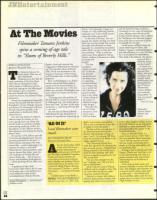
Filmmaker
Tamara Jenkins:
Memoir and
fiction.
on her other, daughter, Jillian, a clone
of herself. Glenda can set a beautiful -
table but is a mess emotionally from =A
denying herself a life outside of the
home/social scene.
Amy, on the other hand, is a
career woman living in New York
who is so petrified about becoming
stuck" like her mother and sister
that she avoids committing more
deeply to a loving relationship with
her boyfriend, Ben.
During a visit to Detroit over Yom
Kippur, Glenda and Amy have a cri-
sis of understanding that leads to a
greater awareness not only of their
relationship but of themselves as
individuals.
In her roles as both writer and
director, Podolsky is no less than bril-
liant. The dialogue and characters are
so real it's hard to believe they don't
actually exist — that Glenda and
Amy and Jillian really aren't the very
people who sit in front of you during
High Holiday services.
"