
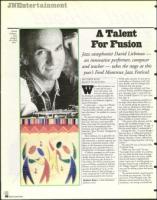

David
Liebman:
`jazz
changed
the whole
deal"
A Talent
For Fusion
j azz saxophonist David Liebman
an innovative performer, composer
and teacher — takes the stage at this
year's Ford Montreux Jazz Festival.
MATTHEW REISS
Special To The Jewish News
liAr
l hen Dave Liebman was
3 years old he had a
bout with polio, and
over the ensuing years
he developed a profound respect for
the doctors who came to treat him at
his home in the Flatbush neighbor-
hood of Brooklyn.
In those days — the end of World
War II and the early '50s — polio
"was like AIDS, nobody would come
near the house," he recalled in a recent
interview.
He started reading books about
being a doctor and "would have gone
that way" had not a more powerful
force intervened. He started listening
to the music of saxophonist John
Coltrane, and it gave his life a new
direction. "Jazz," he said, "changed the
whole deal."
Now Liebman, 52, is generally rec-
ognized as one of America's foremost
jazz innovators, a premier soprano sax-
ophonist, a passionate teacher, a key
figure in the formation of countless
jazz groups and a powerful force in
bringing jazz to European audiences.
A creative composer as well as per-
former, he will put both talents on
display Sunday afternoon, Sept. 6, at
the Ford Montreux Jazz Festival in
Hart Plaza. He will be joined by jazz
great and fellow saxophonist Michael
Brecker and the University of Michi-
gan Jazz Ensemble at 4 p.m. in the
American debut of Rites of Passage, a .
work composed by U-M's Ed Sarath
and commissioned by the German
Matthew Reiss is a New York-based
freelance writer.
8/28
1998
86 Detroit Jewish News
WDR radio network. It received its
world debut in Germany with Lieb-
man, Brecker and the Cologne Jazz
Orchestra this past spring.
Liebman also will play with Dan
Lewis & Friends and Rick Margitza 8
p.m. Saturday, Sept. 5, and with the
Scott Cutshall Quartet 5:15 p.m. Sun-
day, Sept. 6.
Liebman was playing saxophone in
his "high school dance band when, at
15, he started taking the subway to
jazz clubs on Manhattan's West Side to
see Dizzie Gillespie, Jerry Mulligan
and Count Basie. But it was the
intriguing complexities and power of
Coltrane that helped him turn music
from a hobby to a career choice.
"The power of his playing, and the
group, the incredible energy, it was
almost like spiritual fervor," he said. "I
felt the music before I understood it."
During the '60s, "it was as though I
had two lives. A college kid, going to
New York University, affected by the
Beatles, Hendrix, Cream. Affected by
the Vietnam thing, long hair and drug
culture."
His other life was in the jazz clubs.
The black thing.
"Black was very cool," he says.
"Seemingly from another era, coming
out of a really beatnik kind of thing,
very different from the white middle-
class Jewish-Italian neighborhood
where I grew up. It was like going to a
foreign country to go to Birdland, to
the Village Vanguard. Taking the sub-
way was like taking a plane and going
to Africa."
The period marked a turning point
for Jewish jazz musicians. The early
purveyors of the Phrygain scale, like
klezmer-rooted clarinet hero Benny
Goodman, were being overshadowed