

More Inside:
HEALTH, TRAVEL, SPORTS, FOOD
Travel: Trips, Tips, Tours
For Jewish Travelers
L J
r
-1-f fflEv gg 1,
Food: Shabbat Summer Soups
Are Cold And Fruity
C-
gUL_3
This Week's focus:
Health
Stroke Buster
MEGAN SWOYER
Special to The Jewish News
A
fter two years of studying how stroke
victims are helpt4 at Henry Ford Hos-
pital in Detroit, an Israeli physician has
a new mission — to convince his coun-
try to start using the therapy. _
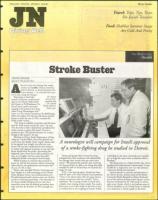
Dr. Steven
Returning to Israel this
Levine,
fore-
month to become a staff neurol-
ground,
and
ogist at the Chaim Sheba Med-
Dr. David
ical Center in Tel Hashomer, Dr.
Tanne review a
David Tanne said he has been
brain scan.
amazed at the potency of a drug
called Tissue Plasminogen Acti-
vator, or t-PA, used to counteract the debilitating
effects of strokes. The 36-year-old doctor said he
hopes to make the use of t-PA a standard for
Israeli stroke victims.
"The drug is available everywhere and has been
used for heart attack victims for years," he said,
"but the twist is that it hasn't been considered for
stroke victims in places like Israel. No one is
pressed to give t-PA priority because it's a major
change in the system," he says.
Working in Henry Ford's Department of Neu-
rology as a stroke fellow, Tanne has learned vol-
umes about the deadly "brain attack" disease and
he has gained new insight into effective treat-
ments. He has also conducted his own research
on ethnic and regional variations in rate and risk
factor distribution for stroke, discovering that
Sephardic Jews, from North Africa and parts of
Asia, are at higher risk for stroke than their
Ashkenazi Jewish counterparts from Europe.
While he plans to continue that research in
Israel, he said his first priority will be convincing
other doctors, the government and insurers that
the use of t-PA is vital.
Tanne, who attended Tel Aviv University and
then worked as a staff neurologist at the Chaim
Sheba Medical Center, has watched dozens of t-
PA-administered stroke victims come out of their
attacks in relatively good shape. The downside of
the drug includes bleeding, but he and other
researchers note that all medical procedures have
risks and that the benefits of t-PA outweigh the
risks.
A neurologist will campaign for Israeli approval
of a stroke-fighting drug he studied in Detroit.
Tanne said people who received the drug
emerged from their incidents with substantially
less damage than victims who got other treat-
ments. "We assessed the patients after receiving
the drug and they are able to do things that they
wouldn't be able to do had they not received the
drug," he said.
TPA, a clot-busting agent, already has been
used for quite a few years in heart attack patients.
"Then it was shown that t-PA can open clots in
arteries in someone that has a stroke," Tanne
explained. "But treating a stroke is much more
complex than treating a heart attack. You need a
brain scan to see if the stroke in the brain is due
to a blood clot or the erupting of vessels. If there
is bleeding in the brain, obviously you wouldn't
give a drug that opens clots to someone that is
bleeding."
The drug comes as a white powder that can be
liquefied and administered intravenously. It costs
$2,000 for a single dose, but it is only adminis-
tered once during the treatment.
Tanne's partner in research and education is
Dr. Steven Levine, division head of the Stroke
Center for Stroke Research at Henry Ford and
one of the nation's leading stroke experts. Levine
has been immersed in the t-PA study for about
eight years. Stroke, which is the leading cause of
chronic disability in the United States, is defined
as an alteration in blood supply to the brain.