

A Friend For Life
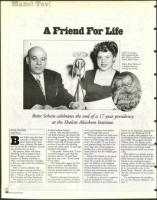
Left:As a teenager,
Bette helped out her
dad, Harry, with the
Jewish Radio Hour.
Below: Bette Schein at
a Sholom Aleichem
meeting last spring.
Bette Schein celebrates the end of a 17-year presidency
at the Sholem Aleichem Institute.
JULIE WIENER
Staff Triter
B
ette Schein says she's been
a member of Sholem Ale-
ichem Institute for more
than a lifetime. She jokes
that she joined the Yiddishist cultural
group before she was born.
-
Her parents, Harry and Jenny
Weinberg, both immigrants from
Eastern Europe, were among the
founders of Sholem Aleichem in
1925, and Schein became a member
in her own right when she enrolled in
school there.
After 17 years as Sholem Ale-
ichem's longest-running president —
not to mention its first woman in the
role — Schein will pass the torch to
Alva Dworkin and May Moskowitz.
On Sunday, she will be honored
for her efforts at a celebratory tea at
8/21
1998
66 Detroit Jewish News
the Birmingham Temple.
Schein, who describes herself as
"the kind of person who doesn't like
just sitting around," has had a busy
tenure, often logging 20-hour weeks
before events like the group's annual
art show. Even after she was diag-
nosed with colon cancer 12 years ago,
she didn't slow down..
"I was lucky," Schein said. "I had a
wonderful surgeon, and when the
operation was over, he said 'Your
operation was a cure.' Knock wood,
he was right."
"Two weeks after surgery she was
back on the job," said Rose Roth,
Sholem Aleichem's vice president,
who also praised Schein for her dedi-
cation and constant input of new
ideas.
Schein has pleasant memories of
her school days at Sholem Aleichem,
which she attended two aftern6ons a
week, plus Sundays, from kinder-
garten through high school.
"When we entered our early teens,
we used to go down to the cinema
theater and see foreign films after
class," she recalled. "It was always a
very pleasant thing. You had to be
there right after school and go on
Sunday, but it was something you
loved, and my love for Yiddish-grew
from that."
Many of her friends in the group
are people she met in school as a
child. As an adult, she enrolled her
own two children in the Institute.
The school closed in the 1970s, but
Sholem Aleichem has continued as a
cultural and social group, sponsoring
holiday celebrations, retreats and
musical and literary events.
In addition to gaining an apprecia-
tion for Yiddishkeit through her
Sholem Aleichem classes, Schein also
had an on-air education, helping her
parents run the Weinberg Jewish
Hour, a weekly radio program that
was broadcast from 1932 through the
mid-1950s. The program featured
Yiddish music, live theater perfor-
mances from visiting Yiddish troupes,
Jewish recipes, news from Jewish
organizations and world news broad-
casts.
After almost two decades of plan-
ning her life around the Sholem Ale-
ichem Institute's calendar of events,
Schein is now looking forward to
relaxing a little. At the top of her and
husband Herb's post-retirement agen-
da is a two-month cruise in the
South Pacific. However, she stressed
that she will continue to be an active
member.
"I'm retiring from the presidency
but not from Sholem Aleichem," she
said. El