

Timetable Uncertain
An historic agreement with Swiss banks
still leaves many questions.
MITCHELL DANOW
Special to The Jewish News
E
stelle Sapir had mixed emo-
tions. "My heart is very
happy," the 73-year-old
Holocaust survivor said in a
slight voice outside the Brooklyn fed-
eral courthouse where Switzerland's
leading commercial banks had just
agreed to a $1.25 billion settlement of
Holocaust-era claims.
But at the same time, Sapir, who
fled a Nazi death camp as a teen-ager,
was concerned about the advanced age
of survivors who have waited decades
for the return of assets they claimed
were rightfully theirs.
"I think this should have happened
long ago. There are many old people
who need help. I am among the
youngest, so you know how old the
others must be."
In May, Sapir reached a settlement
with Credit Suisse, one of the banks
involved in the Aug. 12 landmark
agreement.
But there remain tens of thousands
of survivors who seek payment from
the banks in a more than $20 billion
class-action lawsuit.
. The settlement announced Aug. 12
outside the courthouse came after a
series of negotiations in recent weeks
involving representatives of
Switzerland's two leading commercial
banks — United Bank of Switzerland
and Credit Suisse — as well as World
Jewish Congress officials and the
plaintiffs' lawyers.
According to a source familiar with
the discussions, the talks reached a
turning point Aug. 10, when Judge
Edward Korman — the federal judge
who was considering whether to hear
the lawsuit — invited the participants
for dinner at a steakhouse.
The evidence against the banks pre-
sented during that dinner was "not
just a smoking gun. It was a smoking
machine gun," the source said.
When he saw the evidence, the
Mitchell Danow writes for the Jewish
Telegraphic Agency.
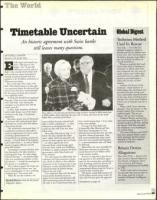
Riva Sefere, a 75-year-old concentration camp survivor, received a $400 check from
a $200 million Swiss bank And last year. She is shown with Swiss Jewish leader
Rolph Bloch, president of the fund.
source added, Korman ordered both
sides to reach a settlement — a clear
indication to the banks that they
would not fare well if the suit went
before him.
More talks followed on Aug. 11-12
before the sides reached the settle-
ment, under which the plaintiffs will
release all claims against the two banks
— as well as against the Swiss
National Bank, which bought gold
from the Nazis worth tens of billions
of dollars in today's currency, the•Swiss
government, other Swiss banks and
Swiss industry.
The only group not affected by the
settlement are Swiss insurance compa-
nies, which are likely to face addition-
al pressure in the coming weeks to pay
Holocaust victims and their heirs the
unpaid proceeds of policies dating
back to the war years.
The settlement also ends the threat
of potentially harmful sanctions
against Swiss banks that financial offi-
cials representing some 20 states and
30 cities in the United States had said
they would impose Sept. 1 if no settle-
ment were reached.
On, Aug. 13, New York City
Comptroller Alan Hevesi and New
York State Comptroller H. Carl
McCall announced that they were lift-
ing their threats of sanctions. They
also recommended that other states
and cities not proceed with boycotts
— a recommendation that will likely
be followed.
Meanwhile, the exact timetable for
Holocaust survivors to receive pay-
ments from the $1.25 billion settle-
ment remains unclear.
Korman is expected to give his ini-
tial approval to the settlement agree-
ment in the coming days, according to
Elan Steinberg, executive director of
the WJC, which has spearheaded
international efforts to get the Swiss to
confront their wartime past.
The banks' initial disbursement of
.$250 million should come within 30
days after Korman gives his approval
UNCERTAIN on page 42
A=.464...... 5r40;41 ,1W.3 W 0441,11Mil.W.,-4t 4 , 4 ,14**
Global Digest
Technion Method
Used In Rescue
New York — Once the U.S.
embassy bombing victims in
Nairobi and Dar es Salaam were
found alive, they still faced possi-
ble kidney damage, heart failure
and loss of limb, all effects of
"Crush Syndrome."
Wherever possible, the Israeli
rescue team used an emergency
technique in which saline solu-
tion is injected into the veins of
crush victims, even before they
are freed from the rubble. This
treatment protocol helps to
reduce the severity of their
injuries.
Professor Ori Better of the
Technion - Israel Institute of
Technology, who developed and
pioneered this life-saving treat-
ment, personally trained members
of the team from the Rescue and
Salvage Unit of the Israel Defense
Forces sent to Nairobi and Dar es
Salaam.
When a Red Cross volunteer
shouted, "You are heroes," to the
Israelis, Major Ofer Porneranz
replied simply, "We are not
heroes. We are only working."
Professor Better's method was
also used successfully after SCUD
missiles landed in Tel Aviv, during
the Persian Gulf War, and after
the Oklahoma City bombing in
the United States.
The Swiss Military and NAOT
also have adopted Better's treat-
ment protocol, which has been
featured in The New England
Journal of Medicine.
Britain Denies
Allegations
New York (JTA) — Britain's for-
eign secretary denied allegations
that British intelligence opera-
tives plotted to kill Libyan
strongman Moammar el-Qaddafi
in 1996.
Robin Cook said an investiga
tion proved there was no basis to
the charge made by a former
member of. Britain's intelligence
services.
8/21
1998
Detroit Jewish News
39