

JULIE EDGAR
News Editor
s a member of the Dutch
Underground during World
War II, Jenny Vander Kamp
hid Jewish schoolchildren in
her family's home, including an 11-
year-old girl named Lisha.
A decade later, Vander Kamp and
her husband packed up their children
and their belongings — including an
antique menorah that had belonged to
Vander Kamp's parents and a thumb-
nail photo of the dark-haired girl in _
pigtails — and headed for America.
The boat ride took 11 days.
Vander Kamp's only daughter,
Margot Parr, doesn't remember much
of the trip because she was 3 -at the
time. But she remembers the menorah
in the living room of her childhood
home in Kalamazoo, its burners still
moist with oil.
Years later — after stints as an
Army medic during the Vietnam War,
a police officer, cosmetologist and
medical assistant — Parr ,wis hired as
a nursing home administrator at the
now-defunct Borman
Hall. Entering the Jewish
world with the vaguest of
understanding, she was,
she recalled, "awed by
the richness of the reli-
gion."
In her four years as
executive director of
Jewish Home and Aging
Services (formerly the
Jewish Home for Aged),
Parr has initiated and
developed a host of pio-
neering programs to
serve the Jewish elderly
and the people who care
for them. After she
managed the closure of
the Jewish community's
last Federation-owned
nursing home, Prentis
Manor, Parr helped
develop the guardian-
ship program and chap-
laincy program for older
Jews who are on the
margins of the commu-
nity and a curriculum
on the "art of Jewish
caregiving."
Her understanding of
Jewish tradition grew to
the point where she was
able to write a resource
guide for caregivers that
beautifully covers every-
8/21
1998
12 Detroit Jewish News
Embraced
By Fate
The non-Jewish head of Jewish
Home and Aging Services
is about to be honored for her
commitment to the community.
thing from the holidays to common
Yiddish words.
Most of all, she has come to deeply
appreciate the community.
"Jewish culture and the Jewish
community have added a new dimen-
sion to my soul," Parr said. She mar-
vels at the support people provide
each other, either through their time
or their money.
On Tuesday, Parr will be recog-
nized for her contributions when the
Jewish Federation presents her with
the 11th annual Berman Award. The
honor is bestowed on out-
standing Jewish communal
x, professionals whose agen-
• 2 c i es are Federation-affiliat-
,4
ed. JHAS is the only
07 Federation agency that has
received two Berman
Awards, and Parr has the
additional status of being
the first non-Jew to receive
one. Her colleague, Carol
Rosenberg, 'director of
community relations and
development at Jewish
Home and Aging Services,
won the award in 1992.
Federation President
Bob Naftaly called Parr
"one of the most wonderful
professionals this commu-
nity has ever had. She dis-
plays not only a tremen-
dous amount of profession-
alism in treating the elder
adult population, but she
does it with great caring
and compassion."
Parr said she is
"absolutely overwhelmed"
by the honor. in prepara-
tion for her acceptance
speech, she has committed
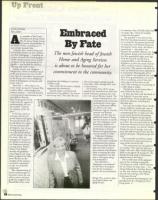
Margot Parr, executive direc-
tor of Jewish Home and
Aging Services.
to memory a few of Golda Meir's bet-
ter quips, like, "Don't be humble;
you're not that great."
The paradox is not lost on her.
But Parr has demonstrated a tenden-
cy to work for the greater good and
to make due with limited resources.
During her Army years, she drove a
motorcycle — she said it was
because she couldn't afford a car, bur
the passion lasted until the birth of
her first grandchild eight years ago.
And she recently moved into a
cramped office at the Fleischman
Residence so that her much roomier
office could be used for admissions
interviews. The massive oak desk she
once sat behind has been replaced by
a countertop. Photographs of her
two children, her husband Jack and
their three grandchildren are crowd-
ed on a credenza, one of the only
other pieces of furniture in the
room. She re-hung an oil painting of
a rabbi deep in study.
The Berman Award comes after a
year of blows for Parr, 45.
In May, she dealt with the death of
her beloved 14-year-old cocker
spaniel Dusty, whom people joked
had Parr's features, including her
blondish hair.
Last year, her mother, Jenny Vander
Kamp, suffered a stroke and came to
live with Parr and her husband Jack,
accompanying Parr to work every day
so she could attend the Fleischman
Adult Day Program and get speech
therapy at the Danto nursing facility
next door. She was interviewed by the
Holocaust Memorial Center about her
actions during the war, but for Vander
Kamp, her acts of courage were ordi-
nary She told the interviewer that she
hid Jews because, "All good people did
that."
Parr eventually moved her mother
into Fleischman, where she lived out
most of the rest of her life.
"The community was very good to
my mother," Parr said, her blue eyes
bright with tears. After Vander Kamp's
death at the age of 78 on June 21, the
friends she had made at Fleischman
planted trees in her honor.
Parr is well aware of the poignant
irony in her working among Jews.
"It's all part of a plan. I felt I was here
for my mother in some ways ... I've
always believed that God has directed
my life, and I believe that finishing
one job and coming to the Home,
God meant for me."
The menorah that belonged to her
grandparents? It is hanging in Parr's
living room.
❑