

Welcoming The World
Now a premier event,' the Maccabi
Games are big
and getting bigger.
LONNY GOLDSMITH Section Editor
Photo by Je nn i fe r We is bord
etroit will welcome more
than 3,000 teen athletes to
the Palace of Auburn Hills
on Sunday for the opening
ceremonies of the Jewish Community
Center Maccabi Games.
When the games became a reality in
1982 in Memphis, Tenn., there were
300 participants.
The games, held this year from Aug.
16-23, will visit Detroit for the third
time in the 16-year history of the event.
Detroit played host to 1,000 athletes
at the 1984 games, and held the open-
ing ceremony at West Bloomfield High
School. In 1990, when the games
opened at the Palace, nearly 2,200 ath-
letes attended Detroit's encore perfor-
mance as a host community. 1990 also
continued the games' enormous growth.
\--D Four cities have committed to act as
hosts for next year's regional games.
From Aug. 8-13, Houston and
Columbus will each host for the second
time. New host cities Cherry Hill, N.J.,
and Rochester, N.Y., will host Aug. 15-
20.
Boca Raton, Cincinnati, St. Louis,
Staten Island and Tucson are slated as
hosts in 2000, and it's almost too late
=for a larger community to be consid-
ered.
According to Lenny Silberman the
continental director of the JCC Maccabi
Games, "large communities" such as
Philadelphia, Atlanta, Cleveland and
Metro West, N.J. have all expressed
interest in hosting perhaps in 2001.
"Our challenge is keeping the geo-
graphical balance," said Silberman, "as
well as between the first and second
week of the games."
Silberman is hoping to find 12 cities
that will commit to a cycle of hosting
the games every four or five years. Thus
far, three-time hosts Pittsburgh, as well
as Houston, St. Louis and Columbus,
have agreed to the concept.
Between Detroit and Charlotte,
Silberman estimates nearly 4,400 Jewish
athletes will participate in Maccabi this
month. This closes in on what he feels is
the limit the games can handle: 5,000 to
6,000. The number of athletes is based
on the number the hosting communities
can handle.
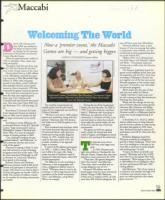
Continental (James. Coordinator Amy Rosenberg, Continental Games
„Director Lenny Silberman and Lraell Shlicha Areal Harel confer
about the Maccabi Games.
The number of participants has
steadily grown over the past several
years, but the magnitude was first felt in
1994 at Cleveland.
"We had to turn down 1,800 athletes
and we saw something wrong with that
picture," Silberman said. The decision
was made not to hold the games at one
site again.
Even-numbered years had been called
the North American Maccabi Games, or
Continental Games, with odd-num-
bered years having smaller, Regional
Games. In 1991, multiple sites were
used for first time, and in 1993, the
number of athletes at the regionals
began to increase.
A total of 3,700 athletes participated
in 1996 — 2,400 at Metro West, N.J.,
and 1,300 at St. Louis, Mo. Today
marks the end of Charlotte's week of
hosting the Maccabi Games, where 850
athletes participated.
The difference in size, according to
Silberman, is due to geography and
when a delegation's athletes return to
school. "Whenever there is a site in the
northeast, it will be large because of the
population of the Jewish community
there," said Silberman, using Metro
West as an example.
During the era of the Continental
Games, one site was used. "In 1996 or
1998, if we had a third site, we'd have
used it," Silberman said. According to
Silberman, the selection of the host
community is a function of when a city
can host based on when their schools
return after the summer break, the size
of the JCCs and the size of the host
communities.
The games are held two separate
weeks, usually the second and third
weeks of August, and delegations attend
based on the opening of the school year.
he Maccabi roots of two
1999 host cities began mea-
gerly.
In 1994, Houston took
eight teen athletes to Cleveland for the
Maccabi Games. Despite that, they were
selected as a host community for 1995.
"They had a 285-person delegation
when they hosted," said Silberman.
"Since then, they've travelled with an
average delegation size of 125."
Houston's 285 athletes was the
fourth-largest total by a host community
behind Chicago (1988), Baltimore
(1992) and Los Angeles (1995), all with
more than 300. Detroit's delegation this
year will have more than 400 athletes.
Houston's selection came, in part,
because of who was running their athlet-
ic department: Stuart Wachs, now the
recreational services programming direc-
tor at the Detroit JCC.
"Before 1995, we in Houston had
very little history with Maccabi," admit-
ted Wachs. "The primary reason for
hosting was to really excite the Houston
community."
The Houston leadership hoped the
games would reaffiliate Jewish teens and
lay leadership with the JCC. Since then,
according to Silberman, Houston has
put together one of the best year-round
Maccabi programs in the country, keep-
ing active 12 months a year with athlet-
ics and social programs.
Wachs hopes that this type of club
will soon be a reality for Detroit.
"Ideally we'd have it ready to go now,"
he said, wanting to keep the momentum
following this year's games.
Wachs said the concept has the sup-
port of Detroit Maccabi Games general
chairman Alan Horowitz, and delega-
tion head Harold Friedman. Using the
Houston model, it is Silberman's goal to
create year-round programming at all
JCCs.
In Rochester, N.Y., the JCC athletic
director didn't know to bring Maccabi
pins for his four athletes to trade during
the team's first games in 1994. Since
then, Rochester has had as many as 62
participants, and will be a first-time host
next year.
Rochester delegation head Josh
Weinstein attributes his delegation's
growth to better marketing. "There were
two of us working on it last year, so we
were able to reach out to more temples
and youth groups," he said.
"It says a lot about our Jewish com-
munity," Weinstein said of the 25,000
Jews who live in the upstate New York
community. "We're hoping to have 150
to 200 athletes for our delegation when
we host, and between 800 and 1,000
visiting athletes."
Said Silberman, "Part of our vision is
to continue and maintain the high level
of athletics and cultural events. It's a
great one week experience that creates
great memories." ❑
8/14
1998
Detroit Jewish News
M5