
j'NEtttettaitttriettt
A
fter a four-year, self-
imposed break from writing
and performing, Marc
Cohn is on the road again,
in search of a musical Promised Land.
It is, he says, a tough but necessary
trek.
Cohn got off to a meteoric start in
1991 with the hit single "Walking in
Memphis" from his Marc Cohn
album, which won a Best New Artist
Grammy. But the 39-year-old's 1993
release, The Rainy Season, didn't even
reach gold and the singer/songwriter
dropped out of performing and tour-
ing entirely.
Now, armed with a new album,
Burning the Daze, he's trying to
reclaim his earlier fame as a thought-
ful, introspective craftsman with deep
roots in American pop tradition. He
will showcase a number of the new
songs as well as some older favorites
when he performs at the Newport
Folk Festival at Pine Knob Saturday,
Aug. 22.
From Burning's opening deeply
ironic cut, "Already Home," examin-
ing the feelings of a Moses-like figure
who can see but not attain his goal, to
its final track, "Ellis Island," an: immi-
grant's hopeful view of his new home-
land, Cohn writes and sings eleven
songs of veiled confession about the
need to keep exploring new places that
are both physical and spiritual.
In a recent interview, Cohn said
that the new work grew out of the
four years of self-examination that fol-
lowed The Rainy Season, which rose
only to. No. 63 on the charts and
never won the kind of excitement or
sales of his debut. And when he came
off the promotional tours for the
record, he found his marriage crum-
bling.
He decided to stay at home.
"It's often thought of as a crime to
do some living when you've got a
record deal and you're supposed to be
putting out product," Cohn recalls. "I
took a chance that I would lose my
audience. I wasn't intending to stop
for four years, but I was going
through what I was going through in
my relationship, and I didn't know
where that was going to end up at the
time.
"I knew it needed attention, and
you can't give much attention to
things like that when you're on a tour
bus or in the recording studio."
It took the better part of three years
8/14
1998
84 Detroit Jewish News
At Home On
The Road
After four years of retreat, Marc
Cohn takes his confessional songs on
tour to rediscover an audience.
Photo by Fra nk Ocken ce ls III
HANK BORDOWITZ
Special to The Jewish News
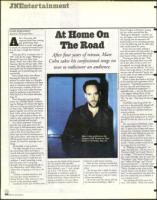
Marc Cohn peifornis at the
Newport Folk Festival at Pine
Knob on Saturday, Aug. 22.
to iron out the details of his personal
life. He and his wife, Jennifer,
divorced. They have joint custody of
their children, a son, 7, and a daugh-
ter, 3 1/2. The divorce, he says,
forced him to confront a series of
painful issues such as the meaning of
loyalty and hope, themes that he con-
tinues to explore in the new album.
He said he needed to resolve them
before he could resume touring.
Now, he says, touring reminds him
why he chose to play music in the first
place.
"It's the part that I relish the most.
I feel better than I ever have perform-
ing. I'm just loving to sing my music
and see my audience."
He hit the road last spring, playing
20 club dates (including a night at
Clutch Cargo's in Pontiac), touring 110
the new music and old hits like
"Walking In Memphis." And he's on
the road again with the Newport festi-
val, hoping that the exposure will
build interest in the recording, getting
it the fan following and the radio play
that would restore his career.
So far, the cuts aren't making it
onto the airwaves and that means, he do
says, that many potential fans simply
don't know he has a new album out.
Touring can help, he says. "The
thing that has always been true with
me is that when I leave a town I've
just played, my record sales go way
up." But it can be difficult. "It's just a
slower way to go about it. It's the only
way you can sell records if you're not
on the radio. It just takes a helluva lot*
longer to make an impact."
Cohn is often described as the king
of the confessional songwriters of his
generation. "Somebody pointed out to
me that not only aren't there very
many 'confessional songwriters' —
especially male — but my first record
is the biggest selling album of that
kind of music for a male artist in the
'90s," he says. "That kind of astound-4
ed me."
Confession may be good for the
soul, but it has practically slipped off
of any pop music scale of coolness,
leaving Cohn in a professionally pre-
carious position.
But he says he can draw on some
strong spiritual background to remind
himself of what he wants to be and
do.
He was raised in Cleveland, where
"my mother died when I was 2," he
says. "I spent a lot of time with some
very devout, Christian, Southern black
women who were helping to raise me
in the absence of a mother." Their
influence shows up in his lyrics and in
his music's occasional use of gospel
motifs. "Those symbols come out in __,
my songs. It's not contrived."
In "Walking In Memphis," he
sang, "And she said, 'Tell me, are you
Christian child?' and I said, 'Ma'am, I
am tonight.'" This kind of iconogra-
phy carries through Daze on tunes like
"Providence" and "Saints Preserve Us"
and "Valley Of Kings" and "Girl of
Mysterious Sorrow" — the last a form
of indirect tribute to Aretha Franklin.
"When I looked at the titles on this
record, when it was all done," Cohn
said, "it only occurred to me then that
the titles could lead you to believe it
was a gospel record."
Yet, winding all of this up is the
tune "Ellis Island." While not overtly
Scanned image of the page. Keyboard directions: use + to zoom in, - to zoom out, arrow keys to pan inside the viewer.
August 14, 1998 - Image 100
- Resource type:
- Text
- Publication:
- The Detroit Jewish News, 1998-08-14
Disclaimer: Computer generated plain text may have errors. Read more about this.