

everywhere, but Allen badgers
himself, fretting about every-
thing from a poor omelet to
his absolute need for an exclu-
sive bathroom. On a gentle
boat ride into Venice, he acts
as if he is barely surviving the
Titanic.
Of course, Allen is being
"Woody Allen." He knows a -
camera is running, and that
he's expected to be entertain-
ing. And he is a trouper. When
a head cold threatens the final
show in London, he rallies
himself. And when his clarinet
nearly conks out during a long
solo passage in Paris, he heads
off the next day to look for a
new one (the snooty instru-
ment firm won't sell him the
old, all-metal clarinet he
wants).
He is such a natural quip-
ster ("This being Milan, I hope
the laundry doesn't come back
breaded") that even the slightest gags
seem charming shavings of Woody.
And with his sister Letty Aronson,
lover Soon-Yi and his musicians
around, there's no shortage of adoring
audience.
Aging seems to have mellowed
Allen into an egotism fairly free of
playing the lead in a movie like
Deconstructing Harry and making
the character a celebrated writer,
don't you create confusion in the
minds of the audience?
WA.: I knew it would be seized upon
as a document of my life, but it isn't.
It's pointless for me to say this
because nobody ever takes it serious-
ly; people think it's an autobiographi-
cal film so they immediately feel that
these things are all true about me,
but they aren't. They're just ideas that
I have that I think will be funny or
full of conflict or interesting, areas to
make jokes in or something, and peo-
ple regard them as documents of my
life but they really aren't.
JN: Even if the characters are fic-
tional, surely the environment (New
York Jewish) isn't.
WA.: You automatically integrate
your environment into your work. I
live in New York and I'm a writer, so
that comes into my work all the time.
I set my films in New York because I
know New York well and I was
brought up in Brooklyn.
0
0
0
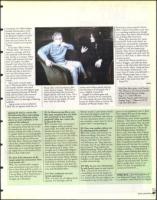
Woody Allen with documentary film-
maker Barbara Kopple. "When he in
control of something like his movies,"
Kopple told the New York Times, "he's a
man of steel. But when he's not in con-
trol, he much more fragile. He needs
Soon-Yi for the life things."
vanity, and without greatly denting
the boyishness of his appeal. He is
now a slightly wizened elf.
Kopple is an adroit gazer and
detailer, intimate yet not voyeuristic.
In a fine touch, she uses Nino Rota's
music for Fellini's films to lyricize the
hubbub of Woody's Italian visits.
JN: In Deconstructing Harry, your
film sister complains that you think
she's too Jewish. Is that autobio-
graphical? (Allen has a sister who
produced the film.)
WA.: I've had many conversations
about religion within my family
many times. Not really with my sister
because my sister is not like that
character in [Deconstructing Harry]
just like Harry is not me. My sister is
not religious, is not married to an
Israeli, is not married to a religious
person in any way. I have had conver-
sations about religion with her many
times growing up. I mean, I was
brought up in a reasonably religious
Jewish home, but our conversation
was not that particular one in the
movie. In the movie, Harry's feelings
are about extremism, and I'm against
extremism in all forms, in all coun-
tries, in all religions. I just don't feel
it ever leads anyplace but to unhappi-
ness, and bloodshed often.
Hebrew school. I came from a family
that observed religion, and I have
experienced it firsthand, and came to
my own conclusions about it, and it
was certainly a major topic of conver-
sation when I was growing up.
J.N: How traditional was your
Jewish upbringing?
WA.: I've had a lot of religious back-
ground. I've had eight years of
JN: Does your mother criticize you
for rejecting Jewish traditions?
WA.: My mother still criticizes me
about everything. You know if I go
over there, she'll say, 'You need a
haircut.' My father is 97 years old
and he'll say to me, 'Your pants are
too long,' and I'll say, 'How can you
see my pants?' They criticize me
about everything. They're still semi-
observant. I mean, they still respect
the tradition, the Jewish tradition,
and go through the motions of the
holidays to the degree that they can
at their advanced age.
JN: Why do you never deal primari-
ly with Jewish issues in your movies?
WA.: The Jewish issue per se is
something I am not an expert on
and is not a great interest of mine.
I'm Jewish, but I'm not religious or
interested in any of the major reli-
Receiving a career award in Venice,
Allen wonders why Fellini never won
it, a touching consideration though
naive about the almost diabolical poli-
tics of Italian film favoritism.
When Allen describes his "quiet,
normal life" back in the States, we
realize how cocooned his controlled,
privileged existence is. But for a few
people he is still the dreamy pip-
squeak, Allen Stewart Konigsberg of
Brooklyn. Kopple ends (and tops) the
movie in New York, as Allen visits his
ancient parents.
Dad thinks Woody should have
been a druggist, and adds the latest
awards to old tchotchkes (like Oscars)
on the mantle. Mom, sizing up Soon-
Yi with myopic forbearance — for
once, Soon-Yi looks uncomfortable —
wishes Woody might have a "nice
Jewish girl." Allen, used to the repar-
tee, calls it "the lunch from hell."
Rated PG.
Wild _Man Blues plays at the Detroit
Film Theatre at the Detroit Institute
of Arts 7 and 9:30 p.m. Friday,
Aug. 7; 4, 7 and 9:30 p.m.
Saturday, Aug. 8; and 4 and 7 p.m.
Sunday, Aug. 9. 'Tickets are $5.50.
Call (313) 833-2323.
gions in any significant way; I don't
have respect for any of the major
religions from Judaism to
Christianity, none of the organized
religions. I feel they're more baneful
than they are helpful. They all tend
to isolate us from each other. They
all stress separateness. They're all
full of dogma, pious morality. I
have a very, very dim view of them.
But I don't have a dim view of the
religious impulse in people. In the
privacy of one's own emotional soli-
tide, it's perfectly possible and it
does occur all the time for a person
to have a truly religious moment, a
religious feeling — some kind of
contact, some inkling that there is
some religious base to the universe.
But not translated into these clubs,
organized clubs which I just don't
approve of and don't like. So why
don't I tackle these issues in my
films? If I did, I'd probably be
tarred and feathered ...
Philip Berk, a four-term president of
the Hollywood Foreign Press Association,
is a freelance writer based in Los Angeles.
8/7
1998
Detroit Jewish News
87