

SUZANNE CHESSLER
Special to The Jewish News
C an the pen really be mightier
than the sword?
The late artist Arthur
Szyk tried to make it so
through the anti-Nazi cartoons and
caricatures he created during World
War II.
An editorial cartoonist for the
Ne'w York Post, Szyk also was repre-
sented in Time, Esquire, the New
York Times and the Chicago Sun.
A comprehensive showing of Szyk's
political drawings, along with his illu-
minated manuscripts, will be featured
Aug. 16-Feb. 28 at the Spertus
.
Museum in Chicago. Justice
Illuminated: The Art of Arthur•tyk is
said to be the largest Szyk exhibition
ever installed.
"How can anyone expect Me to
.
paint landscapes and flowers when the
world is in flames?" the artist told an:
interviewer for The Detroit Jewish "
Chronicle in 1941.
'My son is fighting with rhe -Free,
French under De Gaulle somewhere
in the Middle East. I am a bittoo ''
for that, but as an artist, I believe tItat_
my pen and brush must take their \'''i-
place in the thick of the fight: .;,',,-.:
No part of the human intellec i-i
remain isolationist in a world'in NV ch-
every sphere of our lives is bound up."
Szyk's success was characterized by
first lady Eleanor Roosevelt, who
called him a one-man army. Adolf
Hitler put a price on his head.
"Because Arthur Szyk's work was so
filled with themes and messages about
fighting injustice, tyranny and oppres-
sion, his art is a great educational
tool," said Rabbi Irvin Ungar, a rare
book and manuscript dealer who
curated the exhibition.
"There is nothing simple or com-
fortable about Szyk's art or his mes-
sage. His work challenges us morally
and stimulates us artistically."
Born in 1894 to a middle-class
family in Poland, Szyk left home at
age 15 to study art in Paris. He experi-
mented with various styles of the time,
including abstraction, but felt that
abstract art left too much to the imag-
ination.
Drawn to the intricate and decora-
tive style of decorated texts in the tra-
dition of the 16th-century miniaturist
painters, he created miniature scenes
and portraits, illuminating initial let-
ters, decorative and symbolic border
patterns and calligraphy.
During the early years, he produced
8/7
1998
78 Detroit Jewish News
•
AR.
4,1-11,ar
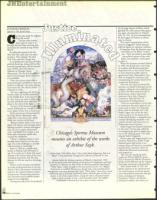
Chicago's. Spertus Museum
mounts an exhibit of the works
of Arthur Szyk.
Arthur Szyk: "The White Paper;" from Szyk's book of drawings, "Ink and
Blood, " 1943,.. watercolor and gouache, collection of Warren D. Star.
Months before the German invasion of Poland in September 1939,
the British government had already restricted Jewish immigration and land
purchases in Palestine. In May 1939, the British passed the MacDonald
"White Paper," which reneged on the tacit promises of the 1917 Balfour
Declaration to establish Palestine as a Jewish state, and curtailed Jewish
immigration even more dramatically. Szyk "White Paper" shows Jews massed
behind the graves of Europe and North. Africa while the gates to Zion are
locked. As the Nazi serpent slithers among the thorns, the Jewish soldier,
knife in hand, attempts to slay a snake of another kind. The Balfour
Declaration is overrun by a rat as Jews in chains call out
the 45-page Statute of Kalisz, which
glorified the 13th-century edict grant-
ing rights of citizenship to Poland's
Jews. In 1931, he Was commissioned
by the League of Nations to illumi-
nate its charter.
The artist's interpretation of the
Passover Haggadah, which featured
political figures to represent tradition-
al characters from the Passover story,
used Hitler as the fabled "wicked
son." Szyk was asked to downplay
the political nature of the work
before any publisher would agree
to print it.
When the Germans invaded Poland
in 1939, the Jewish artist was living
in London, and British authorities
dispatched him to the United States
to sway American public opinion
against the Nazis. Relocated to New
York, he forged his caricature style
incorporating the precise detail of his
miniaturist illustrations.
After the war, Szyk continued his
advocacy on behalf of Europe's Jewish
refugees, calling for the establishment
of Israel. His later work returned to
illumination, and he illustrated
Andersen's Fairy Tales, Chaucer's
Canterbury Tales and the U.S.
Declaration of Independence.
"Szyk was extraordinary in his abili-
ty to perceive the entire span of a sit-
uation and to make very clear ,arid
direct what his message was,"said
Rabbi Ungar, who owns the Szyk
archives and is on the board of the
Arthur Szyk Society, a nonprofit orga-
nization developing materials to be
used by schools and institutions to
further the cause of justice.
Rabbi Ungar first became interested
in the artist 23 years ago, when he
was shopping for gifts to thank every-
one in his wedding party. The rabbi
selected Szyk's Hao-oadahs.
Eleven years ago, beginning his new
business, Historicana, Rabbi Ungar
chanced upon Szyk prints in an
antique shop and found an immediate
interest from customers. Soon, he
offered the illustrated manuscripts
and original art.
The costs for acquiring Szyk's
works run $50 to $300 for prints,
$25 to beyond $1,000 for illustrated
books and $1,000 and up for original
drawings, watercolors and gouaches.
Since Szvk's death in 1951, his
books continue to be reprinted and
his works hang in numerous promi-
nent international museums and gal-
leries, including the Muzeum
Narodowa, -Warsaw; the British
Museum, London; the Library of