

FATHERS OF THE SILVER SCREEN - II
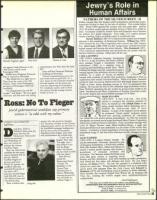
Michelle Friedman Appel
Terry Sever
Thomas A. Law
endorsements, but that's how the cards
fell."
Sever will face Democrat Deborah
J. Goldberg in November.
County commissioners serve two-
year terms and are paid $25,111 a
year. Issues in the primaries centered
on road repairs, on the plans and
costs for improving the emergency
911 telephone system and on how
the county should manage mental
health services.
win against Linda Jolicoeur in the
18th District which covers
Farmington Hills.
Moffitt faces off against Democrat
Ryan J. Gesund in November.
• Ben Marks-lost in a tight race to
Terry Sever for a seat in the 19th
District, which covers Farmington,
and parts of Farmington Hills and -
Southfield.
"I'm disappointed, but not dis-
traught," said Marks. "We ran a good
clean race, and had some very strong
❑
Ross: No To Fie
Jewish gubernatorial candidate says primary
winner is "at odds with my values."
011
LONNY GOLDSMITH
Staff Writer
D
op
oug Ross, third in
Tuesday's three-man pri-
mary race for the
Democratic Party nomi-
nation for governor,
said Wednesday he
does not intend to
endorse the winner,
Geoffrey Fieger.
Ross, the only Jewish
candidate for the nomi-
nation, finished with 22
percent, behind
Geoffrey Fieger's 41
percent, and Larry
Owen's 37 percent. An
unofficial tally that
included 99 percent of
the state's 5,611
precincts showed Fieger
with 293,139 votes to
267,396 for Owen and
155,104 for Ross.
Ross, a former state
Doug Ross
•
senator who also served as Assistant
U.S. Secretary of Labor in the Clinton
Administration, said in an interview at
his Southfield campaign headquarters
that he was no fan of incumbent
Republican- John Engler, who easily
won renomination for a third term.
"I can't vote for
Engler," Ross said,
"but right now, I
don't believe I can
vote for Fieger
either. His actions
are too much at odds
with my values."
Ross did not
attend the
Democratic Party's
"Victory '98
Breakfast" at the
Crown Plaza
Pontchartrain in
Detroit Wednesday
morning because he
was not ready to
endorse Fieger.
❑
Within a decade after film theaters called nickelodeons opened their doors,
Americans flocked to them by the tens of millions. Few existed before
1904. About 9,000 spanned the country only four years later. And by
1910, 26-million weekly patrons attended an hour of films for a nickel or
dime. An industry created by Jewish vision and dynamism was to become
our nation's first global enterprise. Even today, U.S. motion pictures
remain a leading, highly profitable export in worldwide trade.
Barney Balaban (1887-1971) fashioned the modern movie theater
and rose to the presidency of Paramount Pictures. William Fox (1 879-
1952) formed the Fox Film Corporation that evolved into 20th Century
Fox. Jesse Lasky (1880-1958) was the "merger king" of Hollywood who
helped expand and develop the entire industry. Max Reinhardt (1873-
1943) introduced impressionism and advanced the star system with the
Marlene Dietrich mystique. Others also led the way:
CARL LAEMMLE
(1867-1939)'b. Laupheim, Germany Immigrating
to the U.S. at age seventeen, the former clothing
store manager bought a ramshackle Chicago
nickelodeon (1906) as a stepping stone to
acquiring and refurbishing a dozen more. While
building his theater network, Laemmle became a
leading regional film distributor driven by higher
ambition. In a series of moves, he adroitly
merged with a number of smaller film production companies to form an
organization later named Universal Studios. While at its helm, Laemmle
produced what was among Hollywood's first full-length feature movies:
Traffic in Souls, whose smashing success in 1913 revolutionized film
making. He was also the first to hire celebrated stage performers such as
Mary Pickford--launching the star system by giving screen credits to his
talent. Purchased by the Music Corporation of America, Universal is today
the world's largest and most profitable packager of TV films.
MARCUS LOEW
(1870-1927) b. New York City One of the
earliest to recognize the immense potential of
films, he teamed up with Adolph Zukor in the
penny arcade business before branching out to
establish the coast-to-coast chain of Leow
theaters. In many of his majestic movie palaces
he pioneered "mixed media" programs which
drew ever - growing audiences by combining
live vaudeville with motion picture presentations. In 1920, the Austrian
immigrant's son turned movie mogul purchased Metro Pictures Corporation
followed by Goldwyn Picture Corporation. From yet another marriage with
Louis B. Mayer Pictures came Metro-Goldwyn-Mayer, a giant that
dominated Hollywood and established it as the center of the world's film
industry. Lionized as a prime popularizer of moving pictures, Leow died
prematurely at age 57, the first of his illustrious Jewish colleagues to pass
away.
JACK WARNER
(1892-1978) b. London, Ontario, Canada He
was the charismatic "showman" among four sons
of Benjamin Eichelbaum, a Polish-born peddler.
With older brothers Harry, Albert and Samuel, he
joined a motion picture dynasty that became a
powerhouse of cinematic invention and
innovation. The Warners entered the Hollywood
scene after great success in acquiring movie
theaters and film distribution. And while heading up studio production,
Jack filmed the first talkie with dialogue and music: The Jazz Singer
starring Al Jolson (1927). The feat was repeated in a landmark color
feature two years later. Warner Brothers Pictures went on to mesmerize
movie goers with gangster films like Little Caeser with Edward G.
Robinson (1930) and breathtaking musical jubilees by Busby Berkeley.
More recently, the company formed Time Warner Inc. by merging with
Time Inc., creating the world's largest news media/entertainment
conglomerate.
—Saul Stadtmauer
Visit many more notable Jews at our website: www.dorledor.org
COMMISSION FOR THE DISSEMINATION OF JEWISH HISTORY
Walter & Lea Field, Founders/Sponsors
Irwin S. Field, Co-chairperson
Harriet F. Siden, Co-chairperson
Detroit Jewish News
8/7
1998
11