

link activism to Jewish religious tradi-
tion in a way that the "mainstream"
groups do not, Mr. Cohen argues. He
says that on balance, the rise of
Orthodox power has enhanced Jewish
political clout.
But others say that while the rise of
Orthodox power gives .voice to an
under-represented group in Jewish life,
it further erodes the impression of
unity, the coin of the realm for Jewish
politicos.
"When you stop speaking with one
voice, you aren't as powerful," says
Rabbi Schwarz, of the Washington
Institute for Jewish Leadership and
Values. "I don't long for the days when
a single unrepresentative voice had free
reign in Washington, but the Jewish
community has always benefited politi-
cally from the impression of unanimity,
and it's becoming clearer that we aren't
unanimous on very many issues."
Congress is catching on to that fact;
says Reva Price, Washington director for
the Jewish Council for Public Affairs.
"It's no longer enough for a big
group to come in to congressional
offices and say ' this is the Jewish view'
on an issue, because there are so many
Jewish views," she says. "Congress is
getting much more savvy about the dif-
ferent perspectives in the Jewish com-
munity."
New Breed Of Activist
Another threat comes from a change in
the style of Jewish political activism.
Mark Talisman came to Capitol Hill in
1961 as an intern who divided his time
between Congress and President John E
Kennedy's White House and went on to
a career as a top House staffer and
Washington director of the Council of
Jewish Federations.
The bitter partisanship and stridency
of American political life in general has
infected the Jewish world, Mr. Talisman
says.
"Before, bi-partisanship was main-
tained in the Jewish community at all
costs," he says. "We felt we had to work
with everybody; you didn't make ene-
mies when people didn't do what you
wanted them to do."
He referred to the recent congres-
sional attacks on the Clinton adminis-
tration orchestrated by AIPAC — a
clear measure of Jewish clout, but also,
Mr. Talisman says, an example of a
harsh, divisive mode of politics that will
eventually hurt Jewish interests.
Strident media campaigns have
become the norm for Jewish groups,
especially fringe groups that are increas-
ingly able to dominate the Jewish politi-
cal agenda, says Mr. Ginsberg, the polit-
ical scientist.
"For a numerically small group, quiet
insider politics at the highest levels is
the most effective. Now we see, more
and more, the politics of Geshrie. The
media campaign has replaced the Gucci
Gulch style of politics; press releases
with strong headlines have replaced
quiet persuasion with the most power-
ful people. For a numerically small
group, that's definitely not the most
effective style of political action."
"The danger is that we will no
longer be able to attract people of quali-
ty to leadership positions because they
know they'll get attacked by people who
just go after them because they don't
like what they say," says Abraham
Foxman, executive director of the Anti-
Defamation League. "Debate the issues,
challenge people on the merits of the
issue, but don't destroy them."
Political apathy, rampant in America
at large, is seeping into a Jewish corn-
munity that has traditionally enjoyed
higher-than-average levels of participa-
tion.
"The strange thing is that we think
of the Jewish community as so active,"
says Mr. Cardin. "But its always been a
minority within the Jewish community
who are the activists. They enjoy strong
support from the populace, but compla-
cency and a feeling of safety in our
community are real dangers; they mean
that many Jews no longer see the need
for us to be as aggressive in standing up
for Jewish issues."
Inward Introspection
Changes in the American political sys-
tem also affect Jewish political power. In
recent decades, Jewish power has bene-
fited tremendously from the rise of big-
money politics, which gives affluent,
well-organized groups disproportionate
influence in the electoral process.
Effective campaign finance reform is
unlikely, experts say, so that advantage
will continue.
On the downside, more and more
federal authority is being returned to
the states, which means that Jewish
groups will not be able to concentrate
their firepower in Washington as they
have done since the New Deal.
"In some states — Maryland, New
York, Florida and California are good
examples — Jews are well positioned to
play a major role at the state level," says
an official with a Jewish community
relations group. "But in others, local
Jewish communities simply don't have
the resources. Overall, the shift in focus
to the states is going to be problematic
for American Jews."
There's one more factor that may be
cutting into Jewish power, at least in the
short term. Twenty years ago, political
activism in a barely Jewish context
soared as young Jews looked for ways to
maintain their ties to the community
even as religious connections faded.
But today, there's a spiritual renewal
taking place among all streams of
Judaism. Even Jewish political groups
that once rigorously avoided any hint of
religiosity are being forced by members
to introduce more religious content.
At this year's United Jewish Appeal
young leadership conference in
Washington, planners significantly
increased the religious content in
response to requests from participants.
AIPAC now includes sessions on reli-
gious topics as well as politics at its
annual policy conference. A growing
number of groups — once almost
obsessively secular — now offer reli-
gious study sessions at their Washington
offices.
"There's always been the world of
Jewish education and the synagogue,
and then the Jewish public action
world," says Rabbi Schwarz. "Those
two worlds were separate and distinct.
Now we see more of a crossover."
But Jewish religious tradition means
different things to different people; the
turn to spiritual interests will be good
for Jewish souls, but it is unlikely to
revive the powerful veneer of unity that
once provided the propulsion for Jewish
power.
Rabbi Schwarz's Panem al Panem
High School in Washington represents
a pioneering effort to use that growing
interest in religion to spur a new deeper
kind of Jewish political activism. Some
1,000 Jewish high school students every
year come to the capital for an intensive
dose of Judaism and its intersection
with the public policy agenda.
"The loss of the unifying, rally-cry
issues, along with a greater interest in
spirituality, has created a tremendous
turning inward," he says. "We are very
conscious that our program is ensuring
that the next generation of Jews will
have an activist agenda, along with a
much greater understanding and appre-
ciation of Jewish tradition."
That mix, he says, is what will guar-
antee Jewish power for the next genera-
tion and those that follow.
❑
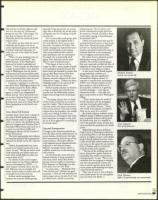
Abraham Foxman:
Attacks turn people off
Newt Gingrich:
Part of the firestorm.
Mark Talisman:
Before, bipartisanship was maintained.
7/ 31
1998
Detroit Jewish News
99