

loathes them. "Look at this," she
ays, picking up a painfully home- 1
ly — don't view this thing after i
eating a full meal — pink-and-blue
troll. "Isn't it just awful?" i
On a den wall covered with
family photos is a black-and-white
picture showing Katie when she
was a little girl. Born in Russia,
he was 4 -when she came with
her family to . Dallas-Ft. Worth. It
was a city in need of residents, so
that's where this immigrant family
was shipped.
In the photo, a round-faced
Katie, who appears to be about
3, holds a doll. This was really
the first in the collection. The doll
has a white dress, wooden arms
and legs that - Move, sparkling ,
eyes and carved teeth.
Today, this very doll holds a
prized place in Mrs. Rube's collec-
tion.
„
"This one," she says, is very
special.”
The second part of the collection
began when Esther was a girl. A
local department store was having
a contest: "You dropped your
name in the box and if it was
picked you won the contest.
"I won two dolls," Mrs. Rube
says. "But don't ask me which
two."
Then the dolls began pouring in
— at holidays, for birthdays,-
no reason at all. Over the years
Esther got the dolls (and continued
to collect them long after her moth-
er died). But it was Katie who
loved them most.
"They were her babies," Mrs.
Rube says.
Mrs. Rube can't pinpoint a
favorite. She says her mother did-
n't have one, either, though she
was partial to a Madame Alexan-
der, garbed in pink, which her
colleagues gave to her when she
retired from the clothing store
where she had worked much of
her life.
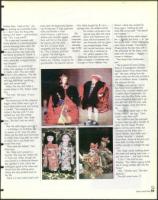
There is a story about each and
School, where she worked for
Mrs. Rube bought for $1 at
every doll: the bejeweled (glisten-
1
many years. Holding the doll
garage sale; the stuffed animal
ing rhinestones) 2"-high Japanese
her mother continued to rec- I close she announced: "We decidi
male and female in tradi-
The
ed to adopt."
ognize long after she came
tional kimonos, a gift from a
collection down with Alzheimer's dis- t Finallyione of the rabbis asked
relative who actually lugged
to "get
comprises
ease; the fruit-covered Car- I her ---41itely but firmly
them with him on the plane;
dolls from men Miranda with her glow- I that outof here." Other colleagues
the beauty with the chalk-
I were more amused. Friend Janet
decades
ing orange-wedge shoes
like skin, of whom Katie
ago to the and myriad bananas, strung e Moses Came the next day with a
repeatedly told her daugh-
little ensemble for the baby, com-
present.
about like a necklace of
ter, "This is bisque, and that
plete with his name — Reggie —
hot, yellow peppers; the
is good;" the blue figure
written
in Hebrew.
Cabbage
Patch-doll-
which
Mrs.
with the crooked mouth that Mrs.
Then there's the Frankenstein
Rube wrapped in a blanket and
Rube's son, Charles, made for his
pair.
brought
to
Akiva
Hebrew
Day
grandmother; the Spanish da ncer
"My husband [Cantor Sidney
Rube of Congregation Shaarey
Zedek] doesn't know about these
yet," she says, taking from the
closet a box just the size to hold a
pair of children's boots. Carefully,
she removes the top.
.11,1 was young I was a
"
big Abbott and Costello fan,"
whose films included Abbott and
Costello Meet Frankenstein. So
when one day:Mrs...-Rube came
across Madame AleXander's ver-
sion of FrdriVand - his wife, well,
it was ob*. us what she had to
jry
do.
"I sawse dead roses in the
she says. "How
I bride's
I could I pass them up?"
Her huSband may be' surprised
to learn there are still 0 handful of
dolls, like the happirranken-
-Ateins, he has yet to meet; but
I chances are the Rube sons —
David Mendil, Saul Asher and
Charles Herschel — already
know them. None of the sons col-
lects dolls, but they love their
mother enough to indulge her pas-
sion.
Mrs. Rube recalls walking down
the street and seeing one more —
just one more — she had to have.
"I can't," she told her son,
Charles. "Your father's going to kill
me if I bring another doll into the
house."
"Ma," Charles said, "live dan-
gerously."
The doll came home. 0
•
7/31
1998
Detroit Jewish News
73