

Our HiStorY
n Tisha B'Av — this Sun-
day, Aug. 2 — we do not
eat nor drink. We do not
wear leather shoes, nor do we
extend greetings to one another.
The reason for all this is something
that happened so many hundreds of
years ago: the destruction of the Tern-
! ple. So why is this relevant to us
today?
For many years, as the Jews wan-
1 dered in the desert, they had nothing
but an Ark where they could worship
God. Then at long last the Jews con-
: quered Jerusalem. Here was a city
that could be home to all the Twelve
I Tribes of Israel, and its historical sig-
nificance was marked. It was in
Jerusalem that God had called for the
sacrifice of Isaac, and this very spot
would become the site of one of the
most holy spots in the Temple, the
altar.
Building the Temple required an
extraordinary amount of work. Cop-
per was brought from King Solomon's
mines to build the large columns. Sil-
1 ver and gold also would be used
:throughout the Temple, whose sanctu-
ary was filled with the most exquisite
treasures.
According to the Tanach, 30,000
'Jews helped build the structure. It
would be called Solomon's Temple,
in honor of the king.
Its first purpose was to house the
Holy Ark, containing the tablets of the
Ten Commandments. One of its most
impressive features was the ceiling,
which was about 50 feet high —
much taller than any other structures
of the time. It had a large courtyard
where visitors could come to pray
and make sacrifices. The Temple was
about 165 feet long with a porch
from which visitors could enter the
main room. Here the doors were
made of olive wood and the win-
: Bows were high. At the back was
the devir, the Holy of Holies, were
the Ark of the Covenant would rest.
The doors to this room also were
made of olive wood, leading to an
altar of cedar and covered with
gold. To approach the alter, one
The Temple
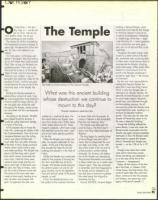
The Kotel is all that remains of the Second Temple.
What was this ancient building
whose destruction we continue to
mourn to this day?
Elizabeth Applebaum AppleTree Editor
walked up a small set of steps. He
then stood before two figures, bear-
ing a lion's body and a child's head,
which rested above the Ark. These
magical sculptures, which bore wings
that stretched across the room, were
said to be God's special guardians
for the Ark.
When the Temple was at last com-
plete, the people celebrated for two
weeks. At the end of the festivities,
they brought the Holy Ark into the
building and placed it in the Holy of
Holies.
Initially, the Temple was constructed
solely for the purpose of housing the
Ark. But it took little time for this to
change. The Temple quickly became
the central location not only for reli-
gious worship, but for the legislative,
ritual and spiritual center of the Jewish
people, as well.
In fact, the Temple became a visi-
ble symbol of the covenant that forev-
er binds God and His people. Its
name in Hebrew is belt hamikdash,
from the root meaning "holy."
The Temple was destroyed not
once but twice. The first to tear it
down was King Nebuchadnezzer of
Babylon.
The king began by stealing some
of the buildings's beautiful adorn-
ments; then he desecrated the struc-
ture itself, and finally, on the 10th
day of the month of Av, he and his
armies burned it so that nothing
remained. For the Jews, the destruc-
tion of the Temple was devastating.
They blamed themselves and vowed
to follow God's law so it would never
happen again. They also promised
to remember what had happened to
the Temple and so instituted a 25
hour fast (one of only two in Judaism
[the other being Yom Kippur]) to
remember the day.
Around 520 BCE, the Jews began
building a Second Temple, which
would look much like the first, though
for financial reasons it was not as
ornate as its predecessor. Interesting-
ly, Greek kings of the time — espe-
cially Antiochus III — were supportive
of its construction and even gave
gifts, such as oil salt and flour, to be
used there.
Throughout the years foreign rulers
would try to take control of the Tem-
ple, sometimes even practicing idola-
try there. Jews would always return to
reconsecrate the Temple, including
Judah Maccabee. When Judah Mac-
cabee lit a small amount of oil he
found in the Temple's storehouse it
burned for eight days — the miracle
of Chanukah.
But the man most responsible for
making the Second Temple the
glory that it was was King Herod,
which is why this Temple often is
referred to as Herod's Temple. He
specially trained thousands of work-
ers and made certain Halachah,
Jewish law, was followed through-
out the building process. By all
accounts he made the Temple more
magnificent than ever, resulting in a
structure so beautiful tradition
recalls: "He who has not seen the
Temple of Herod has never in his
life seen a beautiful building."
Though the building suffered fre-
quent attacks, it was only when the
Romans came to Jerusalem that the
Temple was again almost completely
destroyed. In fact, the Romans were
determined to capture the Temple
Mount. Eventually the Temple was
burned — on the 10th of Av in 70
CE.
Though a few items from inside
were said to have been saved,
almost everything was destroyed —
or, in the case of the Ark of the
Covenant — disappeared.
Today, all that remains of the Tem-
ple is the Kotel, or Western Wall,
whose heavy, haunting stones, thou-
sands of years after they were laid
down, continue to hear the prayers,
and dreams, and yearnings, and
agony of the Jewish people. ❑
7/31
1998
Detroit Jewish News
71