
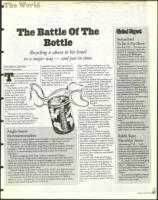

The Battle Of The
Bottle
Recycling is about to hit Israel
in a major way — and just in time.
NECHEMIA MEYERS
Israel Correspondent
/--'
he outcome of the recycling
battle now taking place in
the Knesset will go a long
way towards determining
Israel's quality of life in the
years ahead.
That battle is over a bill
calling for a compulsory
deposit on all soft drink
bottles and cans. It is
sponsored by a group of
greenies" from a variety
of parties and strongly
opposed by the soft drink
industry, which doesn't want to
be bothered with recycling contain-
ers.
The issue is not a trivial one.
Containers are a major source of
Israeli waste. In 1997 alone, 1 million
of them were used and discarded in
Israel, representing 30 percent of
household waste. And experience in
other countries shows that putting a
deposit on them is the most effective
method of ensuring that they are
reused and/or recycled.
Solid waste is - an escalating prob-
lem in Israel. This year Israelis are
expected "to produce" some
4.65 million tons of it, a
"
/-
Anglo-Saxon
Environmentalists
Though there are many Sa.bras (native Israelis) among local environmental-
ists, it cannot be denied that environmentalism — like Coca-Cola and
McDonald's -- is an Anglo-Saxon import to a significant extent
This can be seen m the IUED (Israel Union for Environmental Defense),
founded in 1991 by American-born Dr. Alois Tal shortly after he received
his Ph.D. in environmental health policy and science from Harvard
University.
Its present chairman, Dan Fisch, is also a transplanted Yankee.
The fact that the Anglo-Saxons didn't grow up in Israel may have some-
thing to do with their refusal to accept the exaggerated reliance on improvi-
sation that characterizes so many of their fellow Israelis who when warned
about the dangers of environmental neglect, are apt to say, yihiye beseder
(don't worry, everything will be okay).
Instead, together with other members of the TUED, they fight for stricter
laws to protect the environment, and when the government fails to prose-
cute polluters, they take the polluters to court, often with surprising success.
For example, the IUED forced two giant chemical firms in Haifa to
adhere to a strict timetable for cleaning up the Kishon River and to fund a
program for monitoring pollution in the area. ❑
figure likely to quadruple over the
next two decades, both because high-
er Israeli living standards mean
increased "waste production" and
because population density is grow-
ing all the time.
There are already 630 residents per
square kilometer north of Beersheba,
and by 2020 there will
probably be 800. This compares
with a per square kilometer
population density of about 2.5
in Canada and Australia, 25 in
the United States and 320 in
Holland (the most heavily
populated country in
Europe).
The problem of waste
disposal is compounded by
the fact that recycling is virtually non-
existent in Israel. Approximately 94
percent of solid waste is buried in
landfills, as compared to 12 percent in
Switzerland. Moreover, not only are
many of these landfill sites poorly
managed, but they are also rapidly
reaching capacity — and new ones
will be hard to find.
The answer is clearly to recycle
waste, as is done in most advanced
industrial countries. In Los Angeles,
my original home town, residents have
long been obligated to separate various
types of waste before putting it outside
their residences for collection. But in
my present home town, Rehovot,
everything is dumped into a single
container, thus ruling out any possibil-
ity of recycling.
It is the aim of the Israel Union
for Environmental Defense (IUED)
and other environmental groups to
get Israel started on recycling, but
they don't think that a total transfor-
mation can be accomplished at one
fell swoop, particularly since recy-
cling facilities are still limited. So
they, and like-minded Knesset mem-
bers, have decided to begin with bot-
tles. ❑
Mal Digest
Switzerland
''''
To Be A No--ShokAis4.
New York (JTA) — The Swiss gov-
ernment announced it would not
attend U.S. congressional hearings
on reopening the Washington
Agreement of 1946, under which
Switzerland returned to the Allies a
portion of the gold it received from
Nazi Germany.
Swiss Ambassador Thomas Borer
said his government has already tes-
tified on several occasions and that it
has taken several steps to redress its
wartime past.
Meanwhile, the Swiss supermar-
ket chain Denner launched a boy-
cott of American goods in its 286
branches across Switzerland. The
Swiss Parliament is expected to dis-
cuss soon whether to lift the parlia-
mentary immunity of Rudolf Keller,
the president of the Swiss
Democrats, who may be prosecuted
for urging the boycott.
At the same time, the Swiss
Bankers Association denied a
German newspaper report that it
was prepared to double to $1.2
billion the amount Swiss banks are
willing to pay to settle Holocaust-.
era claims. A spokesman for the
banks called the report a 'cruel
hoax."
Settlement talk between the
banks and Jewish representatives
broke down after the banks said that
$600 million was their best offer.
Rabbi Kept
Mande as Secret
Johannesburg (TA)- South
African Presi dent Nelson M
andela
e speciatarraiem
rat-tw, ents for
the
country's chief
attend'
exnony one da
,
411 ttgki
lace
, Yce o.n the •=to
bekui
caPtus
m oa As
rri
nYed
atZ
V. •
to the best-ke
Africa M
o
Graca
president of Mozambique, Samora
Machel.
At a special prenuptial ceremony,
Harris bestowed the blessing of the
Kohanim on the couple.
7 / 31
1998
Detroit Jewish News
37