

All a ou
Havdalah
O
O
0
O
6
_c
c_
`—)
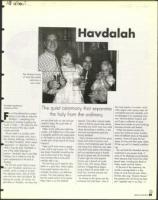
The Terebelo family
of West Bloomfield
welcomes a
new week.
Elizabeth Applebaum
AppleTree Editor
or all the extraordinary prepa-
rations it can take to welcome
Shabbat — everything from
shopping to cooking to getting the
house in order — the ceremony that
I marks the end of this day is both
simple and brief.
All you need is a candle, some
i•spices, wine or grape juice, say a
few brachot, blessings, and that's it.
It's called Havdalah, which means
separation" or "distinction." And
while it may be brief, Havdalah is
one of the oldest blessings in
Judaism. Havdalah also is said after
holidays, but it makes its most fre-
quent appearance at the end of
I Shabbat.
The first item you'll need to have
your own Havdalah ceremony is a
I candle, which is made of at least
two separate wicks, both of which
I unite into one when set aflame. By
1 lighting the candle, on activity not
permitted on Shabbat, we show that
"
the most popular is a tower which
likely began when spices were still
considered rare and valuable, and
so belonged in an impressive struc-
ture. Visit any Jewish museum and
departs. One rather mystical expla-
you'll see a collection of spice
nation is that the spices help refresh I boxes that include not only buildings
the lonely soul which must now walk
but even animals and flowers.
alone (according to tradition, a sec-
While the brachot remain the
ond soul accompanies each Jew
same from home to home, families
during Shabbat).
have all different kinds of Havdalah
Many families today fill their spice
customs. Some will pass the last
boxes with dried cinnamon and 1 drops of wine over their eyes; others
cloves, and sometimes even the left- I fill the cup until it is literally overflow
over etrog from Sukkot (a nice idea, ing.
since that lowly piece of fruit bears
You can find the Havdalah service
such an exorbitant price it should
contained in any prayer book. If
be put to good use). But hundreds
some of the blessings sound familiar,
of years ago the most popular
1 that's because they come from other
choice was a branch of myrtle.
Jewish texts, including the Book of
Then in the 12th century Rabbi
I Esther, Isaiah and the Psalms.
Ephraim of Regensburg began
At the end of the ceremony, the
using a blend of spices held in a
candle is extinguished in a few
small box, and the practice has
I drops of wine from the cup. Many
continued ever since.
I families also sing, "Eliyahu Hanavi,"
As diverse as the spices are the
I the prophet who will bring the Mes-
containers that hold them. One of
siah "speedily and in our day." 0
The quiet ceremony that separate S :
the holy from the ordinary.
we are done with our rest and pre-
1 pared to begin the usual tasks of
I everyday living.
Often it's the child who holds the
I candle, and folklore has it that when
I a daughter performs this responsibili-
ty, the height at which she holds the
I candle also will be that of her future
I husband.
Next, you'll want wine or grape
juice, and a cup to pour it in. Who-
I ever leads Havdalah should be the
one to drink most of this, though
many families like to have each
I member take a sip.
The last thing you'll need for Hay-
dalah is a spice box. Many rabbis
I have posed reasons why this is
included, but there is no definitive
I answer. The most popular idea is
I that the sweet aroma of the spices
I helps cheer us as the Sabbath
1 •
7/24
1998
Detroit Jewish News
65