

CARYN ROMAN
Special to The Jewish News
S
creams erupt from the
Mdapelim (illegal immi-
grants) as they attempt to
run from the surrounding
British Army forces. Soldiers and
Jews scramble blindly in the dark as
each group tries to outwit the other.
As British soldiers lead the illegals to
jail, Palmach forces suddenly rush to
the scene, adding to the confusion
and releasing many of the prisoners.
Above the commotion, a single shot
rings out. Suddenly, the game is over.
On July 14, Teen Mission partici-
pants became British soldiers,
Palmach fighters and illegal immi-
grants in a simulation of a clandes-
tine immigration operation at the
Atlit Detention Center Museum in
Tel Aviv.
I personally received the honor of
becoming a British soldier for the
night, a position I wasn't too excited
about at first. I was placed in a bat-
talion of 32 soldiers responsible for
keeping the immigrants from break-
ing in while preventing the Palmach
from freeing our prisoners. Our
commander" gave us a crash course
in army training — everything from
marching to concealing ourselves in
bushes. Some of my fellow soldiers
also had mixed feelings on our
assignment.
"I kind of felt like a traitor," Beth
Jackson said. "In some ways, I would
have rather been an immigrant or in
the Palmach. I was a bad soldier — I
didn't catch anyone."
CC
War Games
Teens get a taste of
the battles Jews fought
to win the right to a homeland.
The real point
behind the game was
not to see which
group could win but
to show us what it
might have been like
at Atlit 50 years ago.
"I felt like a real
immigrant," Scott
Goldman said. "We
quickly learned to
stay in groups and
work together in
order to stay safe."
This game was
not child's play.
Beginning the simu-
lation well after dark,
we were faced with
obstacles on our
path, such as rocks,
thorn bushes and
hidden holes. We
could tell from the
Caryn Roman, an 11th
grader at Birmingham Groves
High School, has been sharing
her Israel experience with read-
ers since the beginning of Teen
Mission 2 Israel on June 25.
She is traveling on Bus R-4
from Temple Emanu-El and
Temple Kol Ami. The Mission
returns on July 3a
start that this was
not going to be
easy.
"The whole
thing gave me a big
adrenaline rush,"
Jackson said. "It was
physically and emo-
tionally draining."
The third group
of players, the
Palmach, were faced
with the awesome
responsibility of not
only smuggling the
immigrants into the
camp, but also try-
ing to keep their
charges safe from
my group.
"Being in the
Palmach was an
interesting experi-
ence," Olga
Frankstein said. "It involved a lot of
cooperation and teamwork. I
thought it was really cool to trace the
footsteps of history."
In the end, no one really won the
game. Each group had accomplished
some of its goals and failed at others.
What we came to understand, how-
ever, was that in the game of life, the
Jewish people were victorious, win-
ning a homeland and a war for inde-
pendence. To stress this point, all of
the groups came together at the end
to sing "Hatikvah" and view a fire-
works display.
"Coming together at the end to
sing really helped me to appreciate
the moment," Frankstein said.
We continued our exploration
into the struggle for a Jewish home-
land the next day, visiting the
Diaspora Museum, Independence
Hall — where Israel was declared a
state — and Haganah Museum.
"Going to the Diaspora Museum
and seeing the ways in which our
people always managed to keep their
faith no matter where they were, and
then visiting the Haganah Museum
and Independence Hall and realizing
how difficult it was to create Israel
out of the desert, gave me a great
sense of Jewish pride," Adam
Rosenwasser said.
The time we spent exploring this
part of Israel's history was definitely
worthwhile. And after my short-lived
experience as a British soldier, I can
definitely say that I'm proud to be
on the winning side. Being here, I
knew just how sweet victory is. ❑
Photos
Previous page, center:
Caryn Roman and Amy Horning show off their finished mosaic.
Clockwise from top left:
After rafting down the Jordan River, teens on Bus R-4 stop to cheer.
After returning from their desert trek, R-5 teens enjoyed traditional Bedouin
hospitality. After sipping sweet, mint-spiced tea, the group was served bitter coffe e
Rejuvenated by the coffee, Becca Hyke makes pita the old-fashioned way. Mixing flour, water
and salt and then placing it over the hot fire, the pita comes out hot, chewy and delicious.
Brett Mountain and Chrissy Hutcheson of Bus R-5 lead their banana-boat through the
rough waters of Lavnoon Beach on the Kinneret (Sea of Galilee), where busloads of
teens spent two sun-filled days before heading off to their Israeli hosts for Shabbat.
Becca Hyke of Bus R-5 gets the ride of her life during an overnight stop
at the Bedouin village of A'fizr Nokdim. Behind her is Helayne Shaw.
This page, left:
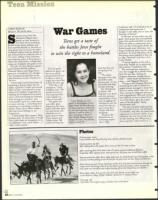
Trip leader Dan Lippitt enjoys a donkey ride in the desert.
7/24
1998
16 Detroit
IPwish News