

someone in Ryan's age group who is
able to influence other young people to
get involved."
For JNF, Seyburn is a beacon in
foggy weather, the promise of new life
here that can lead to new life in Israel.
Growing up in Farmington Hills,
Seyburn's Jewish involvement centered
on Temple Kol Ami in West Bloomfield
and outdoors-oriented jaunts to sum-
mer camp. Once, the boy with shaggy
blond hair and a shy smile had the
opportunity to go canoeing and camp-
ing in Canada, and he fell in love with
the outdoors.
After graduating from North
Farmington High School, Seyburn
headed for UC-Davis, where he
promptly got involved at Hillel and
with the local JNF chapter.
Davis was like "a little Ann Arbor,"
said Seyburn, who used to shop at the
local farmers market there. "Everyone
has a bike. Within about two hours,
you can be at Lake Tahoe, San
Francisco, the Sierra Nevada
Mountains."
In Davis, Seyburn learned to "appre-
ciate the outdoors." The progressive cli-
mate made it "easy for me to connect
with people and spread the message of
the JNE"
Back to JNE Always back to JNE
But that's exactly what many older
Jewish organizations, like JNF, need:
new, enthusiastic blood.
Jewish Roots
The Jewish National Fund was
founded in 1901 at the Fifth Zionist
Congress in Basel, Switzerland. The aim
was to purchase land and hold it in
trust for the Jewish people's return to
their homeland. Jews around the world
contributed spare change to the now-
famous "blue boxes," to build up JNF.
Once the pioneers gained possession
of the land, they realized they had to
develop the terrain, which had eroded
away over centuries. JNF began to plant
trees and drain swamps; it is Israel's only
sole afforestation and land reclamation
agency.
More than 90 percent of Israel's land
is publicly owned and not available for
sale. It is held in the name of the Jewish
people and leased to individuals for
renewable 49-year terms, based on the
Torah's discouragement of monopolistic
landholdings. In 1960, when the Israeli
government extended this policy to all
public land, JNF became the sole
agency for land development.
The budget for the agency, a non-
profit, comes mostly from land holdings
and other such assets. Donation dollars
account for just 20 percent of JNF's
funds.
JNF is not alone in its desperate
desire to attract young adults. An earlier
generation gave their charity dollars and
volunteer time to the few Jewish organi-
zations that existed.
Today, however, the number of
Jewish charities and institutions has
multiplied dramatically, as have the sec-
ular groups that young Jews view as
deserving of their time and money.
Some of the Jewish community's most
promising young leaders also serve on
the boards of arts, environmental and
political organizations.
Due to massive, nationwide downsiz-
ing, JNF's satellite offices are under-
staffed. That makes it hard to let people
know that JNF is not just about Tu
b'Shevat or planting trees — especially
since here at least, it no longer has a
presence in religious schools.
"We're not ready to hire more people
because we want to get the percentage
of funds that go to Israel up. Hopefully
then we'll be back in the schools,"
Sullivan said.
That leaves promotion to lay leaders,
like Seyburn. "He is just so enthusias-
tic," said Sullivan. "He's a great young
man who has spent time in Israel so he
knows what he's talking about."
JNF does have a young adult divi-
sion in Detroit, but Sullivan admits it's
"not real active," save for an occasional
golf tournament or comedy outing.
"If you want an organization where
all the money is going to Israel, JNF is
your organization," she said.
The trick, however, is getting that
message across to young adults. "We
just haven't hit that younger genera-
tion," she said. "That's one of the things
we have a Ryan Seyburn for."
Turning Points
Ryan Seyburn loved northern
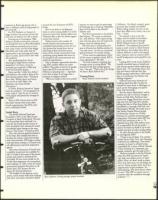
Ryan Seyburn: Getting younger people involved.
California. He hiked, camped, spent
as much time outside as possible.
When college ended, he went to the
place that offers every clime, every ter-
rain — Israel.
He wanted to live in the dry
Negev, but he settled in Jerusalem
after a six-month ulpan through
WUJS (World Union of Jewish
Students). The program gives partici-
pants a crash course in Israeli history
and Hebrew, then helps them find a
yeshiva, kibbutz or job in the Jewish
state. Seyburn went to work at JNF's
world headquarters and stayed for two
years.
Leading JNF youth tours, Seyburn
literally stumbled upon a burial cave
and ancient pottery while exploring a
barren hill. "To teach kids about ecol-
ogy and history and the fact that
Jewish people settled here 2,000 years
ago is so profound, the history and
ecology together."
Seyburn had every intention of
making aliyah last fall, but first he
wanted to come back to Michigan to
pack up his belongings and spend
time with his family.
But the desire diminished, and he
settled into life in Detroit, bought a
house in Oak Park. You'll see him,
minus the shaggy blond hair of years
ago and now sporting silver shades,
riding his bike to One Stop Kosher in
Southfield or through Oak Park and
Huntington Woods. He works out at
the Jimmy Prentis Morris Jewish
Community Center on 10 Mile
because it's a Jewish communal gath-
ering place. He knows what JNF has
done and continues to do — "It
planted more than 200 million trees.
It is responsible for all the parks." —
and so he wants to build it up in the
minds and eyes of other young adults.
So what does he plan to do locally
to reinvigorate JNF?
"I have a ton of ideas. I've contact-
ed the Sierra Club, Teva, the Greening
of Detroit to collaborate. The whole
concept, in Israel, is of kids being
responsible for a piece of land. Instead
of just learning in a classroom, get
people outdoors, get the kids active."
Seyburn intends to do for Detroit
what the JNF has done for Israel,
"get kids and adults active in local
parks. Here, we don't need to plant
trees, but there are a lot of things we
can do. Many people don't have the
opportunity to get outdoors. It's
intimidating, they don't know where
to start. The JNF is a great way to
connect with the outdoors through
Judaism."
❑
7/ 1 7
1998
75